بررسی رابطه مهارتهای فناوری دیجیتال و سواد رسانهای آموزشی معلمان با کاربست فناوری در تدریس مدارس ابتدایی شهر جم
کلمات کلیدی:
مهارتهای فناوری دیجیتال, سواد رسانهای آموزشی, کاربست فناوری در تدریس, معلمان ابتدایی, شهر جمچکیده
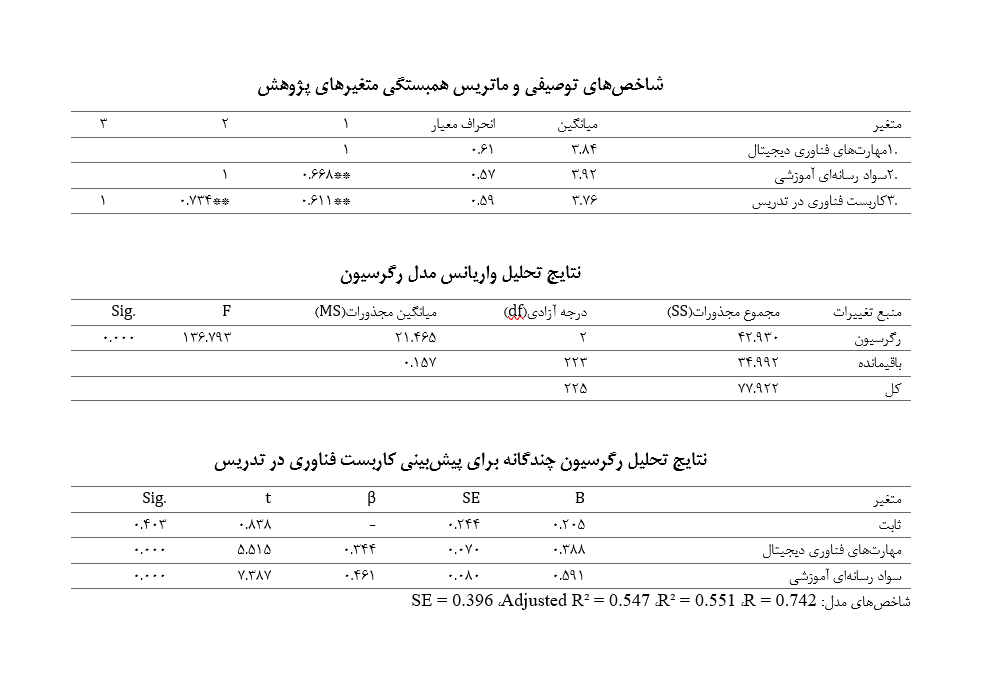
پژوهش حاضر با هدف بررسی رابطه مهارتهای فناوری دیجیتال و سواد رسانهای آموزشی معلمان با کاربست فناوری در تدریس مدارس ابتدایی شهر جم انجام شد. این پژوهش از نظر هدف کاربردی و از نظر روش توصیفی-همبستگی بود. جامعه آماری شامل تمامی معلمان مدارس ابتدایی شهر جم در سال تحصیلی ۱۴۰۵-۱۴۰۴ به تعداد ۵۵۰ نفر بود که از میان آنان ۲۲۶ نفر بر اساس فرمول کوکران و به روش نمونهگیری تصادفی ساده انتخاب شدند. دادهها با استفاده از پرسشنامههای استاندارد مهارتهای فناوری دیجیتال معلمان، سواد رسانهای آموزشی و کاربست فناوری در تدریس گردآوری شد. روایی ابزارها از طریق نظر متخصصان و پایایی آنها بر اساس مطالعات پیشین تأیید گردید. دادهها با نرمافزار SPSS نسخه ۲۶ و با استفاده از آزمون کولموگروف-اسمیرنف، ضریب همبستگی اسپیرمن و تحلیل رگرسیون چندگانه تحلیل شدند. نتایج نشان داد بین مهارتهای فناوری دیجیتال و کاربست فناوری در تدریس رابطه مثبت و معناداری وجود دارد (r=0.611, p<0.001). همچنین، سواد رسانهای آموزشی با کاربست فناوری در تدریس رابطه مثبت و معنادار داشت (r=0.734, p<0.001). رابطه بین مهارتهای فناوری دیجیتال و سواد رسانهای آموزشی نیز مثبت و معنادار بود (r=0.668, p<0.001). نتایج رگرسیون چندگانه نشان داد مهارتهای فناوری دیجیتال و سواد رسانهای آموزشی بهطور همزمان 55.1 درصد از واریانس کاربست فناوری در تدریس را تبیین کردند (R²=0.551, F=136.793, p<0.001). سواد رسانهای آموزشی (β=0.461, p<0.001) نسبت به مهارتهای فناوری دیجیتال (β=0.344, p<0.001) پیشبین قویتری بود. نتایج پژوهش نشان میدهد ارتقای مهارتهای فناوری دیجیتال و بهویژه سواد رسانهای آموزشی معلمان میتواند نقش مؤثری در افزایش کاربست فناوری در تدریس داشته باشد. بنابراین، طراحی برنامههای توانمندسازی حرفهای معلمان در این دو حوزه میتواند به بهبود کیفیت تدریس و یادگیری در مدارس ابتدایی کمک کند.
دانلودها
مراجع
1. Organisation for Economic C-o, Development. Education at a Glance 2020: OECD Indicators. OECD Publishing, 2020.
2. Unesco. ICT Competency Framework for Teachers (ICT CFT), Version 3. UNESCO, 2018.
3. Pilgrim J, Vasinda S, Lisenbee PS. Integrating Technology in Literacy Instruction: Models and Frameworks for All Learners. 2nd ed: Routledge; 2025.
4. Prate J, Kong J, Hoque L, Sugita T, Belom T. A Meta-Analysis of Technology Usage in Word Problem Solving Interventions for Elementary Students: An Application of the SAMR Model. Research and Practice in Technology Enhanced Learning. 2026;21:001. doi: 10.58459/rptel.2026.21001.
5. Wang H, Yu S, Lv B, Ma Z, editors. Construction of Smart Campus in Primary and Secondary Schools Based on Teachers' Needs: Taking the Dongcheng District of Beijing as an Example. Proceedings of the 2023 2nd International Conference on Educational Innovation and Multimedia Technology (EIMT 2023); 2023.
6. Zarghi M, Hosseini Jonbazdi SA, editors. Technology and Tomorrow's Schools: Smart Schools. National Conference on Interdisciplinary Research in Management and Humanities; 2023.
7. Ertmer PA, Ottenbreit Leftwich AT. Removing Obstacles to the Pedagogical Changes Required by Jonassen's Vision of Authentic Technology Enabled Learning. Computers & Education. 2013;64:175-82. doi: 10.1016/j.compedu.2012.10.008.
8. Tondeur J, Pareja Roblin N, van Braak J, Voogt J, Prestridge S. Preparing Beginning Teachers for Technology Integration in Education: Ready for Take Off? Technology, Pedagogy and Education. 2017;26(2):157-77. doi: 10.1080/1475939X.2016.1193556.
9. Jung YJ, Cho K, Shin WS. Revisiting Critical Factors on Teachers' Technology Integration: The Differences between Elementary and Secondary Teachers. Asia Pacific Journal of Education. 2019;39(4):548-61. doi: 10.1080/02188791.2019.1620683.
10. Timotheus R, Lepp M. How and Why Teachers Use Technology: Distinct Integration Practices in K-12 Education. Education Sciences. 2024;14(12):1301. doi: 10.3390/educsci14121301.
11. Redecker C, Punie Y. European Framework for the Digital Competence of Educators: DigCompEdu. Publications Office of the European Union, 2017.
12. Spante M, Hashemi SS, Lundin M, Algers A. Digital Competence and Digital Literacy in Higher Education Research: A Systematic Review. Education and Information Technologies. 2018;23:1-23. doi: 10.1080/2331186X.2018.1519143.
13. Yurdakul C, Demir K. Technology Integration in Pedagogical Processes: Digital Competence and Teaching Practices of Primary School Teachers in Turkey. Discover Education. 2025;4:Article 351. doi: 10.1007/s44217-025-00646-9.
14. Pinto M, Leite C. Digital Technologies in Primary Schools: A Systematic Review of Teacher Acceptance and Adoption Models. Education and Information Technologies. 2025.
15. Rahimi S, Rezaei M. Information Literacy and Perceived Usefulness of Personalized Learning Technologies among Primary Teachers. Journal of Computer Assisted Learning. 2025;41(2):1-18.
16. Abebe F, Trainin G. Predicting Technological, Pedagogical, and Content Knowledge (TPACK) Formation in Elementary Math Education. Contemporary Issues in Technology and Teacher Education. 2024;24(2). doi: 10.70725/521250nwdsyh.
17. Ga S, Cha H, Yoon H. Pre-Service Elementary Teachers' Technological Pedagogical and Content Knowledge in Lesson Planning and Post-Lesson Reflection Discourses on Science Classes Using Virtual and Augmented Reality Content. Journal of Science Education and Technology. 2025;34:171-82. doi: 10.1007/s10956-024-10171-3.
18. Hobbs R. Digital and Media Literacy: Connecting Culture and Classroom: Corwin Press; 2011.
19. Buckingham D. The Media Education Manifesto: Polity Press; 2019.
20. Unesco. Media and Information Literate Citizens: Think Critically, Click Wisely! Curriculum for Teachers and Learners. UNESCO, 2021.
21. Puentedura RR. SAMR: A Contextualized Introduction. Hippasus, 2014.
22. Syukran R, Adriansyah A, Alimir IJ, Syafitri W, Sesmiarni Z, Bayu EPS. Exploring Teachers' Experiences in Integrating SAMR-Based Adaptive Technology in Primary English Reading-Writing Instruction. El-Rusyd. 2025;10(2):330-8. doi: 10.58485/elrusyd.v10i2.535.
23. Liu Y, Pásztor A. Exploring the Digital Divide in Primary Education: A Comparative Study of Urban and Rural Mathematics Teachers' TPACK and Attitudes towards Technology Integration in Post-Pandemic China. Education and Information Technologies. 2025;30(2):1913-45. doi: 10.1007/s10639-024-12890-x.
24. Ursavas ÖF, Karal H. Modelling Primary School Teachers' Acceptance of Distance-Based Educational Technologies: A Post-Pandemic Perspective. Education and Information Technologies. 2024;29(13):16499-523. doi: 10.1007/s10639-024-12509-1.
25. Matsepane JR, Mampane MR. ICT Integration in a Multigrade Context: Exploring Primary School Teachers' Experiences. Research in Social Sciences and Technology. 2024;9(1):232-52. doi: 10.46303/ressat.2024.13.
26. Tan L, Thomson R, Koh JHL, Chik A. Teaching Multimodal Literacies with Digital Technologies and Augmented Reality: A Cluster Analysis of Australian Teachers' TPACK. Sustainability. 2023;15(13):10190. doi: 10.3390/su151310190.
27. Abbaszadeh M, Azizi N, Emamgholizadeh N, editors. The Necessity of Familiarizing Educators and Educational Specialists with Media Literacy and Emerging Technologies. First International Conference on New Horizons in Learning Psychology and Education from the Teacher's Perspective; 2025; Urmia.
28. Sarfarazi S, Payam BA, Nosrati E, Nosrati E, editors. The Role of Teachers' Digital Literacy in Improving the Quality of E-Learning in Smart Schools. Second National Conference on Humanities with a New Approach and First International Research Conference of Modern Educators; 2025; Astara.
29. Jalilian A, editor Investigating Elementary Teachers' Digital Literacy and Its Effect on the Quality of Technology-Based Teaching. First International Conference on Artificial Intelligence in Education, Psychology, Educational Sciences, and Religious, Cultural, Social, and Management Studies in the Third Millennium; 2025; Bushehr.
30. Rezaei M, Ahmadi A, Bagheri M. Identifying the Components of Smart Schools Based on a Constructivist Approach. Development of Education in Jundishapur. 2020;11(Special Issue):115-27.
31. Alirezanajad M, Sabeti Choubdar L, editors. An Introduction to the Application of Information and Communication Technology in Today's Organizations. Seventh National Conference on Management and E-Commerce; 2023; Tehran.
32. Mashhadi H. A Comparative Study of the Curricula of Selected Countries with Emphasis on Developing Information and Communication Technology Literacy among Student Teachers. Curriculum Studies. 2022;17(64):95-124.
33. Taghvaei Yazdi M, Golafshani A, Aghamirzaei Mahalli T, Aghatabar Roudbari J, Yousefi Saeedabadi R. Investigating the Status of Information and Communication Technology Use and Its Effect on Faculty Members' Performance. Research in Medical Education. 2019;11(2):64-73.
34. van Laar E, van Deursen AJAM, van Dijk JAGM, de Haan J. Determinants of 21st-Century Skills and 21st-Century Digital Skills for Workers: A Systematic Literature Review. Sage Open. 2020;10(1). doi: 10.1177/2158244019900176.
دانلودها
گاهشمار انتشار
- ارسال
- بازنگری
- پذیرش
شماره
نوع مقاله
مجوز
حق نشر 2025 Nooshafarin Safari, Parvane Dodman, Bayram Aghapour, Sadegheh Solemani (Author)

این پروژه تحت مجوز بین المللی Creative Commons Attribution-NonCommercial 4.0 می باشد.