Analysis of Cultural, Legal and Strategic Policies of Lifestyle and Family in Relation to Balanced Youth Population Development (Case Study: Khorasan Razavi Province)
DOI:
https://doi.org/10.61838/jsied.437Keywords:
Strategic policies, lifestyle, family, youth population, balanced developmentAbstract
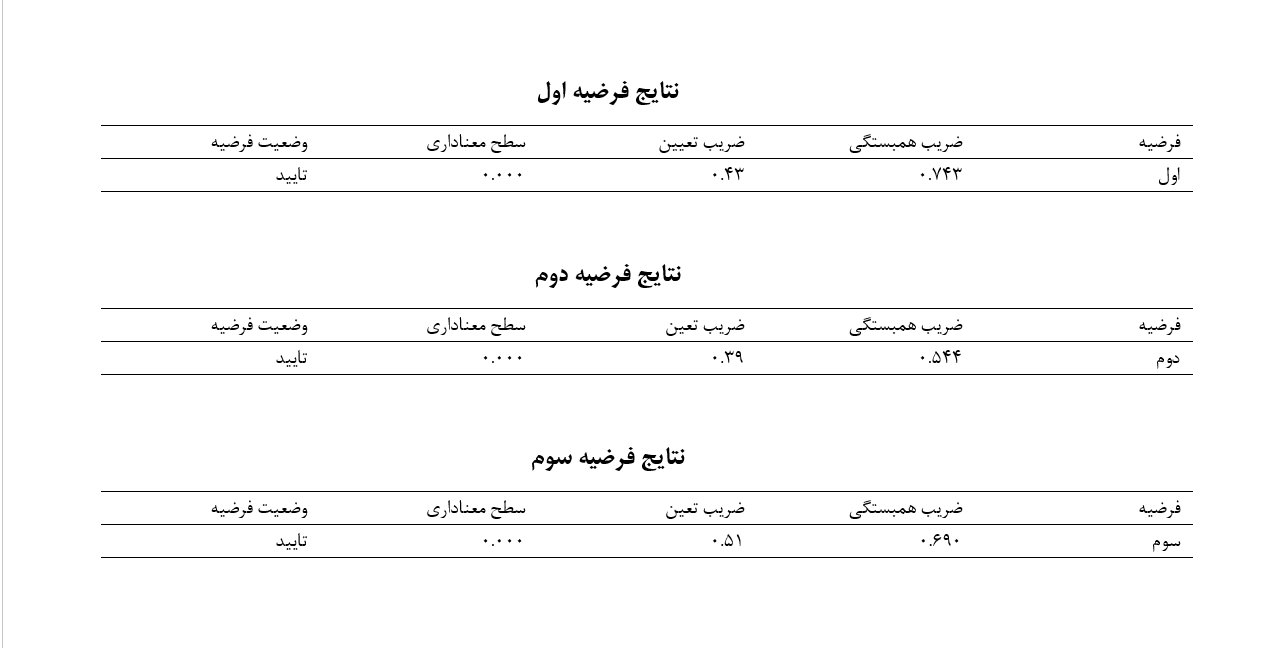
This study aims to examine the effects of cultural, legal, and economic lifestyle and family policies on balanced youth population development. This applied research used a descriptive–analytical design. The statistical population consisted of youth aged 15–35 in Khorasan Razavi Province, from which 384 participants were selected using multi-stage cluster sampling. Data were collected through a researcher-developed questionnaire with confirmed content validity and acceptable reliability. Data analysis was conducted using SPSS version 26 through correlation and regression analyses. Results revealed a strong and significant relationship between cultural policies and balanced youth population development (r = 0.743, p < 0.001), explaining 43% of the variance. Economic policies also showed substantial influence (r = 0.690, p < 0.001), accounting for 51% of the variance. Legal policies were significantly related as well (r = 0.544, p < 0.001), explaining 39% of the variance. All hypotheses were supported. The findings indicate that sustainable youth population development requires an integrated policy framework in which cultural reform functions as the foundational driver, economic support as a reinforcing mechanism, and legal regulation as the stabilizing structure.
Downloads
References
McDonald P. Low fertility and the state: The efficacy of policy interventions. Genus. 2024;80(1):1-15. doi: 10.1186/s41118-024-00212-4.
Goldstone JA, May JF. How 21st century population issues and policies differ from those of the 20th century. World. 2023;3(9):467-76.
Chen M. Can quantitative easing population policy rescue China's sinking fertility rate? A comparative examination between Jiangsu and Zhejiang. International Economic Review. 2023;2(10):100-19.
Bourdieu P. Distinction: A Social Critique of the Judgement of Taste. 2nd ed. Tehran: Saless Publishing; 2012.
Abazari Y, Chavoshian H. From social class to lifestyle: New approaches in the sociological analysis of identity. Journal of Social Sciences. 2002(20):71-98.
Baudrillard J. The Consumer Society: Myths and Structures. 5th ed. Tehran: Saless Publishing; 2015.
Ajili H, Beiki M. An anatomy of lifestyle in capitalist society. Counseling Culture and Psychotherapy. 2014;4(13).
Kim J, Lee S. Lifestyle patterns and psychological well-being in the digital age. Journal of Health Psychology. 2024;29(6):845-60.
Singh K, K AJ. Lifestyle and Mental Health Outcomes of the Korean Wave Beyond the North-East India. 2025. doi: 10.31219/osf.io/f2je8_v1.
Hassan R, Kamali M. Lifestyle transformation in Middle Eastern societies: Tradition, modernity, and identity. Current Sociology. 2025;73(1):45-62.
Goldscheider F, Bernhardt E, Lappegård T. Family life, gender equality, and fertility decline: A reconsideration. Population and Development Review. 2024;50(1):3-28. doi: 10.1111/padr.12592.
Lin Y, Zhang B, Hu M, Yao Q, Jiang M, Zhu C. The effect of gradually lifting the two-child policy on demographic changes in China. Health Policy and Planning. 2024;39(4):363-71.
Zhai Z, Jin G. China's family planning policy and fertility transition. Chinese Journal of Sociology. 2023;9(4):479-96. doi: 10.1177/2057150X231205773.
Jiang Q, Li S, Feldman MW. China's population policy at the crossroads: Social impacts and prospects. Asian Journal of Social Science. 2017;41(2):193-218.
Do M. China's population policies: Past, present and future. ACE Arquitectura Ciudad y Entorno. 2018;12(36):201-18.
Speidel JJ, Weiss DC, Ethelston SA, Gilbert SM. Population policies, programmes and the environment. Philosophical Transactions of the Royal Society B: Biological Sciences. 2019;364(1532):3049-65.
Kolk M. Government transfers to parents and population policy in a global perspective: An economic demographic perspective. The Journal of Development Studies. 2021;57(9):1483-98. doi: 10.1080/00220388.2021.1915480.
Dühr S. Population growth and distribution in Australia: Policy and governance challenges for a more balanced settlement structure. Urban Policy and Research. 2024;42(2):109-23. doi: 10.1080/08111146.2024.2320651.
Sadeghi R, Abbasi-Shavazi MJ, Mahmoudiani S. Population youth bulge in Iran: Research gaps and policy requirements. Journal of the Population Association of Iran. 2015;10(19):9-43.
Torkashvand Moradabadi M, Shams Ghahfarokhi F, Zandi Navagran L. Iran's demographic changes and its security consequences in the future. Socio-Economic Development Studies. 2023;1(1):230-63.
Bakhani G. A qualitative study of attitudes toward population policies and childbearing (Case study: Youth of Ardabil province). Strategic Studies of Women. 2022;24(96):39-67.
Sohrabi HR. Investigating strategies for population increase in Iran based on an Islamic lifestyle. Journal of Religious Culture and Knowledge. 2022;2(1):35-46. doi: 10.52547/jmdp.35.2.131.
Shams Ghahfarokhi F, Askari-Nodoushan A, Eini-Zeynab H, Rouhani A, Abbasi-Shavazi MJ. Challenges of implementing childbearing incentive policies: A qualitative study in Isfahan. Journal of the Population Association of Iran. 2021;16(32):79-112.
Karami A, Abroumand J. Prioritizing the incentives of the Family Support and Youth Population Law for the Seventh Development Plan in the framework of upstream documents with a strategic foresight approach. Foresight of the Islamic Revolution. 2023;4(4):141-68.
Taghizadeh A, Mansourizadeh K, Mousavi SS. Capacity assessment of the Family Support and Youth Population Law toward realizing general social security policies; with an emphasis on childbearing. Legal Research. 2023;4(9):23-44.
Roostaei M, Moghadasi MB. Evaluation of population policies against the principles of criminalization; with emphasis on the Law on Family Support and Youth Population. Research in Criminal Law and Criminology. 2022;10(20):117-50.
Beigi J, Teimouri M. Criminalization of behaviors contrary to population increase and childbearing in the Law on Family Support and Youth Population. Population and Progress Quarterly. 2023;1(2):45-77.
Jafari S, editor The Youth Population Law and the threat to generations. Congress of Students of Law, Political Science, and Social Sciences; 2022; Tehran.
Mahzoon AA. Making population policies effective within the frameworks of: Demographic transition, household economics, and measurement of proximate determinants of fertility in Iran. Population and Progress Quarterly. 2023;1(2):77-89.
Baingani B, Irandoost SF, Ahmadi S. Lifestyle from a sociological perspective: An introduction to understanding and analyzing the concept of lifestyle. Cultural Engineering Journal. 2013(77).
Rahmatabadi E, Aghabakhshi H. Lifestyle and social identity of youth. Social Welfare Scientific Research Quarterly. 2006;5(20).
Ziegenspeck S. Lifestyles of private forest as an indication of social change. Forest Policy and Economics. 2004;6. doi: 10.1016/j.forpol.2004.01.004.
Bryson JM. Strategic Planning for Public and Nonprofit Organizations. Tehran: Public Administration Training Center; 2002.
Islami R, Farkhari M. Examining the population increase policy cycle in the Islamic Republic of Iran (Focusing on the fourth period of population policies). Policy Studies. 2023:34-66.
Rahman ZA, Razali S, Shahibi MS, Amin M, Kamal AA, Asih SR, et al. Healthy Lifestyle Components and Mental Health Among Undergraduate Students. Unnes Journal of Public Health. 2025;14(1):79-92. doi: 10.15294/ujph.v14i1.6267.
Noormazwa S, Normah AN. The Impact of Lifestyle on Students’ Mental Well-Being a Case Study in Terengganu, Malaysia. International Journal of Research and Innovation in Social Science. 2025;VIII(XII):3303-7. doi: 10.47772/ijriss.2024.8120274.
Downloads
Publication Timeline
- Submitted
- Revised
- Accepted
Issue
Section
License
Copyright (c) 2025 Aaliyeh Alizadeh, Gholamreza Jafarinia, Bagher Gorgin (Author)

This work is licensed under a Creative Commons Attribution-NonCommercial 4.0 International License.