A Philosophical Explanation of Teachers’ Moral Responsibility in the Use of Intelligent Educational Systems: A Thematic Analysis
Keywords:
Moral Responsibility, Teacher Ethics, Intelligent Educational Systems, Artificial Intelligence in Education, Professional Autonomy, Thematic AnalysisAbstract
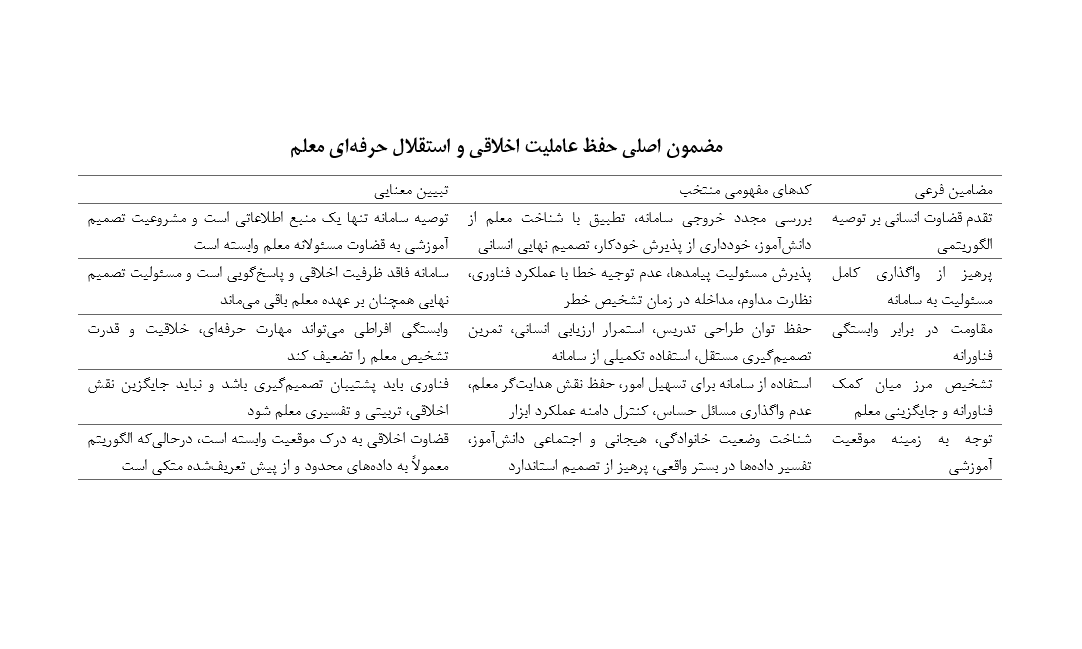
This study aimed to philosophically explain the dimensions and components of teachers’ moral responsibility in the use of intelligent educational systems. This fundamental qualitative study employed thematic analysis within an interpretive framework. The participants were 20 experts and practitioners from Tehran, including five faculty members in philosophy of education, four specialists in ethics and professional ethics, four experts in educational technology and artificial intelligence, and seven teachers with practical experience in using intelligent educational systems. Participants were recruited through purposive maximum-variation sampling, and data collection continued until conceptual saturation was achieved. Data were gathered through in-depth semi-structured interviews lasting 45–75 minutes. The interviews were transcribed verbatim and analyzed concurrently with data collection. MAXQDA 2024 was used to organize and manage the qualitative data. The credibility of the findings was enhanced through member checking, peer review, constant comparison, documentation of the analytical process, and reflexive note-taking. Analysis of the interviews generated 368 initial codes. After removing duplicate codes and integrating conceptually similar items, the data were organized into 112 conceptual codes, 21 subthemes, and seven overarching themes. The themes were preservation of teachers’ moral agency and professional autonomy, protection of student dignity and best interests, justice and resistance to algorithmic discrimination, responsibility for data protection and privacy, transparency and accountability in technology-mediated decisions, preservation of human relationships and the educational nature of teaching, and teachers’ ethical competence and critical artificial-intelligence literacy. Teachers’ moral responsibility in intelligent educational environments is multidimensional, contextual, relational, and non-delegable. Intelligent educational systems are ethically legitimate only when they remain subject to human judgment and are used to protect student dignity, justice, privacy, and holistic development.
Downloads
References
1. Gupta S, Sharma P, Vajrala KR, Fatima A, Sharma N. Integrating Artificial Intelligence in Education: Advancing Personalized Learning Within Ethical Frameworks: An Overview. EthAIca. 2025;4:418. doi: 10.56294/ai2025418.
2. Chen Z, Wenhao Z. Ethical Shifts and Innovative Approaches to Civic Education Under Generative Artificial Intelligence. 2024:181-7. doi: 10.2991/978-2-38476-263-7_25.
3. Hong C. The Ethical Challenges of Educational Artificial Intelligence and Coping Measures: A Discussion in the Context of the 2024 World Digital Education Conference. Science Insights Education Frontiers. 2024;20(2):3263-81. doi: 10.15354/sief.24.re339.
4. Wiese LJ, Patil I, Schiff DS, Magana AJ. AI ethics education: A systematic literature review. Computers and Education: Artificial Intelligence. 2025:100405.
5. Nwokocha S, Kennedy O, Yakpir G, Olori E, Nchindia C, Kachitsa C, et al. Commentary: artificial intelligence and the future of higher education—towards inclusive, ethical, and employability-driven learning ecosystems. Critique Open Research & Review. 2025;3(2):18-29. doi: 10.55640/corr-v03i02-04.
6. Swindell A, Greeley L, Farag A, Verdone B. Against Artificial Education: Towards an Ethical Framework for Generative Artificial Intelligence (AI) Use in Education. Online Learning. 2024;28(2). doi: 10.24059/olj.v28i2.4438.
7. Chatzichristou S. Moral Education and the Role of the Teacher: Reflections on Aristotle's Philosophy. Journal of Educational Philosophy. 2015;39(2):110-25.
8. Martin C. On the Educational Value of Philosophical Ethics for Teacher Education: The Practice of Ethical Inquiry as Liberal Education. Curriculum Inquiry. 2013;43(2):189-209. doi: 10.1111/curi.12010.
9. Orchard J, Heilbronn R, Winstanley C. Philosophy for Teachers (P4T): Developing New Teachers’ Applied Ethical Decision-Making. Ethics and Education. 2016;11(1):42-54.
10. Liu K. Leadership Practices Through Taoist Philosophical Principles and Teachers' Morale in Selected Preschools in Hebei, China. Pacific International Journal. 2025;8(2):47-51. doi: 10.55014/pij.v8i2.788.
11. Clarke M. The Ethico‐politics of Teacher Identity. Educational Philosophy and Theory. 2009;41(2):185-200. doi: 10.1111/j.1469-5812.2008.00420.x.
12. KarakuŞ N, Gedik K, Kazazoğlu S. Ethical Decision-Making in Education: A Comparative Study of Teachers and Artificial Intelligence in Ethical Dilemmas. Behavioral Sciences. 2025;15(4):469. doi: 10.3390/bs15040469.
13. Hadi MH, Jasim AA. Legislative and Ethical Foundations for Future Artificial Intelligence. Journal of the College of Basic Education. 2024;30(126):127-45. doi: 10.35950/cbej.v30i126.12231.
14. Chen H. The Ethical Challenges of Educational Artificial Intelligence and Coping Measures: A Discussion in the Context of the 2024 World Digital Education Conference. Science Insights Education Frontiers. 2024;20(2):3263-81. doi: 10.15354/sief.24.re339.
15. Chidinma AE, Yinka KR. Undergraduate Students' Perception of Artificial Intelligence for Enhancing Educational Practices: Opportunities, Challenges, and Ethical Considerations. Global Journal of Social Sciences Studies. 2025;11(1):30-41. doi: 10.55284/gjss.v11i1.1411.
16. Deep PD, Ghosh N, Natoli AP. Artificial Intelligence for Supporting College Students with Attention-Deficit/Hyperactivity Disorder: Cognitive, Emotional, and Ethical Perspectives. International Journal on Social and Education Sciences. 2026;8(1):1-17. doi: 10.46328/ijonses.5915.
17. Love AS. Artificial Intelligence in Public Health Education: Navigating Ethical Challenges and Empowering the Next Generation of Professionals. Health Promotion Practice. 2025. doi: 10.1177/15248399251320989.
18. Zhang DQW. Goal Progression, Trait Changes, and Practice Paths of Artificial Intelligence Ethics Education of Professional Courses in Higher Education. Jes. 2024;20(2):2151-60. doi: 10.52783/jes.1665.
19. Amiri N, Ketabi S, Hossein Vand F, Papi M, editors. Digital Citizenship Education in Smart Schools with an Emphasis on Digital Ethics. The First International Conference on Artificial Intelligence in Education and Training, Psychology, Educational Sciences, and Religious, Cultural, Social, and Management Studies in the Third Millennium; 2025; Bushehr.
20. Asadi Z, Donyadideh H. Examining the Relationship Between Philosophical Mindset and Moral Intelligence and Social Growth of Secondary School Teachers in Natanz. Journal of Psychology and Educational Sciences. 2022;40:37-45.
21. Biravand F, Sayadi A, Alipour N, editors. Ethical Challenges and Opportunities of Artificial Intelligence in Human Capital Development. 1st National Conference on Human Capital Education and Development; 2025.
Downloads
Publication Timeline
- Submitted
- Revised
- Accepted
Issue
Section
License
Copyright (c) 2025 Sakineh Rastegar Moghadam Ebrahimian (Corresponding author)

This work is licensed under a Creative Commons Attribution-NonCommercial 4.0 International License.