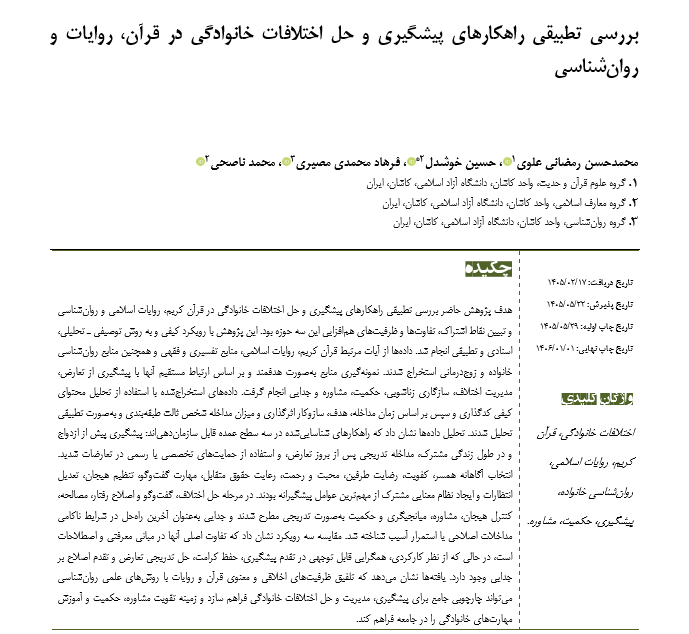
A Comparative Study of Strategies for the Prevention and Resolution of Family Conflicts in the Qur’an, Islamic Narrations, and Psychology
Keywords:
Family Conflicts, Holy Qur’an, Islamic Narrations, Family Psychology, Prevention, Arbitration, CounselingAbstract
This study aimed to comparatively examine strategies for preventing and resolving family conflicts in the Holy Qur’an, Islamic narrations, and psychology and to identify their convergences, differences, and potential for integration. This qualitative study employed a descriptive-analytical, documentary, and comparative design. Data were extracted from relevant Qur’anic verses, Islamic narrations, interpretive and jurisprudential sources, and literature on family psychology and couple therapy. Sources were purposively selected according to their direct relevance to conflict prevention, marital adjustment, conflict management, arbitration, counseling, and separation. Extracted data were coded using qualitative content analysis and were subsequently categorized according to the timing of intervention, intended objective, mechanism of action, and degree of third-party involvement. A comparative analysis was then conducted across the three perspectives. The analysis indicated that the identified strategies could be organized into three major levels: prevention before marriage and throughout marital life, gradual intervention after conflict emerges, and specialized or formal intervention in severe disputes. Informed spouse selection, compatibility, mutual consent, affection and mercy, observance of reciprocal rights, constructive communication, emotional regulation, modification of expectations, and development of shared meaning emerged as major preventive factors. After conflict occurred, constructive dialogue, behavioral correction, reconciliation, emotional regulation, counseling, mediation, and family arbitration formed a gradual intervention sequence. Separation was identified as a final option when corrective interventions failed or when continuation of the relationship resulted in persistent harm. Comparative analysis showed that the primary differences among the three perspectives concerned their epistemological foundations and terminology, whereas substantial functional convergence existed regarding prevention, protection of dignity, gradual conflict resolution, third-party assistance, and prioritization of reconciliation over separation. Integrating the ethical and spiritual capacities of Qur’anic and narrative teachings with scientific psychological methods can provide a comprehensive framework for preventing, managing, and resolving family conflicts and can strengthen family counseling, arbitration, and family-skills education.
Downloads
References
1. Zimon. Key Concepts and Theories in Family Therapy. Tehran: Roshd Publications; 2014.
2. Lebow JL, Snyder DK. Clinical Handbook of Couple Therapy: Guilford Publications; 2022.
3. Ebrahimi Louyeh A, Zolghadr A, Sohbatiha A, Ojaqlou R. Examining Factors Affecting Family Disputes in Zanjan Province. 2013.
4. Enayat H, Dastranj M, Salmani F. Examining Factors Related to Family Disputes. Women and Society Quarterly. 2011;2(5):1-20.
5. Farjad M. Social Pathology. Tehran: Ney Publishing; 2011.
6. DiMatteo JM. Health Psychology. Tehran: Roshd Publications; 2013.
7. Emamzadehei N. The Effectiveness of Mentalization Training on Loneliness, Emotional Functioning, Family Friendliness, and Conflict with Parents Among Adolescent Girls with Internet Addiction: Islamic Azad University, Isfahan (Khorasgan) Branch, Faculty of Educational Sciences and Psychology; 2026.
8. Sadra A, Rezaei S, Charbashlu H, Vakili S. Designing an educational-training model based on family skills in the second secondary curriculum: Islamic lifestyle focusing on health. Islamic Lifestyle with Focus on Health. 2025;2(3).
9. Beheshti M. Family in the Qur'an. Tehran: Institute for Islamic Culture and Thought; 2006.
10. Al-Tabarsi Fia-H. Majma' al-Bayan fi Tafsir al-Qur'an. Tehran: Islamic Culture Foundation; 2015.
11. Yahyaev N. Action-Oriented Methods of Family Education Between Husband and Wife from the Perspective of the Qur'an. Qur'an and Science. 2024;17(33):343-70.
12. Ghaemi AA. The System of Family Life in Islam. Tehran: Daftar-e Nashr-e Ma'aref; 2017.
13. Sobhani J. Nizam al-Nikah in Islamic Jurisprudence. Qom: Imam Khomeini Education and Research Institute; 2016.
14. Mirkhani Ea-S. A New Approach to Family Relations. Tehran: Agah Publications; 2016.
15. Azarbayjani M. Social Psychology with Reference to Islamic Sources. Tehran: Hawzah and University Research Institute and SAMT; 2014.
16. Hakimbashi H. The Verse of Nushuz and Striking the Wife from Another Perspective. Qur'anic Research. 2011;7(27-28):127-.
17. Sadr SM. Physical Punishment of the Wife. Qur'anic Research. 2011;7(27-28):92-4.
18. Mehrizi Z. Women's Personality and Rights. Tehran: SAMT; 2011.
19. E'Zazi M. Family Violence. Tehran: Psychology and Behavioral Sciences Publications; 2016.
20. Jalali M, Khodadadpour M. An Analysis of Arbitration in the Resolution of Family Disputes with Reference to the Family Protection Law (2012). Strategic Studies of Women. 2014;16(64):207-39.
21. Beheshtinia S, Sattarpoor S. Resolution of Family Disputes in Islam. Fifth International Conference on Jurisprudence, Law, and Religious Studies2022.
22. Ehsanbakhsh S. The Role of Religion in the Family. Tehran: SAMT; 2014.
23. Faghihi AN. Counseling in the Mirror of Science and Religion. Tehran: Hawzah and University Research Institute; 2015.
24. Blumberg SL. Fighting for Your Marriage: Wiley; 2010.
25. Beck JS. Cognitive Behavior Therapy: Basics and Beyond2012.
26. Najafi M, Rezaeian Bilandi H, Ahmadi M. A Systematic Review of the Consequences of Emotional Divorce in the Family Based on Islamic Sources: A Qualitative Study. Islamic Studies of Women and Family. 2025;12(23):223-42.
27. Movahedi Rad M, Abbaspour Sisi H, Zarei Toofkhaneh M. Conceptualization of divorce prevention of spouses based on Islamic perspective. Islam and Family Psychology. 2025;1(2):37-64. doi: 10.30471/ipf.2025.10790.1019.
28. Safaei. A Concise Family Law. Tehran: University of Tehran Press; 2014.
Downloads
Publication Timeline
Issue
Section
License
Copyright (c) 2025 Mohammadhasan Ramezani Alavi (Author); Hossein Khoshdel (Corresponding author); Farhad Mohammadi Masiri, Mohammad Nasehi (Author)

This work is licensed under a Creative Commons Attribution-NonCommercial 4.0 International License.