بررسی تأثیر مشتریمداری سازمانی ادراکشده بر توانمندسازی روانشناختی بهعنوان پیشبینیکننده رفتارهای خلاقانه کارکنان خط مقدم: نقش تعدیلگری نظارت عادلانه
کلمات کلیدی:
مشتریمداری سازمانی ادراکشده, نظارت عادلانه, رفتارهای خلاقانه کارکنان خط مقدم, توانمندسازی, میانجیگری تعدیلشدهچکیده
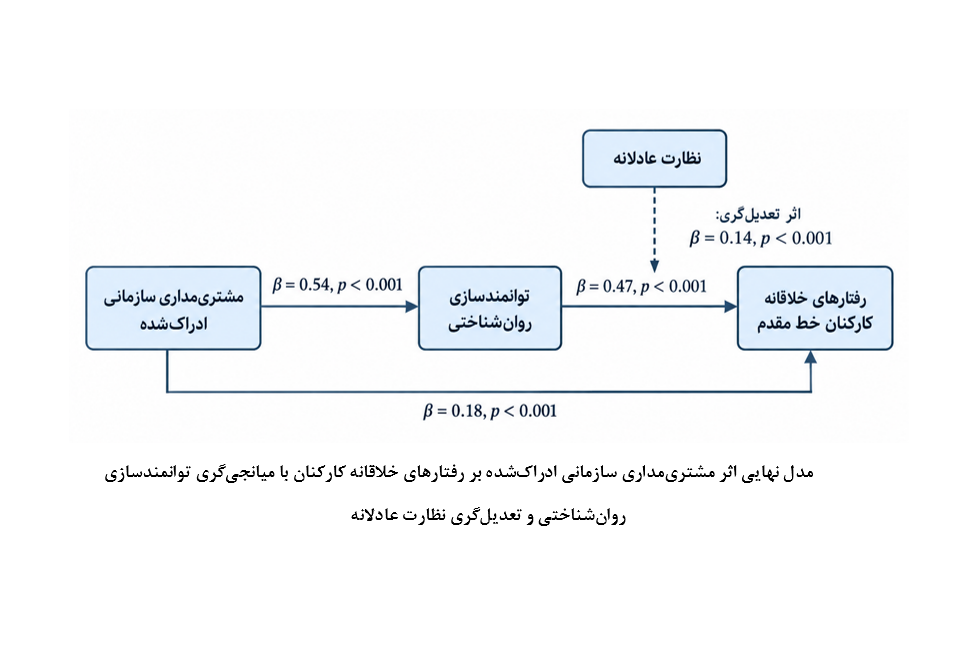
هدف این پژوهش بررسی تأثیر مشتریمداری سازمانی ادراکشده بر رفتارهای خلاقانه کارکنان خط مقدم با تأکید بر نقش میانجی توانمندسازی روانشناختی و نقش تعدیلگر نظارت عادلانه بود. پژوهش حاضر از نظر هدف کاربردی و از نظر روش توصیفی–همبستگی و مقطعی بود. جامعه آماری شامل کارکنان خط مقدم سازمانهای خدماتی شهر تهران بود و 350 نفر با روش نمونهگیری در دسترس انتخاب شدند. دادهها با استفاده از پرسشنامههای مشتریمداری سازمانی ادراکشده، توانمندسازی روانشناختی، نظارت عادلانه و رفتارهای خلاقانه کارکنان گردآوری شد. تحلیل دادهها با استفاده از ضریب همبستگی پیرسون، تحلیل عاملی تأییدی، مدلیابی روابط ساختاری، تحلیل میانجیگری، آزمون تعدیلگری و میانجیگری تعدیلشده انجام شد. برای بررسی اثرات غیرمستقیم و شرطی از روش بوتاسترپ با 5000 بازنمونهگیری و فاصله اطمینان 95 درصدی استفاده شد. نتایج نشان داد مشتریمداری سازمانی ادراکشده اثر مثبت و معناداری بر توانمندسازی روانشناختی داشت (β = 0.54, p < 0.001) و توانمندسازی روانشناختی نیز رفتارهای خلاقانه را بهطور مثبت پیشبینی کرد (β = 0.47, p < 0.001). اثر مستقیم مشتریمداری سازمانی ادراکشده بر رفتارهای خلاقانه نیز معنادار بود (β = 0.18, p < 0.001). اثر غیرمستقیم این متغیر از طریق توانمندسازی روانشناختی برابر با 0.25 بود و فاصله اطمینان 95 درصدی آن بین 0.19 و 0.32 قرار گرفت. همچنین، اثر تعاملی توانمندسازی روانشناختی و نظارت عادلانه بر رفتارهای خلاقانه معنادار بود (B = 0.14, p < 0.001). شاخص میانجیگری تعدیلشده نیز برابر با 0.071 بود و فاصله اطمینان آن صفر را دربر نگرفت. نتایج نشان داد که مشتریمداری سازمانی ادراکشده از طریق تقویت توانمندسازی روانشناختی میتواند رفتارهای خلاقانه کارکنان خط مقدم را افزایش دهد و نظارت عادلانه نیز شدت این رابطه را تقویت میکند؛ بنابراین، ایجاد جهتگیری واقعی مشتریمدار، افزایش احساس توانمندی کارکنان و تقویت عدالت در رفتار سرپرستان میتواند به توسعه خلاقیت در کارکنان خط مقدم کمک کند.
دانلودها
مراجع
1. Wang L, Jin X, Yoo JJ. The Process of Visionary Leadership Increases Innovative Performance Among IT Industry 4.0 for SMEs for Organizational Sustainability: Testing the Moderated Mediation Model. Sustainability. 2024;16(19):8690. doi: 10.3390/su16198690.
2. Ofori I. Organizational Climate and Workplace Deviance a Bibliometric and Systematic Review of the Literature. 2026. doi: 10.21203/rs.3.rs-9800008/v1.
3. Pratiwi NA, Fatimah S, Susilo AK. The Impact of Organizational Support and Employee Attitude to Innovative Work Behavior Mediating Role of Psychologic Empowerment. Journal of Information and Organizational Sciences. 2023;47(2):443-70. doi: 10.31341/jios.47.2.11.
4. Nazaruddin I, Hasna A, Yani I. Innovative Bahavior in Higer Education Institution: Does Performance Measurement Systems Matters? Jurnal Reviu Akuntansi Dan Keuangan. 2023;13(2):333-50. doi: 10.22219/jrak.v13i2.27260.
5. Yang Y, Su X. How Psychological Empowerment Enhances Innovative Work Behaviour Among Non-Permanent Employees in Higher Education Institutions: The Moderating Role of Psychological Safety. Sage Open. 2026;16(2). doi: 10.1177/21582440251412048.
6. Kustandi T. Pengaruh Pemberdayaan Psikologis Dan Komitmen Organisasi Terhadap Kinerja Peran Ekstra Karyawan. Jurnal Ekuisci. 2024;1(5):280-92. doi: 10.62885/ekuisci.v1i5.283.
7. He Y. Empowering Leadership and Employee Job Performance: Review and Prospect. Highlights in Business Economics and Management. 2023;11:291-301. doi: 10.54097/hbem.v11i.8146.
8. Bhatti MH, Akram U, Bhatti MH, Riaz T, Syed N. Knowledge Has No Value Until It Is Shared: An Empowering Leadership Perceptive. International Journal of Quality and Service Sciences. 2021;14(1):133-53. doi: 10.1108/ijqss-04-2021-0064.
9. Ayubi W, Zadran HG. Impacts of Abusive Supervision on Employee S Creativity: The Mediating Role of Psychological Empowerment . Kardan Journal of Economics and Manangement Sciences. 2022. doi: 10.31841/kjems.2022.122.
10. Desrumaux P, Pohl S, Dose É, Chaumon M-ÉB. When Leader-Member Exchanges Make Workers Happy and Innovative: Do Efforts and Rewards Act as Mediators? Journal of Technology Management & Innovation. 2022;17(1):27-37. doi: 10.4067/s0718-27242022000100027.
11. Mai S, Wang L, Na M. The Influence of Organizational Fairness, Identity and Empowerment on Employee Creativity: Mediating Role of Corporate Social Responsibility. Sage Open. 2025;15(1). doi: 10.1177/21582440251328475.
12. Zheng J, Zhuo R, Xie H, Wu G, Zhao X. How Empowerment Congruence Impacts Performance in Cross-Functional Project Teams: A Polynomial Regression Analysis. Project Management Journal. 2024;56(4):501-21. doi: 10.1177/87569728241286040.
13. Mataboge SKC, Mahlangu VP. Attributes and Actions of Principals as Instructional Leaders in Empowering School Management Teams (SMTs) in Schools. E-Kafkas Eğitim Araştırmaları Dergisi. 2024;11(1):20-32. doi: 10.30900/kafkasegt.1192563.
14. González‐Torres T, Sánchez JJN, Huertas-Valdivia I, Pérez‐Pérez C. Understanding Leadership Styles and Effects in Hospitality: A Co-Word Analysis. Tourism and Hospitality Research. 2023;25(3):506-18. doi: 10.1177/14673584231215731.
15. Guchait P, Peyton T, Madera JM, Gip H, Molina A. 21st Century Leadership Research in Hospitality Management: A State-of-the-Art Systematic Literature Review. International Journal of Contemporary Hospitality Management. 2023;35(12):4259-96. doi: 10.1108/ijchm-05-2022-0620.
16. Yang M, Chen W, Yang B, Xu CG. The Status and Future Trends of Chinese Leadership Research: A Bibliometric Approach. Nankai Business Review International. 2021;13(1):1-33. doi: 10.1108/nbri-03-2021-0016.
17. Khan AK, Bell C, Quratulain S. Interpersonal Justice and Creativity: Testing the Underlying Cognitive Mechanisms. Management Research Review. 2022;45(12):1627-43. doi: 10.1108/mrr-03-2021-0206.
18. Choi W, Kang SW, Choi SB. Creativity in the South Korean Workplace: Procedural Justice, Abusive Supervision, and Competence. International Journal of Environmental Research and Public Health. 2022;19(1):500. doi: 10.3390/ijerph19010500.
19. Fadhilaini CR, Tjahjono HK, Susanto S. Improving Employee Engagement of Muhammadiyah Teachers With Organizational Trust, Distributive Justice, and Psychological Empowerment. Journal the Winners. 2021;22(2). doi: 10.21512/tw.v22i2.7085.
20. Arshad A, Sun PYT, Desmarais F. Abusive Supervision and Employee Empowerment: The Moderating Role of Resilience and Workplace Friendship. Journal of Leadership & Organizational Studies. 2021;28(4):479-94. doi: 10.1177/15480518211005449.
21. Lee J, Ahn S, Henning MA, Ridder JMMvd, Rajput V. Micromanagement in Clinical Supervision: A Scoping Review. BMC Medical Education. 2023;23(1). doi: 10.1186/s12909-023-04543-3.
22. Shore LM, Chung BG. Inclusive Leadership: How Leaders Sustain or Discourage Work Group Inclusion. Group & Organization Management. 2021;47(4):723-54. doi: 10.1177/1059601121999580.
23. Sfetcu L. An Introduction to Servant Leadership and Its Potential for Nonprofit Organizations. Journal of Community Positive Practices. 2021;21(4):48-60. doi: 10.35782/jcpp.2021.4.04.
24. Ha K-V, Linh PM, Nguyen T-T-N, Vu M-C. Linking Ethical Leadership to Employee Creative Performace: The Role of Leader-Member Exchange and Work Engagement. International Journal of Professional Business Review. 2023;8(8):e03046. doi: 10.26668/businessreview/2023.v8i8.3046.
25. Zhang J, Choi M-C, Kim HE. How Can Ethical Leadership Increase Employees' Bootlegging Innovation Behavior in China?: A Serial Mediation Model of Psychological Wellbeing and Psychological Entitlement. Frontiers in Psychology. 2025;16. doi: 10.3389/fpsyg.2025.1506906.
26. Rajun ISA, Singh SSB, Taat MS, Mosin M. Exploring the Effect of Inclusive Leadership on Psychological Distress Through Organizational Climate Mediation and Moderation. Humanities and Social Sciences Letters. 2024;12(2):425-42. doi: 10.18488/73.v12i2.3787.
27. Memon KR, Ghani B. The Relationship Between Performance Appraisal System and Employees' Voice Behavior Through the Mediation-Moderation Mechanism. South Asian Journal of Business Studies. 2021;12(2):220-41. doi: 10.1108/sajbs-01-2020-0012.
28. Santiago-Torner C, Jiménez-Pérez Y, Tarrats-Pons E. Interaction Between Ethical Leadership, Affective Commitment and Social Sustainability in Transition Economies: A Model Mediated by Ethical Climate and Moderated by Psychological Empowerment in the Colombian Electricity Sector. Sustainability. 2025;17(13):6068. doi: 10.3390/su17136068.
29. Alexandre-Sousa P, Costeira C, Santos C, Saraiva AC, Santos JS, Mendes J. Clinical Supervision and Positive Practice Environments: A Scoping Review. Portuguese Journal of Public Health. 2026:1-20. doi: 10.1159/000552254.
30. Ma Z, Hira Salah ud din K, Chughtai MS, Li M, Qadri SU. A Review of Supervisor–Subordinate Guanxi: Current Trends and Future Research. Sustainability. 2023;15(1):795. doi: 10.3390/su15010795.
31. Nugroho TP. The Impact of Leadership Style, Work Culture, and Motivation on Contract Workers Performance in Outsourcing Companies in Batam City. 2026. doi: 10.21203/rs.3.rs-10213192/v1.
دانلودها
گاهشمار انتشار
- ارسال
- بازنگری
- پذیرش
شماره
نوع مقاله
مجوز
حق نشر 2026 Kamal Ghalandari (Corresponding author)

این پروژه تحت مجوز بین المللی Creative Commons Attribution-NonCommercial 4.0 می باشد.