Identifying the Components and Indicators of Cultural Policymaking for Realizing a Family-Centered Society Using a Meta-Synthesis Approach
DOI:
https://doi.org/10.61838/jsied.419Keywords:
Cultural policymaking, Family-centered society, Meta-synthesis, MAXQDAAbstract
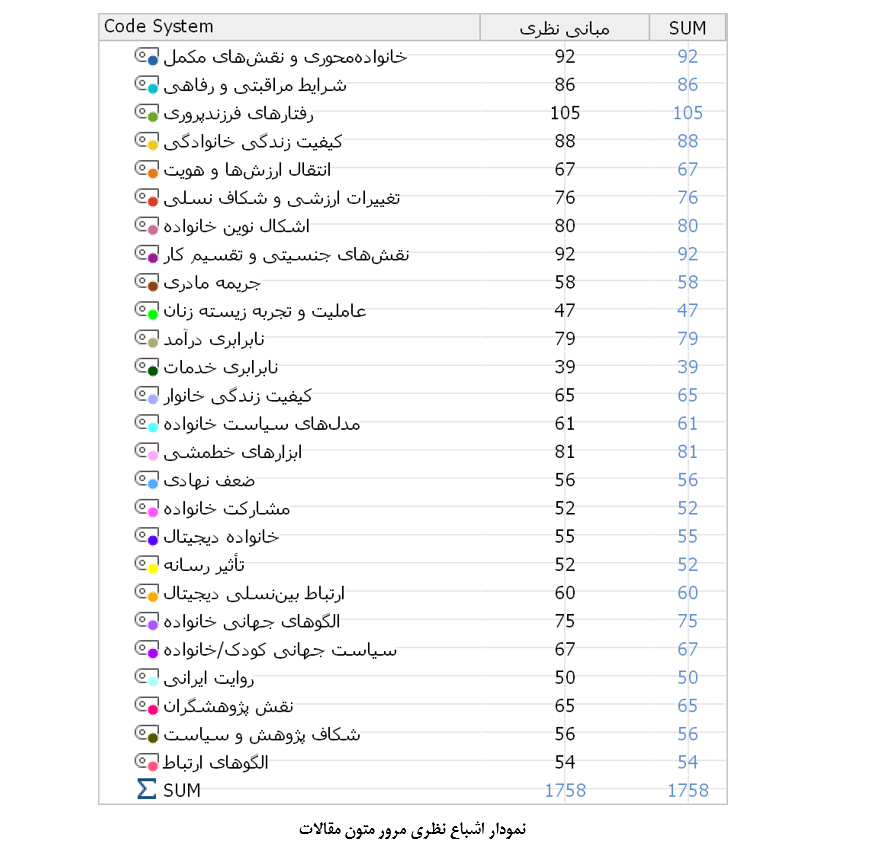
The purpose of the present study is to identify the components and indicators of cultural policymaking for realizing a family-centered society using a meta-synthesis approach. The study adopted a qualitative design based on a literature review. After formulating the research question, a systematic search of domestic and international scientific databases was conducted. Relevant keywords were extracted and used to locate credible studies on cultural policymaking, family, family-centered society, and cultural development. Ultimately, 18 English articles and books and 14 Persian articles containing extractable conceptual data were selected. The primary data were coded, and the codes were subsequently integrated and refined to determine the final structure of components and the relationships among them. A systematic review of domestic and international studies and a meta-synthesis analysis of 32 credible sources led to the extraction of 26 components and 83 indicators as a cultural policymaking model for realizing family-centeredness. The extracted model can be used as a comprehensive roadmap for cultural policymaking institutions; a model that, while grounded in scientific evidence, is capable of repairing fragmented links among family, culture, and governance and of clarifying the path toward a family-centered and culturally sustainable society. This model provides a foundation for more coherent, goal-oriented, and effective decision-making at various levels of policymaking and underscores the necessity of moving away from fragmented policies toward integrated cultural–social policymaking.
References
Durkheim E. Foundations of Sociological Ethics. Tehran: Markaz Publishing; 2006.
Malinowski B. Family and Marriage in Primitive Society. Tehran: Scientific Publishing; 2006.
Coltrane S. Families and Society: Cengage Learning; 2016.
Berger LM, Font SA. The role of the family and family-centered programs and policies. The future of children. 2015;25(1):155. doi: 10.1353/foc.2015.0007.
Bogenschneider K. Family policy matters: How policymaking affects families and what professionals can do: Routledge; 2014.
Ahmadi H, Yaghouti M. Structural Changes in Iranian Families and Their Social Consequences. Iranian Social Studies. 2018;22(4):255-78.
Azad Armaki T. Sociology of Family in Iran. Tehran: Ney Publishing; 2016.
Safiri S, Colleagues. Changing the Concept of Marriage in Contemporary Iran: Cultural and Social Consequences. Quarterly Journal of Cultural Research. 2018;12(3):145-68.
Bagheri K. The History of Family Institution Transformation in Islamic Iran. Tehran: Research Institute for Culture and Islamic Thought; 2013.
Hashemian SMH, Karam-Elahi Nm, Kargar R. Identifying Key Issues in Strengthening Families in Iran (With Emphasis on Future Value Changes). Islam and Social Studies Quarterly. 2016;4(3):89-112. doi: 10.22081/jiss.2016.63941.
Kermani M, Jafari Kafiabad S. Discourse Analysis of Government Policies Regarding Family and Comparison with Social Reality. Gender and Family Studies Quarterly. 2023;11(1):167-91.
Youssefzadeh H. Theoretical Foundations of Family-Oriented Models and Their Requirements for Social Institutions. Islamic Studies in Women and Family. 2018;9:31-53.
Palme J, Heimer M. A taxonomy of child policies: Conceptualizing the missing step in defamilization of social policy. Social Politics: International Studies in Gender, State & Society. 2021;28(2):405-27. doi: 10.1093/sp/jxz016.
Moradi R. Analysis of Family Cultural Policies in Post-Revolutionary Iran. Quarterly Journal of Culture-Communication Studies. 2021;22(53):223-48. doi: 10.22083/jccs.2019.193233.2858.
Bagheri S, Motaharnezhad SM, Sadat Chavoshian SMH. Critical Review of Family Policy in Iran and Strategic Requirements for Family-Oriented Policy-Making. Cultural Social Studies of the Seminary. 2020;4(8):83-108. doi: 10.22081/scs.2021.72444.
Javaheri F, Jalali SY. Paradoxes in Cultural Policy-Making in Iran: Proposing a Study Model. Quarterly Journal of Culture-Communication Studies. 2021;22(53):201-22. doi: 10.22083/jccs.2020.206939.2948.
Ebadpour N. Challenges in Institutionalizing Government Power in Cultural Policies Regarding Family in Iran. Government Studies Quarterly. 2023;9(35):37-74. doi: 10.22054/tssq.2023.71684.1372.
Giddens A. Transformation of Intimacy. Tehran: Sales Publishing; 2016.
Drobnič S, Huinink J, Kusnierz M. Family image, cultural values, and family policy from a global perspective. International Journal of Population Studies. 2024;11(3):105-24. doi: 10.36922/ijps.1993.
Lu HJ, Zhu N, Chen BB, Chang L. Cultural values, parenting, and child adjustment in China. International Journal of Psychology. 2024;59(4):512-21. doi: 10.1002/ijop.13100.
Badaoui E, Matteazzi E. Cultural‐Policy Framework and Mothers' Earnings Penalty: A European Comparison. Kyklos. 2025. doi: 10.1111/kykl.70013.
Hajek K. Productive and hazardous: Investing in families in social policy. Critical Social Policy. 2024;44(1):87-105. doi: 10.1177/02610183231185760.
Helgøy A, Van Hootegem A. The formation of family policy attitudes: the role of justice perceptions in the division of household labour. Journal of Social Policy. 2024:1-17. doi: 10.1017/S0047279424000345.
Gur A, Hindi TN, Krisi-Kadosh L. The Contribution of Family-Centered Services to Enhanced Quality of Life and Reduced Distress in Families of Children With Disabilities During the COVID-19 Pandemic. Focus on Autism and Other Developmental Disabilities. 2024;39(1):56-66. doi: 10.1177/10883576231202700.
Hwang W, Silverstein M. Intergenerational Solidarity and Family Functioning Within Korean Families in the Post‐Pandemic Transition. Family Process. 2025;64(3):e70072. doi: 10.1111/famp.70072.
Qian Y, Hu Y. The digitalization of family life: A multilevel conceptual framework. Journal of Marriage and Family. 2024;86(5):1160-83. doi: 10.1111/jomf.12983.
Supreme Council of the Cultural R. Family Transformation Charter. 2006.
Hosseini SH, Azizi M. Review of Family Support Laws and Policies After the Islamic Revolution in Iran. Women's and Family Studies Quarterly. 2016;4(1):7-34.
Mirzaei F. Cultural Policy-Making in Iran: Foundations and Requirements. Tehran: Soore Mehr; 2009.
Fadaei H, Mehrmohammadi M, Salehi Amiri SR, Zolfagharezadeh MM. Family Participation in Educational Policy-Making: Identifying Intervening Factors. Behavioral Studies in Management Quarterly. 2023;13(30):40-63.
Fadaei S, Others. The Role of Family in Cultural Policy-Making: Challenges and Necessities. Cultural Policy Quarterly. 2023;9(2):33-56.
Farhadi Babadi F, Navabakhsh M, Khademian T. Lived Experiences of Women in Family-Oriented Roles in South Tehran Neighborhoods. Social-Psychological Studies of Women. 2025;22(3):7-38. doi: 10.22051/jwsps.2024.45775.2821.
Khan Mohammadi H, Asli Pour H, Yaghmaiyan M, Askari Baqerabadi M. Identifying Factors Affecting the Implementation of General Family Policies in Iran. Women's and Family Cultural-Educational Quarterly. 2025;19(66):133-56.
Mokhles-Abadi Farahani M, Hatami Z, editors. A Framework for Designing Family Governance Based on Cultural Foundations and Requirements. First National Conference on Governance and Cultural Policy-Making Systems; 2025.
Sandelowski M, Barroso J, Voils CI. Using qualitative metasummary to synthesize qualitative and quantitative descriptive findings. Research in nursing & health. 2007;30(1):99-111. doi: 10.1002/nur.20176.
Parvaresh E, Hejazi SN, Haghighatian M. A Grounded Theory Model of Family Sustainability with an Emphasis on Cultural Structures (Case Study: The City of Isfahan). Iranian Evolutionary Educational Psychology Journal. 2025;7(3):0-.
Parvaresh M, Seifi N, Colleagues. The Role of Family Cultural Capital in Social Cohesion Among the New Generation. Quarterly Journal of Cultural Studies. 2025;18(1):77-102.
Gurín M, Kim JH. The multidimensionality of childcare policy change: novel policy approaches, competing policies and feedback tensions. Journal of Social Policy. 2025:1-18. doi: 10.1017/S0047279425100895.
Madama I, Mercuri E. All in, against all odds. Path shift in family policy via cross‐party agreement: the case of the Single Universal Allowance reform in Italy. Social Policy & Administration. 2024;58(3):474-90. doi: 10.1111/spol.12981.
Kluczewska K. Family-Centered World Ordering: Polish Conservative Civil Society Seeking Remedies to the World in Crisis. Global Studies Quarterly. 2024;4(3):ksae067. doi: 10.1093/isagsq/ksae067.
Downloads
Publication Timeline
- Submitted
- Revised
- Accepted
Issue
Section
License
Copyright (c) 2025 Alireza Shariatzadeh, AbbasAli Ghaiyoomi, Fateme Azizabadi Farahani (Author)

This work is licensed under a Creative Commons Attribution-NonCommercial 4.0 International License.