The Paradigmatic Model of Good Marital Conduct Based on Islamic Sources
DOI:
https://doi.org/10.61838/jsied.505Keywords:
Good marital conduct, Islamic sources, paradigmatic model, family resilience, marital happiness, emotional companionship, marital satisfactionAbstract
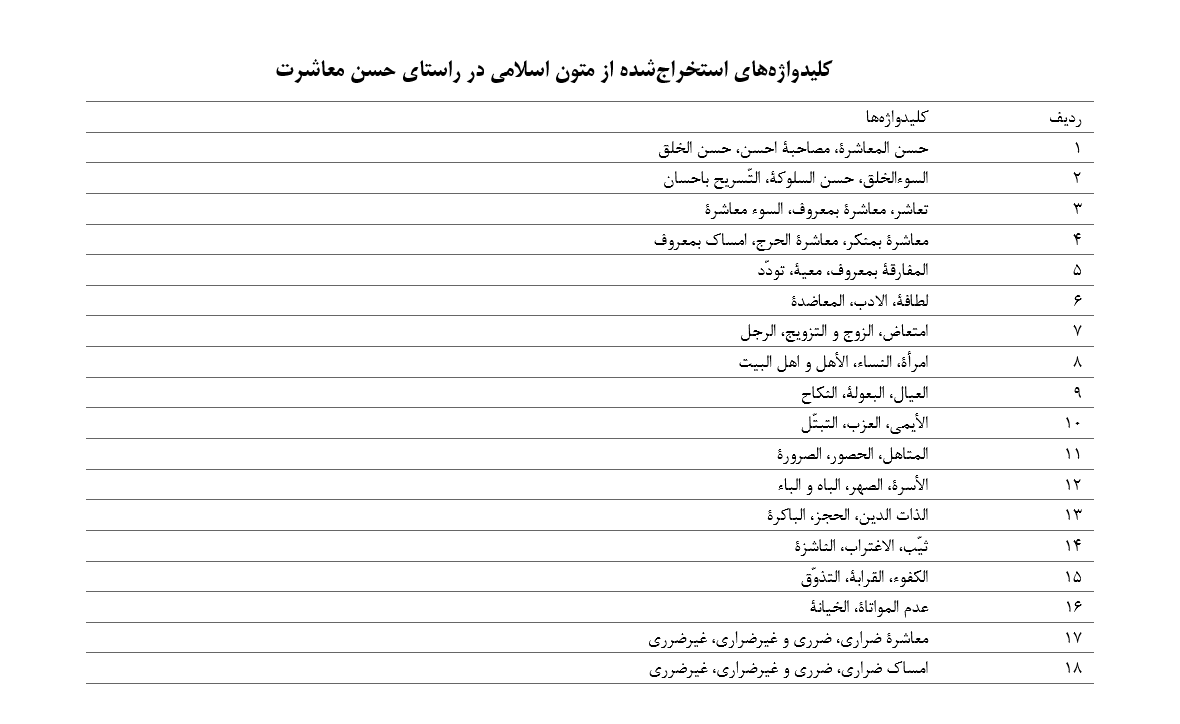
The present study aimed to design and explain a paradigmatic model of good marital conduct based on Islamic sources and to investigate its dimensions, causal conditions, strategies, and consequences in strengthening family resilience, marital happiness, and relational stability among couples. This study was conducted using a qualitative grounded theory approach. Data were collected through the analysis of Islamic sources including Quranic verses, narrations, Islamic ethical texts, and scientific literature related to marital satisfaction, family resilience, spirituality, emotional companionship, and interpersonal communication. Purposive sampling was employed, and data analysis was performed through open, axial, and selective coding procedures. Continuous comparison, conceptual review, and category consistency examination were used to enhance the credibility and trustworthiness of the findings. The findings demonstrated that good marital conduct is a multidimensional construct composed of ethical, emotional, spiritual, and behavioral components that directly contribute to family cohesion, marital satisfaction, emotional security, and family resilience. Data analysis revealed that spirituality, religious commitment, empathy, patience, mutual respect, emotional support, and constructive dialogue represent the most significant causal conditions and interactional strategies within marital relationships. Contextual factors such as cultural identity, religious awareness, and socioeconomic conditions were also found to influence the development of good marital conduct patterns. The findings further indicated that couples who employ emotional companionship, cooperation, empathy, and spiritual coping strategies experience higher levels of happiness, emotional stability, and family adaptability. The findings suggest that good marital conduct in Islamic sources is not merely an ethical recommendation but rather a comprehensive framework for regulating emotional, cognitive, and behavioral interactions within family life. This framework can serve as a culturally and religiously grounded model for promoting family mental health, reducing marital conflicts, and enhancing family resilience.
Downloads
References
1. Cowan CP, Cowan PA. When partners become parents: The big life change for couples: Lawrence Erlbaum Associates; 2020.
2. Hetherington EM, Kelly J. For better or for worse: Divorce reconsidered. 2020.
3. Birni G, Eryilmaz A. Enhancing well-being of the married: Investigating marital satisfaction, self-compassion and happiness increasing strategies. Turkish Psychological Counseling and Guidance Journal. 2022;12(67):650-68.
4. Carreno DF, Eisenbeck N, Greville J, Wong PTP. Cross-cultural psychometric analysis of the Mature Happiness Scale-Revised: Mature happiness, psychological inflexibility, and the PERMA model. Journal of Happiness Studies. 2023;24:1075-99.
5. Lüscher J, Pauly T, Gerstorf D, Stadler G. Having a good time together: The role of companionship in older couples' everyday life. Gerontology. 2022;68:1428-39.
6. Stadler G, Scholz U, Bolger N, Shrout PE, Knoll N, Lüscher J. How is companionship related to romantic partners' affect, relationship satisfaction, and health behavior? Using a longitudinal dyadic score model to understand daily and couple-level effects of a dyadic predictor. 2022. doi: 10.1111/aphw.12450.
7. Tong JPS, Lu S, Sing CY, Sze LCY, Lum TYS, Tse S. It was the deepest level of companionship: Peer-to-peer experience of supporting community-dwelling older people with depression: A qualitative study. BMC Geriatrics. 2022;22:443. doi: 10.1186/s12877-022-03121-4.
8. Yaya Bocoum F, Kabore CP, Barro S. Women's and health providers' perceptions of companionship during labor and childbirth: A formative study for the implementation of WHO companionship model in Burkina Faso. Reproductive Health. 2023;20:46. doi: 10.1186/s12978-023-01597-w.
9. Pudjiati SRR, Reksodiputro SHD, Purwono RU. Family resilience model: The influence of cultural identity, coping, family strain, socioeconomic status, and community support on family resilience among the Batak Toba ethnic group. Makara Human Behavior Studies in Asia. 2021;25(2):153-69. doi: 10.7454/hubs.asia.1131121.
10. Ouoba Y, Sawadogo N. Food security, poverty and household resilience to COVID-19 in Burkina Faso: Evidence from urban small traders' households. World Development Perspectives. 2022;25:100387.
11. Kasdi A, Saifudin S. Resilience of Muslim families in the pandemic era: Indonesian millennial Muslim community's response against COVID-19. Jurnal Penelitian. 2020:81-94.
12. Fathoni A. Family resilience and implementation of Islamic family jurisprudence on millennial Muslim families in Gresik, Indonesia. Journal of Islamic Law. 2021;2(2):247.
13. Lazarus A, Arun VM. Spiritual involvement, resilience, and positive mindset in adults. World Journal of Advanced Research and Reviews. 2025;26(1):799-806. doi: 10.30574/wjarr.2025.26.1.0951.
14. Cohen K, Baker S, Hoggard L. Religious coping, compassion and resilience in context of adversity. International Journal of Wellbeing. 2025.
15. Lyman EM, Marks LD, Dollahite DC, Leavitt CE, Wagner KN, Gergetz SM. How do religious women cope with marital conflict and hardship? Psychology International. 2024;6(4):1013-27. doi: 10.3390/psycholint6040063.
16. Saud M, Ashfaq A, Abbas A, Ariadi S, Mahmood QK. Social support through religion and psychological wellbeing: COVID-19 and coping strategies in Indonesia. Journal of Religion and Health. 2021;60(5):3309-25. doi: 10.1007/s10943-021-01327-1.
17. Chen N, Chen HC. Religion, marriage, and happiness: Evidence from Taiwan. Applied Research in Quality of Life. 2021;16(2):259-99. doi: 10.1007/s11482-019-09797-0.
18. Wheatley I. Religious service attendance and its association with well-being. Journal of Family and Community Studies. 2023;12(3):45-59. doi: 10.1080/12345678.2023.987654.
19. Bahlgerdi M, Miri M, Sharifzadeh G, Noroozi E, Hosseini T. The effect of educational intervention based on theory of planned behavior and self-regulatory strategies on the social vitality of women employee. Journal of Education and Health Promotion. 2021;10:94.
20. Dehkami S, Rostami K, Khademian Z. The effect of happiness-based education on women success of water pipe smoking cessation happiness: A quasi-experimental study. BMC Psychology. 2023;11:371.
21. Sattarzadeh Jahdi N, Hakimi S, Shakbaeifar M. The effect of sexual assertiveness training on marital satisfaction and happiness of Azari women: A semi-experimental study. Medical Journal of Tabriz University of Medical Sciences. 2024;46(2):188-98. doi: 10.34172/mj.2024.025.
22. Koçak TM, Dibek BC, Polat EN, Kafesçioğlu N, Demiroğlu C. Automatic detection of attachment style in married couples through conversation analysis. EURASIP Journal on Audio, Speech, and Music Processing. 2023:26. doi: 10.1186/s13636-023-00291-w.
23. Boateng G, editor Towards real-time multimodal emotion recognition among couples. Proceedings of the 2020 International Conference on Multimodal Interaction; 2020.
24. Boateng G, Zurich E, Hilpert P, Bodenmann G, Neysari M, Kowatsch T. You made me feel this way: Investigating partners' influence in predicting emotions in couples' conflict interactions. 2021.
25. Pirutinsky S, Cherniak AD, Rosmarin DH. COVID-19, mental health, and religious coping among American Orthodox Jews. Journal of Religion and Health. 2020;59(5):2288-301. doi: 10.1007/s10943-020-01070-z.
26. Prasetyo YB, Masruroh NL, Melizza N, Laksono AD, Abdullah Y. The inference of religious well-being on family resilience in maintaining a positive outlook during the COVID-19 pandemic. Jurnal Aisyah: Jurnal Ilmu Kesehatan. 2023;8(1):49-54.
27. Sholeh AN, Saputra N, Haymans A. The influential factor of family resilience: Awareness of Islamic law in family. Journal of Psychology and Education. 2021;38(1):3195-207.
28. Nurdin R, Ridwansyah M, Iskandar Z. Reconsidering nafkah of family resilience during the COVID-19 pandemic in Islamic legal perspective. Journal Ilmu-Ilmu Keislaman. 2021;45(1).
29. Gumiandari S, Nafia I. Mubadalah as an Islamic moderating perspective between gender and patriarchal regimes in building family resilience. Journal of Penelitian. 2020;17(2).
30. Hidayati TW, Susilawati U, Sriani E. Dynamics of family fiqh: The multiple roles of women in realizing family resilience. Wacana Hukum Islam dan Kemanusiaan. 2022;22(2):219-38.
31. Duran S, Avci D, Esim F. Association between spiritual well-being and resilience among Turkish hemodialysis patients. Journal of Religion and Health. 2020;59(6):3097-109. doi: 10.1007/s10943-020-01000-z.
32. Kim M, Moon SH, Kim JE. Effects of psychological intervention for Korean infertile women under in vitro fertilization on infertility stress, depression, intimacy, sexual satisfaction and fatigue. Archives of Psychiatric Nursing. 2020;34(4):211-7.
33. Hoseinnejad H, Chopaniyan F, Sarvi Moghanlo O, Rostami M, Dadkhah A. Marital satisfaction and happiness in parents with autistic and normal children. Iranian Rehabilitation Journal. 2020;18(1):49-56. doi: 10.32598/irj.18.1.655.1.
34. Zhang H, Shen B, Deng C, Lyu X. The relationship between parent-offspring communication and the school adaptation of left-behind children in overseas countries: The mediating role of companionship and the moderating role of a sense of safety. 2023;13(7):557.
35. Madeline RL, van Scheppingen MA, Bleidorn W. Self-other agreement in personality development in romantic couples. European Journal of Personality. 2020.
36. Habibolahi M. Factors and components of resilience from the perspective of Quran and hadiths. Quarterly Journal of Extension in Ethics. 2021;11(43):1-30.
37. Fauzi F, Ashilah AS. The polemic of the controversial articles on the family resilience bill from the perspective of Islamic law, psychology and social communication. Wacana Hukum Islam dan Kemanusiaan. 2020;20(1):115-45.
Downloads
Publication Timeline
- Submitted
- Revised
- Accepted
Issue
Section
License
Copyright (c) 2025 Zeynab Sadat Mirghazanfary (Author); MohammadReza Jahangirzade Ghomi (Corresponding author); Pantea Jahangir, Farideh Dokanehifard (Author)

This work is licensed under a Creative Commons Attribution-NonCommercial 4.0 International License.