The Role of Power in Prisoners’ Educational Activities: A Foucauldian Dispositif Analysis
Keywords:
prison, discursive formation, educational activities, power, non, discursive practices, institutionsAbstract
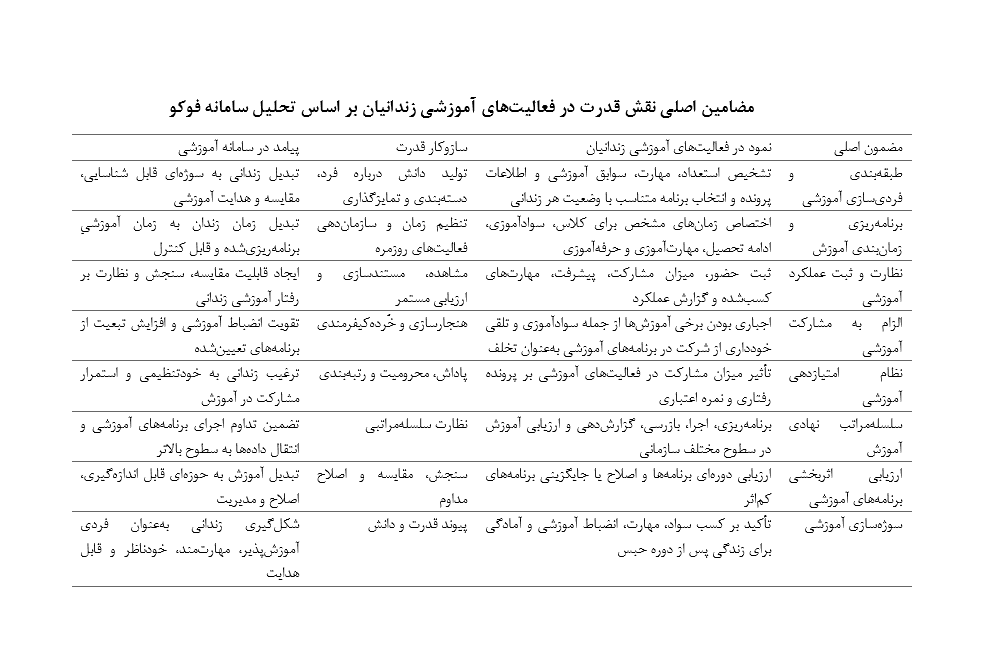
This study aimed to analyze the role of power in the formation, organization, implementation, and evaluation of prisoners’ educational activities using Michel Foucault’s dispositif analysis. This qualitative, historical-interpretive study was conducted based on Foucauldian dispositif analysis. Data were collected through purposive examination of laws, prison regulations, organizational documents, administrative directives, and provisions directly related to prisoners’ literacy education, continuation of formal education, scientific instruction, and vocational training. The sources were selected through theoretical purposive sampling, with the analytical scope restricted exclusively to educational activities. Data analysis was conducted at three interconnected levels: archaeology, genealogy, and dispositif analysis. The archaeological stage identified statements, concepts, subject positions, and rules governing the formation of educational discourse. The genealogical stage examined the connection between these discourses and techniques of power. Finally, dispositif analysis reconstructed the relationships among regulations, institutions, educational knowledge, assessment procedures, documentation practices, and supervisory mechanisms. Inferential findings revealed five major mechanisms through which power operated in prisoners’ educational activities: educational classification and individualization, temporal regulation of learning, continuous surveillance and documentation of performance, linkage of educational participation to institutional incentives and sanctions, and hierarchical organization of educational planning and evaluation. These mechanisms transformed education from a merely instructional process into a field for producing knowledge about prisoners, comparing individuals, normalizing conduct, and directing educational trajectories. Consequently, the prisoner was constituted as an educable, measurable, governable, and partially self-regulating subject within the educational dispositif. Prisoners’ educational activities function within a power–knowledge dispositif that simultaneously develops educational and vocational capacities and organizes educational conduct through classification, assessment, surveillance, and normalization; therefore, prison education should be understood as a dual process in which empowerment and the exercise of power operate concurrently and remain deeply intertwined.
Downloads
References
1. Beigi J, Teymouri M. Prisoners' Enjoyment of the Right to Education: A Strategy for Preventing Recidivism. Quarterly Journal of Research and Development in Comparative Law. 2022;5(16):67-91. doi: 10.22034/law.2022.55686701180.
2. Alikhani E, Salehi K, Mansouri SM. The Status of Correction and Rehabilitation of Prisoners through Vocational Training Courses: A Case Study of Prisoners in Shahrekord. Encyclopedia of Comparative Jurisprudence and Law. 2026;5(4):260-72. doi: 10.22034/jccj.2026.546910.1759.
3. Teymouri F, Ashrafi M, Heidari M. Sustainable Employment of Prisoners: A New Approach to Boosting Production. Legal Research Quarterly, Shahid Beheshti University. 2025;28(110):201-20. doi: 10.48308/JLR.2025.228596.2300.
4. Foucault M. Society Must Be Defended. Tehran: Akhtaran Publications; 2021.
5. Dreyfus H, Rabinow P. Michel Foucault: Beyond Structuralism and Hermeneutics. Tehran: Ney Publishing; 2000.
6. Ritzer G. Sociological Theory. Tehran: Ney Publications; 2021.
7. Foucault M. Care and Punishment: The Birth of Prison. Tehran: Ney Publications; 2016.
8. Foucault M. The Order of Things: An Archaeology of the Human Sciences. Tehran: Mahi Publishing; 2017.
9. Foucault M. Philosophy Theater: A Selection of Lectures, Short Writings, and Dialogues. Tehran: Ney Publications; 2010.
10. Foucault M. History of Sexuality: The Will to Know. Tehran: Ney Publications; 2015.
11. Mesgarzadeh S, Bani Fatemeh H. Power and Urban Space: An Examination of the Concepts of Dispositif and Object. Quarterly Journal of Urban Sociological Studies. 2020;10(35):27-56.
12. Khazaei Y. The Structuration Process of the Prison Institution: From the Constitutional Revolution to the End of the First Pahlavi Period. Tehran: Agah Publishing; 2022.
13. Salehi A, Sheikh Movahed MA, Shakeri Y. Culture-Oriented Correction and Treatment Policies in Iranian Prisons. Crime Prevention Approach Quarterly. 2019(4):89-107. doi: 10.61838/jecjl.790.
14. Mousavi SA, Ameri Shahrabi M, Biabani G. The Role of Cultural Activities in the Correction, Education, and Reintegration of Prisoners into Life: A Case Study of Hamedan Central Prison. Journal of New Research Approaches in Management and Accounting. 2020;41(2):96-114.
15. Ranjbari A, Rajabi A, Gol-Khandan S. Examining the Status of Religious Programs in the Correctional and Educational Approach of the Prisons Organization. Comparative Criminal Jurisprudence Quarterly. 2022;2(1):51-60. doi: 10.22034/jccj.2022.346902.1040.
Downloads
Publication Timeline
- Submitted
- Revised
- Accepted
Issue
Section
License
Copyright (c) 2026 Moazzam Bahri Iraii (Author); Reza Najafzadeh (Corresponding author); Mahshid Talebi Somesarai (Author)

This work is licensed under a Creative Commons Attribution-NonCommercial 4.0 International License.