تبیین هویت اخلاقی کارکنان براساس رهبری تحولآفرین و محیط حامی خودپیروی با میانجیگری تعهد سازمانی در محیطهای آموزشی
کلمات کلیدی:
تعهد سازمانی, رهبری تحولآفرین, محیط حامی خودپیروی, کارکنان آموزشی, هویت اخلاقیچکیده
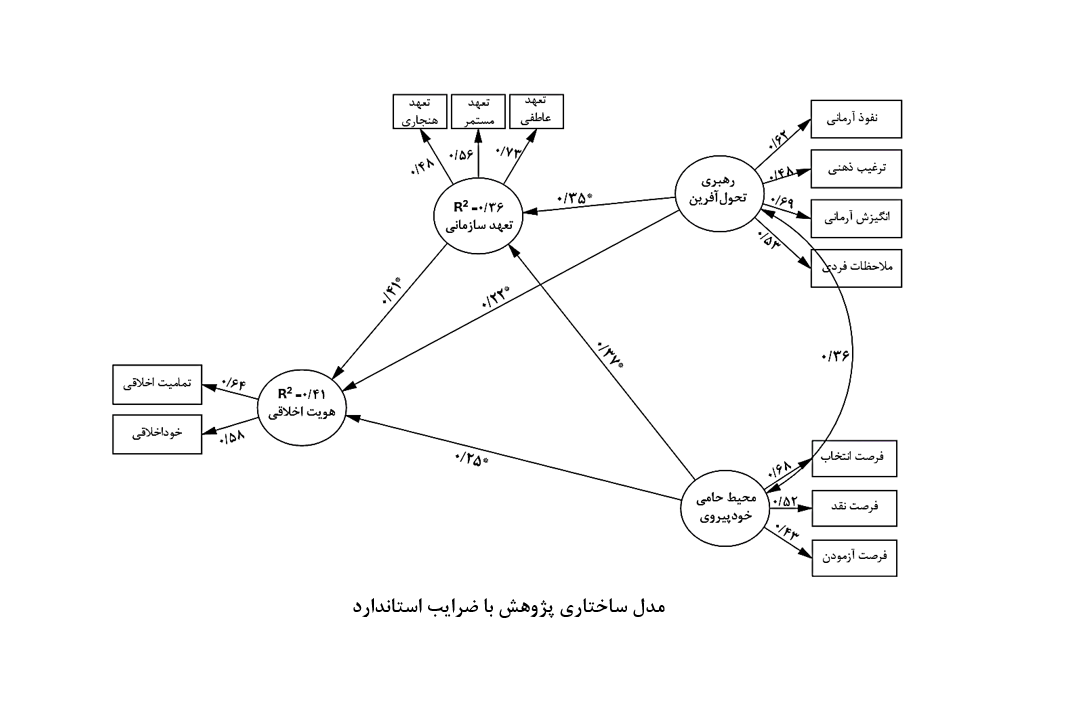
پژوهش حاضر با هدف تبیین هویت اخلاقی کارکنان براساس رهبری تحولآفرین و محیط حامی خودپیروی با تأکید بر نقش میانجی تعهد سازمانی در محیطهای آموزشی انجام شد. پژوهش حاضر از نظر هدف کاربردی و از نظر روش توصیفی-همبستگی بود که با استفاده از مدلیابی معادلات ساختاری انجام شد. جامعه آماری شامل 468 نفر از کارکنان اداری نواحی چهارگانه آموزش و پرورش شهر شیراز در سال تحصیلی 1404–1405 بود. با استفاده از نمونهگیری تصادفی ساده، 246 نفر وارد پژوهش شدند و پس از حذف پرسشنامههای ناقص، دادههای 231 نفر تحلیل شد. ابزارهای گردآوری دادهها شامل پرسشنامه رهبری تحولآفرین باس و آولیو، مقیاس محیط حامی خودپیروی آسور، پرسشنامه تعهد سازمانی آلن و مایر و پرسشنامه هویت اخلاقی بلک و رینولدز بود. دادهها با استفاده از ضریب همبستگی پیرسون و مدلیابی معادلات ساختاری در نرمافزارهای SPSS-27 و AMOS-27 تحلیل شدند. نتایج نشان داد رهبری تحولآفرین اثر مثبت و معناداری بر تعهد سازمانی (β=0.35, p=0.001) و هویت اخلاقی (β=0.22, p=0.001) داشت. محیط حامی خودپیروی نیز تعهد سازمانی (β=0.37, p=0.001) و هویت اخلاقی (β=0.25, p=0.001) را بهطور مثبت و معنادار پیشبینی کرد. تعهد سازمانی نیز اثر مثبت و معناداری بر هویت اخلاقی داشت (β=0.41, p=0.001). اثر غیرمستقیم رهبری تحولآفرین بر هویت اخلاقی از طریق تعهد سازمانی معنادار بود (β=0.14, p=0.001)، و اثر غیرمستقیم محیط حامی خودپیروی بر هویت اخلاقی نیز معنادار بهدست آمد (β=0.15, p=0.001). همچنین، متغیرهای پیشبین 36 درصد از واریانس تعهد سازمانی و 41 درصد از واریانس هویت اخلاقی را تبیین کردند. رهبری تحولآفرین و محیط حامی خودپیروی میتوانند هویت اخلاقی کارکنان را هم بهطور مستقیم و هم از طریق افزایش تعهد سازمانی تقویت کنند؛ بنابراین، ایجاد سبکهای رهبری تحولآفرین و محیطهای کاری حمایتکننده از خودپیروی میتواند راهبردی مؤثر برای ارتقای تعهد سازمانی و درونیسازی ارزشهای اخلاقی در کارکنان سازمانهای آموزشی باشد.
مراجع
1. Arslan A, Yener S, Akturan A. Moral identity and the ethics of digital piracy: A self-regulatory model of contextual reasoning and religious norms. Journal of Information, Communication and Ethics in Society. 2026;24(1):145-74. doi: 10.1108/JICES-05-2025-0097.
2. He W, Sun Y. The impact of employees’ constrictive deviance on job performance: The roles of ethical conflict and moral identity. Scientific Reports. 2026;16(1):13651. doi: 10.1038/s41598-026-44262-5.
3. Kim D, McOwen B. Development and validation of engineering professional moral identity measure. Science and Engineering Ethics. 2026;32(3):24. doi: 10.1007/s11948-026-00593-0.
4. Nguyen-Viet B, Vo Tri Chau T. The impact of counterproductive work behavior on organizational citizenship behavior: The moderating role of moral identity and organizational justice. Cogent Business & Management. 2025;12(1):2444545. doi: 10.1080/23311975.2024.2444545.
5. Gupta N, Verma HV. Witnessing justice in action: How emotions, moral identity and commitment shape third-party reactions to service recovery. Journal of Services Marketing. 2025;39(5):475-92. doi: 10.1108/JSM-08-2024-0428.
6. Zhou Q, Zheng X. Socially responsible human resource management and employee green behavior at work: The role of learning goal orientation and moral identity. The International Journal of Human Resource Management. 2024;35(1):1-35. doi: 10.1080/09585192.2023.2192358.
7. Nagraj A. Exploring the nexus between socially responsible human resource management, employee green behavior, learning goal orientation, and moral identity: A novel perspective using BSP-CRF technique. Journal of Advances in Management, Engineering and Science (JAMES). 2026;1(02):1-9. doi: 10.65470/james.v1i02.19.
8. Zaeri Behrouz M, Mahmoudi Mashaei M, Rostami Matak S, Sadeghzadeh M. The role of emotional self-awareness in the formation of moral identity: The mediating effect of intrinsic motivation. Ethics in Science and Technology. 2025;20(3):101-9. doi: 10.22034/ethicsjournal.20.3.101.
9. Wang X, Wei H, Wang P. Adolescents high in callous-unemotional traits are prone to be bystanders: The roles of moral disengagement, moral identity, and perceived social support. Child Psychiatry & Human Development. 2026;57(1):241-53. doi: 10.1007/s10578-024-01709-y.
10. Zhao H, Chen Y, Xu Y, Zhou Q. Socially responsible human resource management and employees' turnover intention: The effect of psychological contract violation and moral identity. Journal of Management & Organization. 2025;31(3):1283-300. doi: 10.1017/jmo.2022.16.
11. Van HA, Hien HM. Moral identity as an educational outcome and psychological pathway to social entrepreneurship intention. AMCA Journal of Education and Behavioral Change. 2026;6(1):25-31. doi: 10.51773/ajeb.v6i1.456.
12. Cai Q, Chen W, Wang M, Di K. The impact of self-determined efficacy on university student’s environmental conservation intentions: An SEM-ANN exploration. Environment, Development and Sustainability. 2025:1-38. doi: 10.1007/s10668-024-05923-5.
13. Maco M, Kwon J. Fostering pro-environmental behavior at work: A self-determination theory perspective. Business Ethics, the Environment & Responsibility. 2025;34(2):473-88. doi: 10.1111/beer.12665.
14. Asi MH, Barzegar Bafrooie K, Hassani H. The mediating self-system perceptions in the relationship between the teaching emotions and autonomy supportive environment. Teaching and Learning Research. 2024;21(2):129-40. doi: 10.22070/tlr.2024.16502.1294.
15. Dadvand F, Fooladchang M. The relationship between an autonomy-supportive environment and academic citizenship behavior among female students through the mediating roles of self-efficacy and coping competence in facing cultural challenges. Cultural Psychology of Women. 2025;17(66):1-15. doi: 10.82542/jwc.2025.1216148.
16. Ye L, Li Y, Zhang N. The impact of autonomy-supportive organizational environments on employees’ emotions and creative performance: A self-determination theory perspective. PLOS ONE. 2025;20(5):e0322184. doi: 10.1371/journal.pone.0322184.
17. Fernández RJN, Rodriguez MT, Hirano LG. Gender differences in STEM careers: Autonomy-supportive climate, metacognitive strategies, self-efficacy, and their association with academic performance and satisfaction. 2026.
18. Abdou AH, Albohnayh ASM. Promoting psychological wellbeing in hospitality: The interactive roles of autonomy-supportive leadership, psychological need satisfaction, and perceived organizational support. Frontiers in Psychology. 2026;17:1813978. doi: 10.3389/fpsyg.2026.1813978.
19. Agazu BG, Kero CA, Debela KL. Transformational leadership and firm performance: A systematic literature review. Journal of Innovation and Entrepreneurship. 2025;14(1):29. doi: 10.1186/s13731-025-00476-x.
20. Afriana R, Komariah M, Mediawati AS, Aziz MA. The role of transformational leadership in improving nurse retention and well-being in non-Western countries: A systematic review. Journal of Healthcare Leadership. 2026:556120. doi: 10.2147/JHL.S556120.
21. Rezaeimanesh B, Hamzavi H, Norouzi Ardaki M. The effect of transformational leadership on employees' mental health in the workplace: The mediating role of human resource resilience. Comparative Public Administration. 2024;2(1):54-85. doi: 10.22098/cpa.2024.14812.1039.
22. Bellibaş MŞ, Ryskulueva F, Levin J, Pietsch M. A safe space and leadership matter for innovation: Exploring the role of psychological safety in the relationship between transformational leadership and innovation radicalness in Kyrgyz classrooms. Educational Management Administration & Leadership. 2026;54(2):556-78. doi: 10.1177/17411432241264696.
23. Erfiyana E, Hoerudin CW, Arifudin O, Kartika I. Transformational leadership of school principals in developing Islamic education in elementary madrasahs. International Journal of Science Education and Technology Management (IJSETM). 2026;5(1):32-44. doi: 10.28301/ijsetm.v4i1.48.
24. Menge C, Gerick J. The potential of transformational leadership and self-regulation for enhanced occupational well-being among early-career teachers. Teaching and Teacher Education. 2026;169:105238. doi: 10.1016/j.tate.2025.105238.
25. Schwepker CH, Jr., Good MC. The impact of moral identity and supervisor bottom-line mentality on salesperson bottom-line mentality and customer-relationship-building behaviors. Journal of Business-to-Business Marketing. 2026:1-17. doi: 10.1080/1051712X.2026.2642238.
26. Topcan O, Uluturk B, Iltar EK, Akcoru R. Impact of Islamic work ethic on employee ethical behavior: The serial mediation of moral identity and felt obligation. Personnel Review. 2025;54(1):350-70. doi: 10.1108/PR-01-2024-0045.
27. Alomran AM, Ahmed TSA, Kassem AM. Impact of organizational trust on organizational commitment: The moderating effect of national identity. Cogent Social Sciences. 2024;10(1):2309712. doi: 10.1080/23311886.2024.2309712.
28. Rajhi M, Aljuhmani HY. Fostering sustainable innovation through communication quality: The sequential role of trust in leadership and organizational commitment in team-based enterprises. Sustainability. 2026;18(2):554. doi: 10.3390/su18020554.
29. Mahmutoğlu C, Celep C, Kaya A. The impact of school administrators’ influence tactics on teachers’ organizational commitment: The role of learning agility. Frontiers in Psychology. 2025;16:1549328. doi: 10.3389/fpsyg.2025.1549328.
30. Fardiansyah IE, Jumady E, Djaharuddin D. Leadership and organizational commitment in improving employee performance: The role of job satisfaction as a mediator. Golden Ratio of Human Resource Management. 2025;5(1):221-31. doi: 10.52970/grhrm.v5i1.862.
31. Mo Z, Liu MT, Chark R, Zeng S, Song X. How AI adoption in human resource management practices can enhance tourism employees' organizational commitment. Journal of Hospitality and Tourism Management. 2025;63:54-67. doi: 10.1016/j.jhtm.2025.03.003.
32. Rahnavard R, Mohammadi M, Amirmohammadi M. The effect of organizational commitment on individual productivity through the mediation of motivation and perceived organizational support. Management and Development Process. 2024;37(3):25-60. doi: 10.61882/jmdp.37.3.25.
33. Shabbir SW, Nawaz M, Muhammad S, Aziz SZ. Perceptions of corporate social responsibility (CSR) among employees and its impact on organizational commitment. Review of Applied Management and Social Sciences. 2025;8(3):1241-60. doi: 10.47067/ramss.v8i3.564.
34. Adel SMR, Bayat Z, Ghorbandordinejad F. Moral disengagement and cyberbullying among Iranian EFL learners: Moral identity as mediator and artificial intelligence self-efficacy as moderator. International Journal of Ethics and Society. 2026;7(4):65-78. doi: 10.22034/ijethics.7.4.363.
35. Çivilidağ A, Durmaz Ş. The relationship of flexible working arrangements on work-family conflict, work-life balance and organizational commitment: A systematic review and meta-analysis. BMC Psychology. 2026;14(1):472. doi: 10.1186/s40359-026-04216-y.
دانلودها
گاهشمار انتشار
- ارسال
- بازنگری
- پذیرش
شماره
نوع مقاله
مجوز
حق نشر 2025 Fatemeh Dadvand, Reza Manzaritavakoli (Author); Gholamhossein Maktabi (Corresponding author)

این پروژه تحت مجوز بین المللی Creative Commons Attribution-NonCommercial 4.0 می باشد.