The Impact of Using Intellectual and Group Toys on Enhancing Children's Social Skills

Authors

    Fatemeh  Rahmani  Department of Sociology, Central Tehran Branch, Islamic Azad University, Tehran, Iran
    Majid Radfar * Associate Professor, Department of Social Sciences, Roudehen Branch, Islamic Azad University, Roudehen, Iran. Majid.Radfar@iau.ac.ir
    Alieh Shekarbeygi  Assistant Professor, Department of Social Sciences,Central Tehran Branch, Islamic Azad University, Tehran, Iran
https://doi.org/10.61838/jsied.218

Keywords:

Skills, Social , Tools , Game , Intellectual, Game, Group, Growth, Child, Learning, Participatory

Abstract

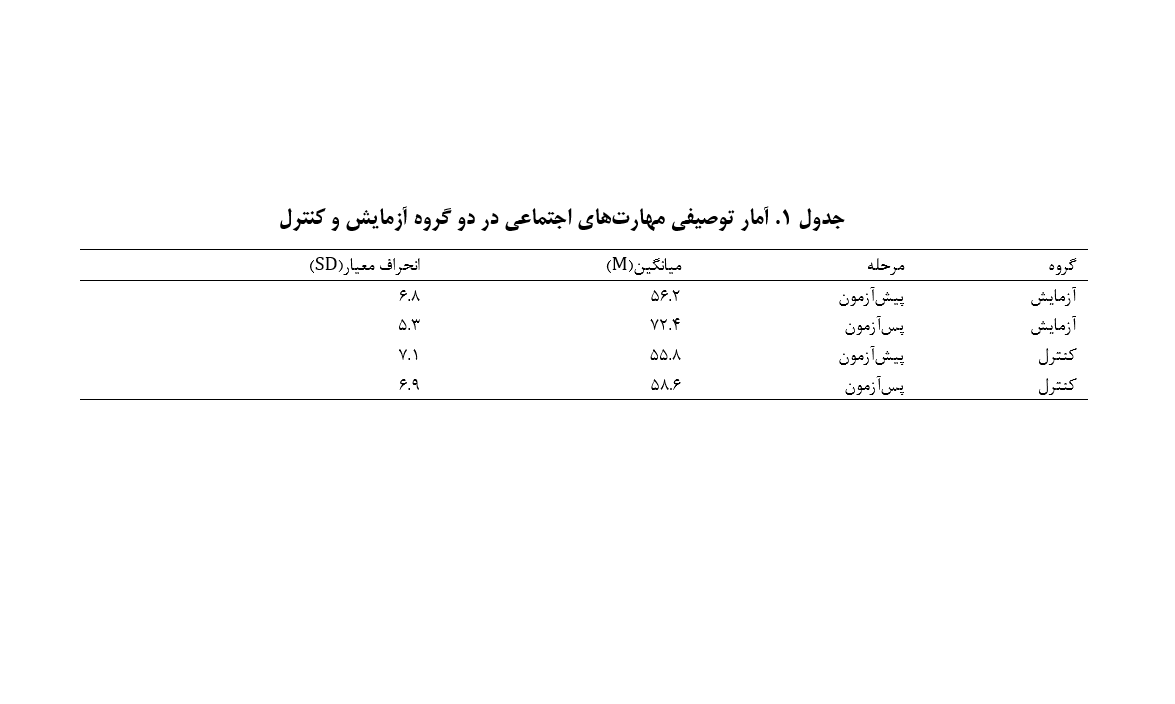
This study aimed to examine the impact of intellectual and group toys on enhancing the social skills of children aged 6 to 10. This research employed a quasi-experimental design with a pre-test, post-test, and control group. The sample consisted of 120 children (60 boys and 60 girls) randomly selected from four schools in Tehran and assigned to experimental and control groups. Data collection tools included the Social Skills Rating System (SSRS) questionnaire and an observational checklist of interactive behaviors. The experimental group participated in twelve 45-minute structured play sessions using intellectual and group toys, while the control group engaged in unstructured free play. Data were analyzed using ANCOVA and thematic analysis for qualitative data in SPSS version 26. The mean social skills score in the experimental group increased from 56.2 (SD = 6.8) in the pre-test to 72.4 (SD = 5.3) in the post-test, while the control group showed minimal changes (55.8 to 58.6). ANCOVA results confirmed a significant effect of the intervention (F = 34.7, p < 0.001, η² = 0.42), indicating a high effect size in improving children's social skills. Intellectual and group toys can serve as effective tools for improving children's social skills. The findings highlight the importance of incorporating structured group play in educational programs and suggest broader integration of these tools in both school and home settings.

Downloads

Download data is not yet available.

Author Biographies

  • Fatemeh  Rahmani , Department of Sociology, Central Tehran Branch, Islamic Azad University, Tehran, Iran

    This study investigated the effect of using intellectual and group toys on improving social skills in children aged 5 to 8 years. Social skills such as effective communication, cooperation, empathy, and conflict resolution play a key role in children's cognitive and emotional development and strengthen their ability to build relationships and adapt to social environments. In this study, using a quasi-experimental design, 60 children were divided into two experimental and control groups. The experimental group participated in structured play sessions with group intellectual toys (such as board games, puzzles, and group building blocks) for 8 weeks, while the control group participated in unstructured free play. Assessments were conducted using standard observation checklists and teacher and parent questionnaires in two stages before and after the intervention. The findings showed a statistically significant improvement (p < 0.05) in the social skills of the experimental group, especially in areas such as turn-taking, active listening, and collaborative problem solving, compared to the control group. Qualitative feedback also indicated increased self-confidence and reduced social anxiety in children. The results of this study indicate that intellectual and collective toys, by creating an interactive and purposeful space for play, provide opportunities for children to practice and internalize social norms. This research emphasizes the importance of integrating purposeful play tools into educational and family environments to support children's comprehensive social development. It is recommended that future studies examine the long-term effects and cultural differences in toy-based interventions.

  • Majid Radfar, Associate Professor, Department of Social Sciences, Roudehen Branch, Islamic Azad University, Roudehen, Iran.

    This study investigated the effect of using intellectual and group toys on improving social skills in children aged 5 to 8 years. Social skills such as effective communication, cooperation, empathy, and conflict resolution play a key role in children's cognitive and emotional development and strengthen their ability to build relationships and adapt to social environments. In this study, using a quasi-experimental design, 60 children were divided into two experimental and control groups. The experimental group participated in structured play sessions with group intellectual toys (such as board games, puzzles, and group building blocks) for 8 weeks, while the control group participated in unstructured free play. Assessments were conducted using standard observation checklists and teacher and parent questionnaires in two stages before and after the intervention. The findings showed a statistically significant improvement (p < 0.05) in the social skills of the experimental group, especially in areas such as turn-taking, active listening, and collaborative problem solving, compared to the control group. Qualitative feedback also indicated increased self-confidence and reduced social anxiety in children. The results of this study indicate that intellectual and collective toys, by creating an interactive and purposeful space for play, provide opportunities for children to practice and internalize social norms. This research emphasizes the importance of integrating purposeful play tools into educational and family environments to support children's comprehensive social development. It is recommended that future studies examine the long-term effects and cultural differences in toy-based interventions.

  • Alieh Shekarbeygi , Assistant Professor, Department of Social Sciences,Central Tehran Branch, Islamic Azad University, Tehran, Iran

    This study investigated the effect of using intellectual and group toys on improving social skills in children aged 5 to 8 years. Social skills such as effective communication, cooperation, empathy, and conflict resolution play a key role in children's cognitive and emotional development and strengthen their ability to build relationships and adapt to social environments. In this study, using a quasi-experimental design, 60 children were divided into two experimental and control groups. The experimental group participated in structured play sessions with group intellectual toys (such as board games, puzzles, and group building blocks) for 8 weeks, while the control group participated in unstructured free play. Assessments were conducted using standard observation checklists and teacher and parent questionnaires in two stages before and after the intervention. The findings showed a statistically significant improvement (p < 0.05) in the social skills of the experimental group, especially in areas such as turn-taking, active listening, and collaborative problem solving, compared to the control group. Qualitative feedback also indicated increased self-confidence and reduced social anxiety in children. The results of this study indicate that intellectual and collective toys, by creating an interactive and purposeful space for play, provide opportunities for children to practice and internalize social norms. This research emphasizes the importance of integrating purposeful play tools into educational and family environments to support children's comprehensive social development. It is recommended that future studies examine the long-term effects and cultural differences in toy-based interventions.

References

Evans GW. The physical context of child development. Current Directions in Psychological Science. 2021;30(1):41-

doi: 10.1177/0963721420980719.

Kurnia D, Jarwo S, Friskawati GF. Free play is important for children's motor development, but how we can supervise

it?: A phenomenological study at early childhood education. Retos: nuevas tendencias en educación física, deporte y recreación.

(58):256-64. doi: 10.47197/retos.v58.104099.

Giddings S. Toy Theory: Technology and Imagination in Play: MIT Press; 2024.

Chinwe DL. Imperativeness of Toy Making for Cognitive Development in Early Childhood Care and Education for

Sustainable Development in Nigeria. Journal of Education in Developing Areas. 2023;31(2):130-40.

Badami, Moghaddadi, Pilevar. The Role of Legal Protections for Children in Cyberspace with Emphasis on the Right

to Religious Education. Legal Studies. 2022;21(50):457-94.

Barimani S, Asadi J, Khajavand. The Effectiveness of Play Therapy on Social Adaptation and Communication Skills

in Deaf Children. Rehabilitation Archives Quarterly. 2018;19(3):250-61. doi: 10.32598/rj.19.3.250.

Boghian I, Cojocariu VM. Using games to build social emotional learning skills. Revista Romaneasca pentru Educatie

Multidimensionala. 2023;15(1):622-56. doi: 10.18662/rrem/15.1/715.

Irshad S, Maan MF, Batool H, Hanif A. Vygotsky's Zone of Proximal Development (ZPD): An evaluative tool for

language learning and social development in early childhood education. Multicultural Education. 2021;7(6):234-42.

Garaigordobil M, Berrueco L, Celume MP. Developing children's creativity and social-emotional competencies

through play: Summary of twenty years of findings of the evidence-based interventions "game program". Journal of

Intelligence. 2022;10(4):77. doi: 10.3390/jintelligence10040077.

Shoshani A, Krauskopf M. The Fortnite social paradox: The effects of violent-cooperative multi-player video games

on children's basic psychological needs and prosocial behavior. Computers in Human Behavior. 2021;116:106641. doi:

1016/j.chb.2020.106641.

Malakouti N, Mohseni A, Farid S. Community-Based Prevention of Juvenile Delinquency in Virtual Educational

Environments (With Emphasis on Criminological Findings). Judicial Law Perspectives Quarterly. 2023;28(102):207-34.

Eimer T, Aleksić G, Zhang Q. The Role of LEGO in Numeracy Development: A Case Analysis. Social Ecology of a

Chinese Kindergarten: Where culture grows2020. p. 93-109.

Chen J, Yang S, Mei B. Towards the sustainable development of digital educational games for primary school students

in China. Sustainability. 2021;13(14):7919. doi: 10.3390/su13147919.

Rahbar V, Heydari. The Impact of Social Capital on the Advancement of Policy-Making. Quarterly Journal of

International Relations Studies. 2011;4(14):219-53.
Downloads

Published

2025-07-13

Submitted

2024-12-30

Revised

2025-01-17

Accepted

2025-01-28

Issue

Section

مقالات

How to Cite

Rahmani , F., Radfar, M., & Shekarbeygi , A. . (2025). The Impact of Using Intellectual and Group Toys on Enhancing Children’s Social Skills. Journal of Study and Innovation in Education and Development, 5(2), 1-12. https://doi.org/10.61838/jsied.218

Similar Articles

1-10 of 173

You may also start an advanced similarity search for this article.