Explaining Employees’ Moral Identity Based on Transformational Leadership and Autonomy-Supportive Environment with the Mediating Role of Organizational Commitment in Educational Environments
Keywords:
Autonomy-supportive environment, Educational employees, Moral identity, Organizational commitment, Transformational leadershipAbstract
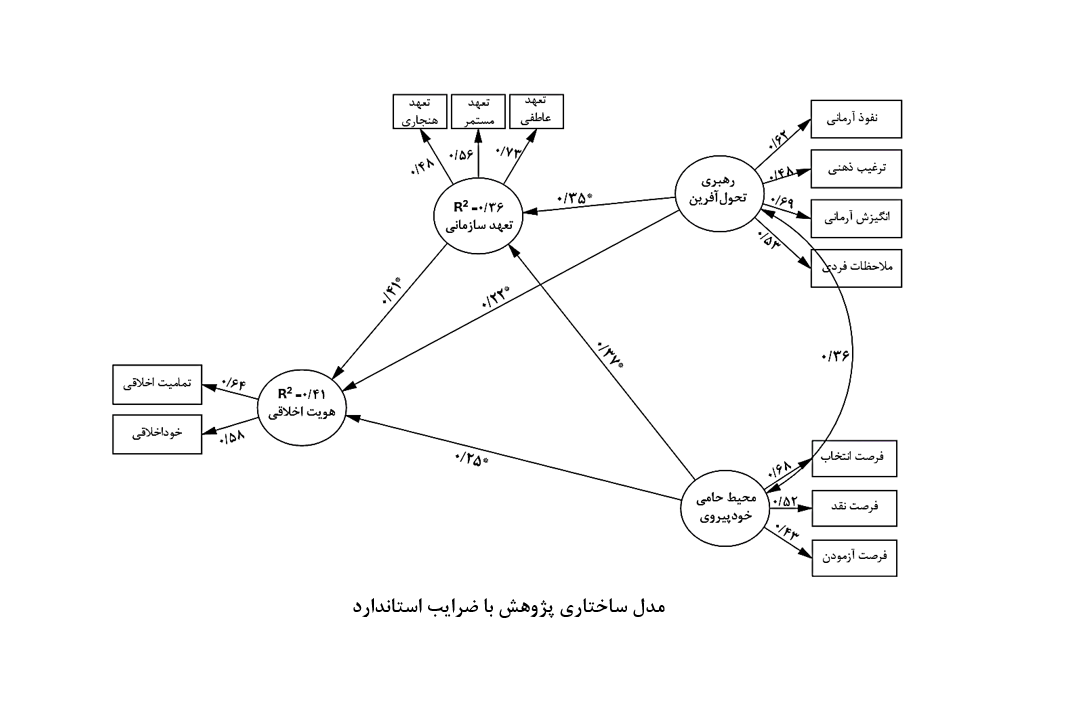
This study aimed to explain employees’ moral identity based on transformational leadership and an autonomy-supportive environment, with particular emphasis on the mediating role of organizational commitment in educational settings. This applied study employed a descriptive-correlational design using structural equation modeling. The statistical population consisted of 468 administrative employees working in the four educational districts of Shiraz during the 2025–2026 academic year. Using simple random sampling, 246 employees were recruited, and after excluding incomplete questionnaires, data from 231 participants were included in the final analyses. Data were collected using the Bass and Avolio Transformational Leadership Questionnaire, Assor’s Autonomy-Supportive Environment Scale, Allen and Meyer’s Organizational Commitment Questionnaire, and the Black and Reynolds Moral Identity Questionnaire. Pearson correlation analysis and structural equation modeling were conducted using SPSS-27 and AMOS-27. Transformational leadership had significant positive effects on organizational commitment (β=0.35, p=0.001) and moral identity (β=0.22, p=0.001). An autonomy-supportive environment also significantly and positively predicted organizational commitment (β=0.37, p=0.001) and moral identity (β=0.25, p=0.001). Organizational commitment exerted a significant positive effect on moral identity (β=0.41, p=0.001). Furthermore, the indirect effect of transformational leadership on moral identity through organizational commitment was significant (β=0.14, p=0.001), as was the indirect effect of an autonomy-supportive environment on moral identity (β=0.15, p=0.001). The predictor variables explained 36% of the variance in organizational commitment and 41% of the variance in employees’ moral identity. Transformational leadership and an autonomy-supportive environment contribute to strengthening employees’ moral identity both directly and indirectly through enhanced organizational commitment. Accordingly, promoting transformational leadership practices and creating work environments that support employee autonomy may represent effective organizational strategies for reinforcing commitment and facilitating the internalization of ethical values among employees in educational organizations.
References
1. Arslan A, Yener S, Akturan A. Moral identity and the ethics of digital piracy: A self-regulatory model of contextual reasoning and religious norms. Journal of Information, Communication and Ethics in Society. 2026;24(1):145-74. doi: 10.1108/JICES-05-2025-0097.
2. He W, Sun Y. The impact of employees’ constrictive deviance on job performance: The roles of ethical conflict and moral identity. Scientific Reports. 2026;16(1):13651. doi: 10.1038/s41598-026-44262-5.
3. Kim D, McOwen B. Development and validation of engineering professional moral identity measure. Science and Engineering Ethics. 2026;32(3):24. doi: 10.1007/s11948-026-00593-0.
4. Nguyen-Viet B, Vo Tri Chau T. The impact of counterproductive work behavior on organizational citizenship behavior: The moderating role of moral identity and organizational justice. Cogent Business & Management. 2025;12(1):2444545. doi: 10.1080/23311975.2024.2444545.
5. Gupta N, Verma HV. Witnessing justice in action: How emotions, moral identity and commitment shape third-party reactions to service recovery. Journal of Services Marketing. 2025;39(5):475-92. doi: 10.1108/JSM-08-2024-0428.
6. Zhou Q, Zheng X. Socially responsible human resource management and employee green behavior at work: The role of learning goal orientation and moral identity. The International Journal of Human Resource Management. 2024;35(1):1-35. doi: 10.1080/09585192.2023.2192358.
7. Nagraj A. Exploring the nexus between socially responsible human resource management, employee green behavior, learning goal orientation, and moral identity: A novel perspective using BSP-CRF technique. Journal of Advances in Management, Engineering and Science (JAMES). 2026;1(02):1-9. doi: 10.65470/james.v1i02.19.
8. Zaeri Behrouz M, Mahmoudi Mashaei M, Rostami Matak S, Sadeghzadeh M. The role of emotional self-awareness in the formation of moral identity: The mediating effect of intrinsic motivation. Ethics in Science and Technology. 2025;20(3):101-9. doi: 10.22034/ethicsjournal.20.3.101.
9. Wang X, Wei H, Wang P. Adolescents high in callous-unemotional traits are prone to be bystanders: The roles of moral disengagement, moral identity, and perceived social support. Child Psychiatry & Human Development. 2026;57(1):241-53. doi: 10.1007/s10578-024-01709-y.
10. Zhao H, Chen Y, Xu Y, Zhou Q. Socially responsible human resource management and employees' turnover intention: The effect of psychological contract violation and moral identity. Journal of Management & Organization. 2025;31(3):1283-300. doi: 10.1017/jmo.2022.16.
11. Van HA, Hien HM. Moral identity as an educational outcome and psychological pathway to social entrepreneurship intention. AMCA Journal of Education and Behavioral Change. 2026;6(1):25-31. doi: 10.51773/ajeb.v6i1.456.
12. Cai Q, Chen W, Wang M, Di K. The impact of self-determined efficacy on university student’s environmental conservation intentions: An SEM-ANN exploration. Environment, Development and Sustainability. 2025:1-38. doi: 10.1007/s10668-024-05923-5.
13. Maco M, Kwon J. Fostering pro-environmental behavior at work: A self-determination theory perspective. Business Ethics, the Environment & Responsibility. 2025;34(2):473-88. doi: 10.1111/beer.12665.
14. Asi MH, Barzegar Bafrooie K, Hassani H. The mediating self-system perceptions in the relationship between the teaching emotions and autonomy supportive environment. Teaching and Learning Research. 2024;21(2):129-40. doi: 10.22070/tlr.2024.16502.1294.
15. Dadvand F, Fooladchang M. The relationship between an autonomy-supportive environment and academic citizenship behavior among female students through the mediating roles of self-efficacy and coping competence in facing cultural challenges. Cultural Psychology of Women. 2025;17(66):1-15. doi: 10.82542/jwc.2025.1216148.
16. Ye L, Li Y, Zhang N. The impact of autonomy-supportive organizational environments on employees’ emotions and creative performance: A self-determination theory perspective. PLOS ONE. 2025;20(5):e0322184. doi: 10.1371/journal.pone.0322184.
17. Fernández RJN, Rodriguez MT, Hirano LG. Gender differences in STEM careers: Autonomy-supportive climate, metacognitive strategies, self-efficacy, and their association with academic performance and satisfaction. 2026.
18. Abdou AH, Albohnayh ASM. Promoting psychological wellbeing in hospitality: The interactive roles of autonomy-supportive leadership, psychological need satisfaction, and perceived organizational support. Frontiers in Psychology. 2026;17:1813978. doi: 10.3389/fpsyg.2026.1813978.
19. Agazu BG, Kero CA, Debela KL. Transformational leadership and firm performance: A systematic literature review. Journal of Innovation and Entrepreneurship. 2025;14(1):29. doi: 10.1186/s13731-025-00476-x.
20. Afriana R, Komariah M, Mediawati AS, Aziz MA. The role of transformational leadership in improving nurse retention and well-being in non-Western countries: A systematic review. Journal of Healthcare Leadership. 2026:556120. doi: 10.2147/JHL.S556120.
21. Rezaeimanesh B, Hamzavi H, Norouzi Ardaki M. The effect of transformational leadership on employees' mental health in the workplace: The mediating role of human resource resilience. Comparative Public Administration. 2024;2(1):54-85. doi: 10.22098/cpa.2024.14812.1039.
22. Bellibaş MŞ, Ryskulueva F, Levin J, Pietsch M. A safe space and leadership matter for innovation: Exploring the role of psychological safety in the relationship between transformational leadership and innovation radicalness in Kyrgyz classrooms. Educational Management Administration & Leadership. 2026;54(2):556-78. doi: 10.1177/17411432241264696.
23. Erfiyana E, Hoerudin CW, Arifudin O, Kartika I. Transformational leadership of school principals in developing Islamic education in elementary madrasahs. International Journal of Science Education and Technology Management (IJSETM). 2026;5(1):32-44. doi: 10.28301/ijsetm.v4i1.48.
24. Menge C, Gerick J. The potential of transformational leadership and self-regulation for enhanced occupational well-being among early-career teachers. Teaching and Teacher Education. 2026;169:105238. doi: 10.1016/j.tate.2025.105238.
25. Schwepker CH, Jr., Good MC. The impact of moral identity and supervisor bottom-line mentality on salesperson bottom-line mentality and customer-relationship-building behaviors. Journal of Business-to-Business Marketing. 2026:1-17. doi: 10.1080/1051712X.2026.2642238.
26. Topcan O, Uluturk B, Iltar EK, Akcoru R. Impact of Islamic work ethic on employee ethical behavior: The serial mediation of moral identity and felt obligation. Personnel Review. 2025;54(1):350-70. doi: 10.1108/PR-01-2024-0045.
27. Alomran AM, Ahmed TSA, Kassem AM. Impact of organizational trust on organizational commitment: The moderating effect of national identity. Cogent Social Sciences. 2024;10(1):2309712. doi: 10.1080/23311886.2024.2309712.
28. Rajhi M, Aljuhmani HY. Fostering sustainable innovation through communication quality: The sequential role of trust in leadership and organizational commitment in team-based enterprises. Sustainability. 2026;18(2):554. doi: 10.3390/su18020554.
29. Mahmutoğlu C, Celep C, Kaya A. The impact of school administrators’ influence tactics on teachers’ organizational commitment: The role of learning agility. Frontiers in Psychology. 2025;16:1549328. doi: 10.3389/fpsyg.2025.1549328.
30. Fardiansyah IE, Jumady E, Djaharuddin D. Leadership and organizational commitment in improving employee performance: The role of job satisfaction as a mediator. Golden Ratio of Human Resource Management. 2025;5(1):221-31. doi: 10.52970/grhrm.v5i1.862.
31. Mo Z, Liu MT, Chark R, Zeng S, Song X. How AI adoption in human resource management practices can enhance tourism employees' organizational commitment. Journal of Hospitality and Tourism Management. 2025;63:54-67. doi: 10.1016/j.jhtm.2025.03.003.
32. Rahnavard R, Mohammadi M, Amirmohammadi M. The effect of organizational commitment on individual productivity through the mediation of motivation and perceived organizational support. Management and Development Process. 2024;37(3):25-60. doi: 10.61882/jmdp.37.3.25.
33. Shabbir SW, Nawaz M, Muhammad S, Aziz SZ. Perceptions of corporate social responsibility (CSR) among employees and its impact on organizational commitment. Review of Applied Management and Social Sciences. 2025;8(3):1241-60. doi: 10.47067/ramss.v8i3.564.
34. Adel SMR, Bayat Z, Ghorbandordinejad F. Moral disengagement and cyberbullying among Iranian EFL learners: Moral identity as mediator and artificial intelligence self-efficacy as moderator. International Journal of Ethics and Society. 2026;7(4):65-78. doi: 10.22034/ijethics.7.4.363.
35. Çivilidağ A, Durmaz Ş. The relationship of flexible working arrangements on work-family conflict, work-life balance and organizational commitment: A systematic review and meta-analysis. BMC Psychology. 2026;14(1):472. doi: 10.1186/s40359-026-04216-y.
Downloads
Publication Timeline
- Submitted
- Revised
- Accepted
Issue
Section
License
Copyright (c) 2025 Fatemeh Dadvand, Reza Manzaritavakoli (Author); Gholamhossein Maktabi (Corresponding author)

This work is licensed under a Creative Commons Attribution-NonCommercial 4.0 International License.