تأثیر تناسب فرد–محیط بر سکوت سازمانی با نقش میانجی بیاعتمادی سازمانی و تعدیلگری رهبری اخلاقی
کلمات کلیدی:
تناسب فرد–محیط, سکوت سازمانی, بیاعتمادی سازمانی, رهبری اخلاقی, شرکتهای توزیع داروچکیده
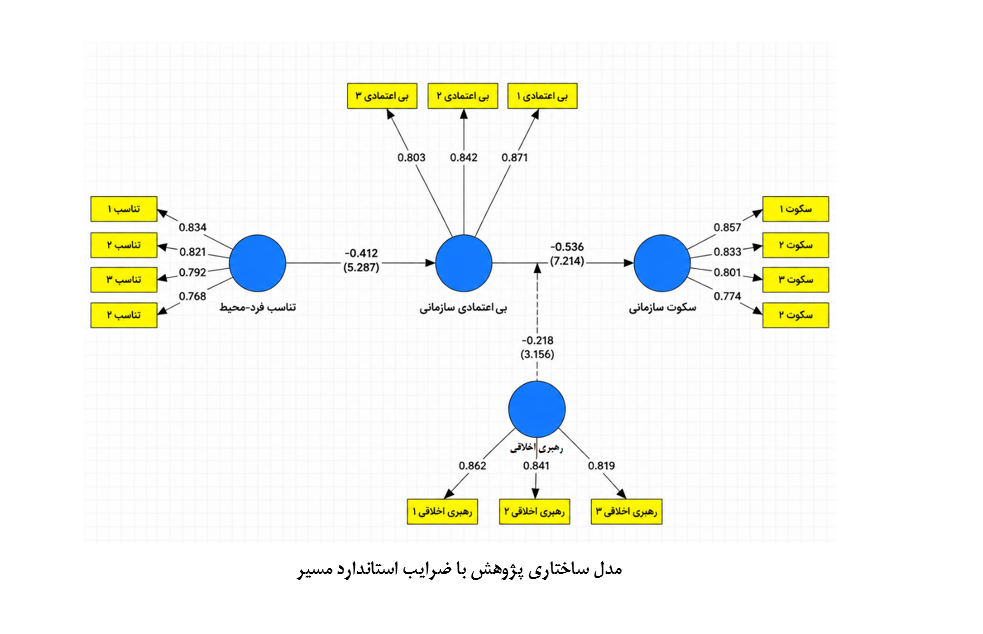
هدف پژوهش حاضر بررسی تأثیر تناسب فرد–محیط بر سکوت سازمانی با نقش میانجی بیاعتمادی سازمانی و نقش تعدیلگر رهبری اخلاقی در میان کارکنان شرکتهای توزیع دارو بود. این پژوهش از نظر هدف، کاربردی و از نظر روش، توصیفی–پیمایشی و از نوع همبستگی بود که با رویکرد مدلیابی معادلات ساختاری انجام شد. جامعه آماری شامل 780 نفر از کارکنان شرکتهای توزیع دارو بود که از میان آنان 274 نفر با روش نمونهگیری طبقهای نسبی انتخاب شدند. دادهها با استفاده از پرسشنامههای استاندارد تناسب فرد–محیط، بیاعتمادی سازمانی، رهبری اخلاقی و سکوت سازمانی گردآوری شد. تحلیل دادهها با استفاده از نرمافزار SPSS نسخه 26 و SmartPLS نسخه 4 انجام گرفت. نتایج استنباطی نشان داد تناسب فرد–محیط اثر منفی و معناداری بر بیاعتمادی سازمانی داشت (β=-0.47, t=9.12, p<0.001). همچنین بیاعتمادی سازمانی اثر مثبت و معناداری بر سکوت سازمانی نشان داد (β=0.52, t=11.34, p<0.001). اثر مستقیم تناسب فرد–محیط بر سکوت سازمانی نیز منفی و معنادار بود (β=-0.41, t=7.28, p<0.001). افزون بر این، رهبری اخلاقی اثر مستقیم منفی و معناداری بر سکوت سازمانی داشت (β=-0.29, t=5.43, p<0.001). اثر غیرمستقیم تناسب فرد–محیط بر سکوت سازمانی از طریق بیاعتمادی سازمانی معنادار بود (β=-0.244, t=6.90, p<0.001) و نقش میانجی جزئی بیاعتمادی سازمانی تأیید شد. همچنین اثر تعاملی بیاعتمادی سازمانی و رهبری اخلاقی بر سکوت سازمانی منفی و معنادار بود (β=-0.18, t=3.41, p<0.001). نتایج نشان داد افزایش تناسب فرد–محیط میتواند بهطور مستقیم و نیز از طریق کاهش بیاعتمادی سازمانی، سکوت سازمانی را کاهش دهد. همچنین رهبری اخلاقی با تضعیف اثر بیاعتمادی سازمانی بر سکوت، نقش حفاظتی مهمی در تقویت فضای ابراز نظر و مشارکت کارکنان ایفا میکند.
دانلودها
مراجع
1. Wright PM, McMahan GC. Exploring Human Capital: Putting Human Back into Strategic Human Resource Management. Human Resource Management Journal. 2011;21(2):93-104. doi: 10.1111/j.1748-8583.2010.00165.x.
2. Morrison EW. Employee Voice and Silence: A Review and Directions for Future Research. Annual Review of Organizational Psychology and Organizational Behavior. 2014;1(1):173-97. doi: 10.1146/annurev-orgpsych-031413-091328.
3. Donoso LM, Demerouti E, Garrosa E. Consequences of Organizational Silence: Burnout, Job Satisfaction, and Turnover Intentions. Journal of Occupational Health Psychology. 2020;25(3):189-201.
4. Morrison EW. Employee Voice and Silence: What We Know and Where We Should Go Next. Academy of Management Annals. 2023;17(2):481-512.
5. Jian Z, Zhu X, Fu X, Zong X, Tang J, Chi C, et al. The Experiences of Organizational Silence Among Nurses: A Qualitative Meta-Synthesis. BMC Nursing. 2025;24(1). doi: 10.1186/s12912-024-02636-y.
6. Harris TB, Li N, Kirkman BL. Person-Environment Fit in the Modern Workplace: A Meta-Analysis of the Consequences of Fit Dimensions. Journal of Management. 2022;48(3):675-709.
7. Wang Y, Zhang J, Zhou F. Subjective Person-Environment Misfit and Defensive Silence: The Role of Threat to Self-Esteem. Frontiers in Psychology. 2020;11:1530.
8. Chen P, Sparrow P, Cooper C. The Impact of Person-Environment Fit on Organizational Withdrawal Behaviors: The Mediating Role of Work Alienation. Journal of Vocational Behavior. 2021;125:103528.
9. Khalili S, Rahimi Q. Analyzing the Effect of Person-Organization Fit on Employees' Organizational Silence in the Public Sector. Behavioral Studies in Management. 2023;14(1):23-40.
10. Rezaei M, Ahmadi A. Examining the Relationship between Person-Environment Fit and Employees' Passive Behaviors with Emphasis on the Mediating Role of Job Attitudes. Organizational Behavior Management Quarterly. 2022;9(3):45-62.
11. Costigan RD, Insinga RC, Gibbons AJ, Stankeviciute Z. The Effect of Organizational Distrust on Employee Voice and Silence. Journal of Business and Psychology. 2012;27(4):445-58.
12. Pendleton A, Robinson A, Wilson M. Organizational Silence and Employee Participation: The Role of Trust and Climate. Human Relations. 2019;72(10):1621-44.
13. Lee Y, Kim S, Park H. Organizational Distrust as a Mediator between Poor Person-Environment Fit and Defensive Silence. International Journal of Human Resource Management. 2022;33(12):2410-35.
14. Sharif S, Hassan S, Ahmad U. Unpacking the Link between P-E Fit and Employee Silence: The Mediating Role of Distrust. European Journal of Work and Organizational Psychology. 2023;32(4):512-27.
15. Newman A, Kiazad K, Booth S, Sholl M. Ethical Leadership and Employee Voice: The Mediating Role of Psychological Safety. Journal of Business Ethics. 2015;131(2):383-95.
16. Knoll M, Redman T. Does the Presence of Ethical Leadership Reduce Employee Silence? A Multi-Source Study. British Journal of Management. 2016;27(4):812-28.
17. Zare F, Mohammadi H. The Role of Ethical Leadership in Predicting Psychological Safety and Employees' Willingness to Speak Up. Human Resource Management Research. 2023;15(2):112-35.
18. Kim M, Beehr TA, Fritz C. Can Ethical Leadership Buffer the Negative Effects of Organizational Distrust on Employee Voice? Journal of Organizational Behavior. 2024;45(1):89-105.
19. Zhang L, Liu Y, Wang Z. Mitigating the Negative Effects of Distrust on Voice: The Role of Ethical Leadership and Psychological Safety. Leadership & Organization Development Journal. 2023;44(5):601-18.
20. Knoll M, Hall RJ, Weigelt O. The Consequences of Employee Silence: A Meta-Analytic Review of the Relationships between Silence and Employee Outcomes. Journal of Occupational and Organizational Psychology. 2021;94(3):523-56.
21. Sulphey MM, Jasim KM. Perceived Anomie, Organizational Silence, Compulsory Organization Citizenship Behavior, and Workplace Alienation as Antecedents of Knowledge Hiding. Knowledge and Process Management. 2025;32(4):174-89. doi: 10.1002/kpm.70001.
22. Panagiotounis F, Saiti A. The Silent Path to Cynicism: Knowledge Donating and Collecting as Mediators Linking Organizational Silence to Cynicism in Higher Education. 2026. doi: 10.21203/rs.3.rs-8854007/v1.
23. Panagiotounis F. The Sound of Silence: Examining the Mediating Roles of Management Support and Interpersonal Trust on Organizational Commitment in Greek Higher Education Institutions. 2026. doi: 10.21203/rs.3.rs-8853984/v1.
دانلودها
گاهشمار انتشار
- ارسال
- بازنگری
- پذیرش
شماره
نوع مقاله
مجوز
حق نشر 2025 Mehdi Farahani, Samad Rahimi Aghdam (Author)

این پروژه تحت مجوز بین المللی Creative Commons Attribution-NonCommercial 4.0 می باشد.