Analyzing the Relationships Among Educational Innovation Ecosystem, Digital Organizational Citizenship Behavior, and Learning Performance in Smart Schools
DOI:
https://doi.org/10.61838/jsied.501Keywords:
Educational Innovation Ecosystem, Digital Organizational Citizenship Behavior, Learning Performance, Smart Schools, Organizational Learning, Digital EducationAbstract
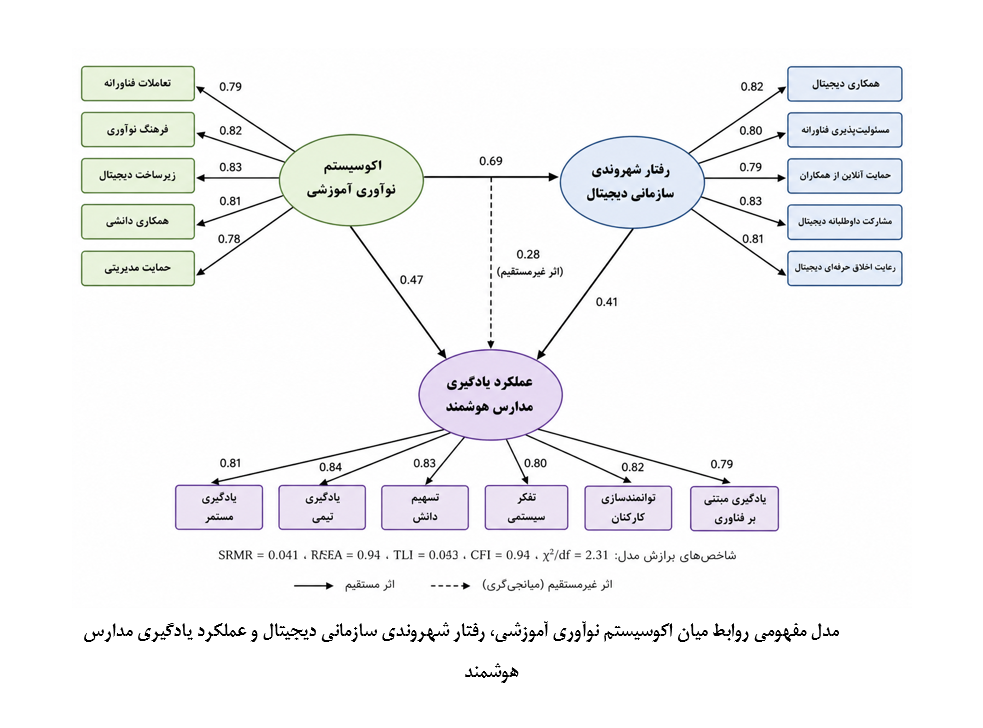
The present study aimed to analyze the relationships among educational innovation ecosystem, digital organizational citizenship behavior, and learning performance in smart schools and to examine the mediating role of digital organizational citizenship behavior in these relationships. This applied study employed a descriptive-correlational design using structural equation modeling. The statistical population included all teachers and staff working in smart schools in District 1 of Ahvaz during the 2025–2026 academic year, from which 384 participants were selected through stratified random sampling. Research instruments included the Educational Innovation Ecosystem Questionnaire, the Digital Organizational Citizenship Behavior Questionnaire, and the Organizational Learning Performance Questionnaire. Data were analyzed using SPSS-27 and SmartPLS-4 software. Pearson correlation coefficients and structural equation modeling were used to test the research hypotheses. The findings indicated that educational innovation ecosystem had a significant direct effect on digital organizational citizenship behavior (β=0.69, p<0.001) and learning performance in smart schools (β=0.47, p<0.001). Digital organizational citizenship behavior also had a significant positive effect on learning performance (β=0.41, p<0.001). Furthermore, the indirect effect of educational innovation ecosystem on learning performance through digital organizational citizenship behavior was statistically significant (β=0.28, p<0.001). Model fit indices also confirmed the acceptable fit of the proposed conceptual model. The findings revealed that strengthening educational innovation ecosystems can improve learning performance in smart schools through enhancing digital organizational citizenship behaviors. Therefore, simultaneous attention to technological infrastructure, innovation culture, knowledge collaboration, and digital participation among school staff can significantly improve educational effectiveness and organizational learning in smart schools.
References
1. Moravec JW, Martínez-Bravo MC. Global Trends in Disruptive Technological Change: Social and Policy Implications for Education. On the Horizon the International Journal of Learning Futures. 2023;31(3/4):147-73. doi: 10.1108/oth-02-2023-0007.
2. Tian X. Educational Reform and Prospects in the Post-Pandemic Era. Journal of Education Humanities and Social Sciences. 2023;19:262-70. doi: 10.54097/ehss.v19i.11142.
3. Dominici P. Democracy Is Complexity. Social Transformation From Below. Societàmutamentopolitica. 2023;14(28):21-32. doi: 10.36253/smp-15009.
4. Sá MJ, Serpa S, Ferreira CM. Citizen Science in the Promotion of Sustainability: The Importance of Smart Education for Smart Societies. Sustainability. 2022;14(15):9356. doi: 10.3390/su14159356.
5. Baldi G, Megaro A. Smart Small Villages Conceptualization Based on the Capabilities Co-Elevation for Smart Citizens. Itm Web of Conferences. 2023;51:02004. doi: 10.1051/itmconf/20235102004.
6. Saif N, Ali S, Shaheen I, Goh GGG, Khan S. Revolutionizing Healthcare Leadership the Critical Role of Digital Citizenship in Knowledge Sharing. Scientific Reports. 2025;15(1). doi: 10.1038/s41598-025-93117-y.
7. Yang Y. Organizational Citizenship Behavior, Team Performance and Organizational Performance: Basis for Human Resource Management Framework for Chinese Public Vocational Colleges. International Journal of Research Studies in Management. 2024;12(1). doi: 10.5861/ijrsm.2024.1013.
8. Ravina. Unveiling the Impact and Dynamics of Organizational Citizenship Behavior in Educational Environments: A Comprehensive Narrative Review. International Journal for Multidisciplinary Research. 2023;5(6). doi: 10.36948/ijfmr.2023.v05i06.10502.
9. Mark HDR, Sylvia JP. Organizational Citizenship Behavior, Adversity Quotient and Management Competence of School Heads in Davao Region, Philippines: A Convergent Design. American Journal of Multidisciplinary Research and Innovation. 2022;1(5):1-13. doi: 10.54536/ajmri.v1i5.489.
10. Haskasap E, Saner T, Eyüpoğlu ŞZ, Haskasap CSG. Influence of Organizational Democracy on Organizational Citizenship Behaviors in Digital Transformation: Mediating Effects of Job Satisfaction and Organizational Commitment for Smart Services. Sustainability. 2022;15(1):452. doi: 10.3390/su15010452.
11. Sonia NR, Sutiah, Wahidmurni W, Soeharto S. Islamic Leadership, Workplace Spirituality, and Innovative Work Behavior on Teachers’ Islamic Performance: Mediating Role of OCBIP. Cendekia Jurnal Kependidikan Dan Kemasyarakatan. 2024;22(1). doi: 10.21154/cendekia.v22i1.9092.
12. Budiarta K, Hidayat A, Lubis NW, Hasyim D. Determining Factors of the Relationship of Knowledge Management and Human Capital on Innovation Performance of Digital School. Al-Tanzim Jurnal Manajemen Pendidikan Islam. 2024;8(2):521-33. doi: 10.33650/al-tanzim.v8i2.7506.
13. Alpianoor A, Suriansyah A, Metroyadi M. The Effect of Organizational Culture, Achievement Motivation and Organizational Commitment to Organizational Citizenship Behavior (OCB) of Elementary School Teachers in Lampihong District. International Journal of Social Science and Human Research. 2022;05(12). doi: 10.47191/ijsshr/v5-i12-05.
14. Rahmansyah R. The Effect of Transformational Leadership and Motivation on Organizational Citizenship Behavior in Primary Schools. Al-Ishlah Jurnal Pendidikan. 2022;14(3):3111-20. doi: 10.35445/alishlah.v14i3.955.
15. Herfina H, Sunaryo W, Tukiran M, Wulandari D, Herlinda H. The Effect of Job Satisfaction, Transformational Leadership and Interpersonal Communication on Organizational Citizenship Behavior. Jppi (Jurnal Penelitian Pendidikan Indonesia). 2022;8(3):692. doi: 10.29210/020221642.
16. Hidayat R, Patras YE. The Effect of Organizational Trust and Job Satisfaction on Teachers’ Organizational Citizenship Behavior (OCB) in Private Senior High Schools. Al-Tanzim Jurnal Manajemen Pendidikan Islam. 2022;6(4):1049-63. doi: 10.33650/al-tanzim.v6i4.3488.
17. Barth A, Tsemach S. Empowerment as a Mediator Between Instructional Leadership and Teachers’ Organizational Citizenship Behavior. Research in Educational Administration & Leadership. 2023;8(2):335-71. doi: 10.30828/real.1282746.
18. Ayyaz M, Tasmin R, Saeed B, Nguyen M, Hafeez A. Motivating Tacit Knowledge Sharing: The Role of Perceived Value of Knowledge and Organizational Citizenship Behavior. International Journal of Professional Business Review. 2023;8(11):e03892. doi: 10.26668/businessreview/2023.v8i11.3892.
19. Srimulyani VA, Rustiyaningsih S, Hermanto YB. The Relationship of Servant Leadership on Knowledge Sharing Behavior With Organizational Culture and Organizational Citizenship Behavior as Mediator. Jurnal Bina Praja. 2023;15(3):521-41. doi: 10.21787/jbp.15.2023.521-541.
20. Malla HAB, Hamka H, Kurnia K, Abu A. The Effect of Principal Leadership Through Organizational Citizenship Behavior of Teachers on the Quality of Islamic Religious Education Learning. Qalamuna Jurnal Pendidikan Sosial Dan Agama. 2023;15(1):483-502. doi: 10.37680/qalamuna.v15i1.3945.
21. Khan MZ, Niqab M, Ali N. Analyzing the Mediating Effect of Organizational Citizenship Behavior on the Relationship Between HRM Practices and Intellectual Capital in Educational Settings in Pakistan. Pakistan Journal of Humanities and Social Sciences. 2023;11(1). doi: 10.52131/pjhss.2023.1101.0327.
22. Rafiq A, Mehmood S, Nazim M, Abdi FA. Unveiling the Role of Hope in Fostering Organizational Citizenship Behavior. Journal of Business and Social Review in Emerging Economies. 2023;9(4):539-50. doi: 10.26710/jbsee.v9i4.2864.
23. Khan K, Gogia EH, Shao Z, Rehman MZ, Ullah A. The Impact of Green HRM Practices on Green Innovative Work Behaviour: Empirical Evidence From the Hospitality Sector of China and Pakistan. BMC Psychology. 2025;13(1). doi: 10.1186/s40359-025-02417-5.
24. Alqudah MKm, Yusof Y. Improving Environmental Performance Through Innovative Academic Citizenship Behaviour: Green Training and Development, Green Recruitment and Selection as Antecedents in Jordanian Government University. Economics. 2024;12(1):101-29. doi: 10.2478/eoik-2024-0002.
25. Bismala L, Syaifuddin S, Sembiring R. Drivers of Organizational Citizenship Behavior of Elementary School Teachers. International Journal of Evaluation and Research in Education (Ijere). 2024;13(2):792. doi: 10.11591/ijere.v13i2.26833.
26. Hermanto YB, Srimulyani VA, Pitoyo DJ. The Mediating Role of Quality of Work Life and Organizational Commitment in the Link Between Transformational Leadership and Organizational Citizenship Behavior. Heliyon. 2024;10(6):e27664. doi: 10.1016/j.heliyon.2024.e27664.
Downloads
Publication Timeline
- Submitted
- Revised
- Accepted
Issue
Section
License
Copyright (c) 2025 Seyed Mohammad Hossein Heydarzadeh (Corresponding author)

This work is licensed under a Creative Commons Attribution-NonCommercial 4.0 International License.