Modeling the Role of University Administrators’ Instructional Leadership in Students’ Academic Achievement: The Mediating Roles of Teachers’ Teaching Self-Efficacy and Students’ Academic Engagement
Keywords:
Instructional Leadership, Teaching Self-Efficacy, Academic Engagement, Academic Achievement, Structural Equation ModelingAbstract
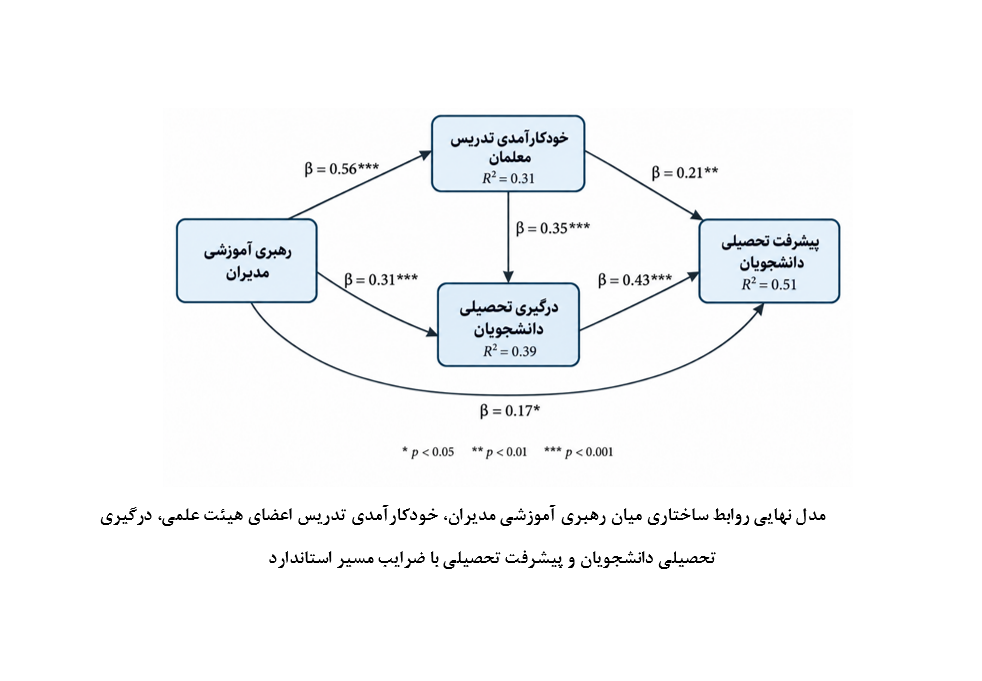
This study aimed to model the role of university administrators’ instructional leadership in students’ academic achievement through the mediating roles of faculty members’ teaching self-efficacy and students’ academic engagement. This applied study employed a descriptive-correlational design based on structural equation modeling. The study population consisted of students and faculty members at Khatam University during the 2025–2026 academic year, and the final analyses were conducted using matched data from 320 students and their corresponding instructors in selected courses. Data were collected using an instructional leadership measure, a teaching self-efficacy scale, an academic engagement scale, and students’ grade point averages. Data were analyzed using descriptive statistics, Pearson correlation coefficients, confirmatory factor analysis, and structural equation modeling. The significance of indirect effects was examined using bootstrapping with 5,000 resamples. Instructional leadership had a significant positive effect on teaching self-efficacy (β = 0.56, p < 0.001) and directly predicted academic engagement (β = 0.31, p < 0.001). Teaching self-efficacy had significant positive effects on academic engagement (β = 0.35, p < 0.001) and academic achievement (β = 0.21, p = 0.001). Academic engagement exerted the strongest direct effect on academic achievement (β = 0.43, p < 0.001), while the direct effect of instructional leadership on academic achievement was also significant (β = 0.17, p = 0.011). Significant indirect effects were observed through teaching self-efficacy (β = 0.118), academic engagement (β = 0.133), and the sequential pathway of teaching self-efficacy and academic engagement (β = 0.084). The model explained 51% of the variance in academic achievement. Instructional leadership can enhance students’ academic achievement both directly and indirectly by strengthening faculty members’ teaching self-efficacy and increasing students’ academic engagement. Accordingly, improving instructional leadership, supporting instructors’ teaching capabilities, and promoting active student engagement may serve as effective strategies for improving educational outcomes in higher education.
References
1. Kemethofer D, Helm C, Warwas J. Does Educational Leadership Enhance Instructional Quality and Student Achievement? The Case of Austrian Primary School Leaders. International Journal of Leadership in Education. 2025;28(3):461-85. doi: 10.1080/13603124.2021.2021294.
2. Özdoğru M, Sarier Y, Korucuoğlu T. How Leadership and School Climate Influence Student Achievement: Evidence from a Comparative Meta-Analysis. Educational Process: International Journal. 2025;15:e2025156. doi: 10.22521/edupij.2025.15.156.
3. Norman E, Masruri A, Wahid J, Hasbian Y. Managing Teacher Competence Improvement through Leadership, Professional Development, and Digital Innovation: A Systematic Literature Review. Journal of Educational Management Research. 2025;4(6):2135-70.
4. Fiantini I, Rifa'i M. School Principals' Leadership Strategies in Enhancing Inclusive Teachers' Competencies to Optimize Child Development. Journal of Educational Management Research. 2026;5(1):639-54. doi: 10.61987/jemr.v5i1.1734.
5. Kostogriz A, Manton C, Wilkinson J, Bright D, Fielding R, Gamble N, et al. Leadership as conversion: How school leaders enable teacher capabilities for responsive education in diverse schools. International Journal of Leadership in Education. 2026. doi: 10.1080/13603124.2026.2654866.
6. Ping H, Zhang Y. The Impact of Principals' Transformational Leadership on Multidimensionality of Teacher Job Performance: SEM Evidence from Chinese Schools. Journal of Asian Research Association for Educational Management. 2025;12(2):45-62.
7. Wang G. Exploring the Effects of Empowering Leadership on Teachers’ Career Calling in China: The Mediating Role of Psychological Empowerment. Chinese Education and Society. 2025;58(3-4). doi: 10.1080/10611932.2025.2541589.
8. Siregar J, Widodo W, Permana R, Sriyono H, Saputro A. Evoking Teachers' Innovative Work Behavior: Perspective of Digital Leadership, Creativity, and Proactive Personality through Work Engagement. European Journal of Educational Research. 2026;15(1):323-39. doi: 10.12973/eu-jer.15.1.323.
9. Zahed Babolan A, Hosseinzadeh R, Hanifi Kalashani S. The Role of Teachers' Attitudes and School Culture in Predicting Elementary School Teachers' Self-Efficacy. Educational Leadership Research. 2025;9(34):223-46.
10. Sahrudin S. Implementation of Islamic Leadership Values by School Principals in Enhancing Teacher Competence in Public Junior High Schools in Indramayu. Eduprof: Islamic Education Journal. 2025;7(1):140-61. doi: 10.47453/eduprof.v7i1.348.
11. Assefa Y, Alhur AA, Tilwani SA, Spahiu I, Majeed H. The Influence of Teacher Leadership on Student Self-Determination in Higher Education: The Moderating Role of Institutional Support and Classroom Climate. Social Sciences & Humanities Open. 2025;12:102166. doi: 10.1016/j.ssaho.2025.102166.
12. Xi Y, Yang G, Zhang X. How Supervisor–Student Interactions Matter for Leadership Education: Insights From the ‘Shimen’ Ecosystem. European Journal of Education. 2026;61(2). doi: 10.1111/ejed.70573.
13. Sariakin S, Yeni M, Usman MB, Mare AS, Munzir M, Saleh M. Fostering a productive educational environment: The roles of leadership, management practices, and teacher motivation. Frontiers in Education. 2025;10.
14. Karimian Poor G, Hosseini S, Amrollahi Biouki M, Ghaed Rahmati M. The relationship between teacher leadership style and academic enthusiasm in students: The mediating role of school climate and academic self-efficacy. Applied Educational Leadership. 2024;5(3):234-46.
15. Otieno RA. Mental health and academic performance among university undergraduate students: Depression and anxiety. Artificial Intelligence, Digital Learning, and Leadership: Redefining Higher Education: IGI Global; 2025. p. 253-68.
16. Neves MdLG. Exploring the Relationship between Ethical Leadership, Teacher Motivation and Commitment in Portuguese Public Schools. Frontiers in Education. 2025;10:1456685. doi: 10.3389/feduc.2024.1456685.
17. Mesbahi S, Einollahi Rezabegloo A, Fathi E. The Effect of School Principals' Ethical Leadership on Teachers' Organizational Commitment in Public Schools of Ardabil Province. Management and Development of Education and Learning. 2025;4(2).
18. Ozodova M. The Effect of Collectivist Culture on Teachers’ Wellbeing: Mediating Role of Social Justice Leadership. International Journal of Educational Management. 2025;39(4):898-915.
19. Polatcan M, Bellibaş MŞ, Apaydın Ç. Cultural and Psychological Dynamics in School Leadership: The Moderating Role of Trust in the Relationship Between Teachers' Cultural Values and Their Expectations for Paternalistic Leadership. European Journal of Education. 2025;60(1). doi: 10.1111/ejed.70002.
20. Ma H, Ismail L. Empowering Language teacher educators: the impact of training, emotions, leadership, and infrastructure on digital pedagogy and the facilitation of future teachers' competence. Education and Information Technologies. 2025:1-27. doi: 10.1007/s10639-025-13700-8.
21. Ahmadifar R, Mohammadi Gheshlagh P, Abdi S, Khakzad F, Sarbakhshrad A. Designing a Leadership Competency Model for Generation Z Students in Upper Secondary Schools of Kurdistan Province. Interdisciplinary Studies in Education. 2025;4(2):109-32.
22. Rajabian Dehzireh M, Moradi R, Taheri H. Developing the Components and Elements and Determining the Validity of the Talent Identification and Academic Guidance Model for Students in Alborz Schools. Applied Educational Leadership. 2025;6(1):171-91.
23. Sattarovich AU. Psychological Foundations of the Formation of Leadership and Willpower Qualities in the Personality of Students of Military Education. PJP. 2025;2(4):8. doi: 10.47134/pjp.v2i4.4590.
Downloads
Publication Timeline
- Submitted
- Revised
- Accepted
Issue
Section
License
Copyright (c) 2025 Reyhaneh Seyfi (Author); Fatemeh Madanipour (Corresponding author); Vahid Manzari Tavakoli (Author)

This work is licensed under a Creative Commons Attribution-NonCommercial 4.0 International License.