Structural Analysis of Barriers to Women’s Career Advancement in Public Organizations: Emphasis on Succession Planning and Gender Justice
DOI:
https://doi.org/10.61838/jsied.338Keywords:
Glass barriers, succession planning, empowerment, supportive organizational culture, women's empowermentAbstract
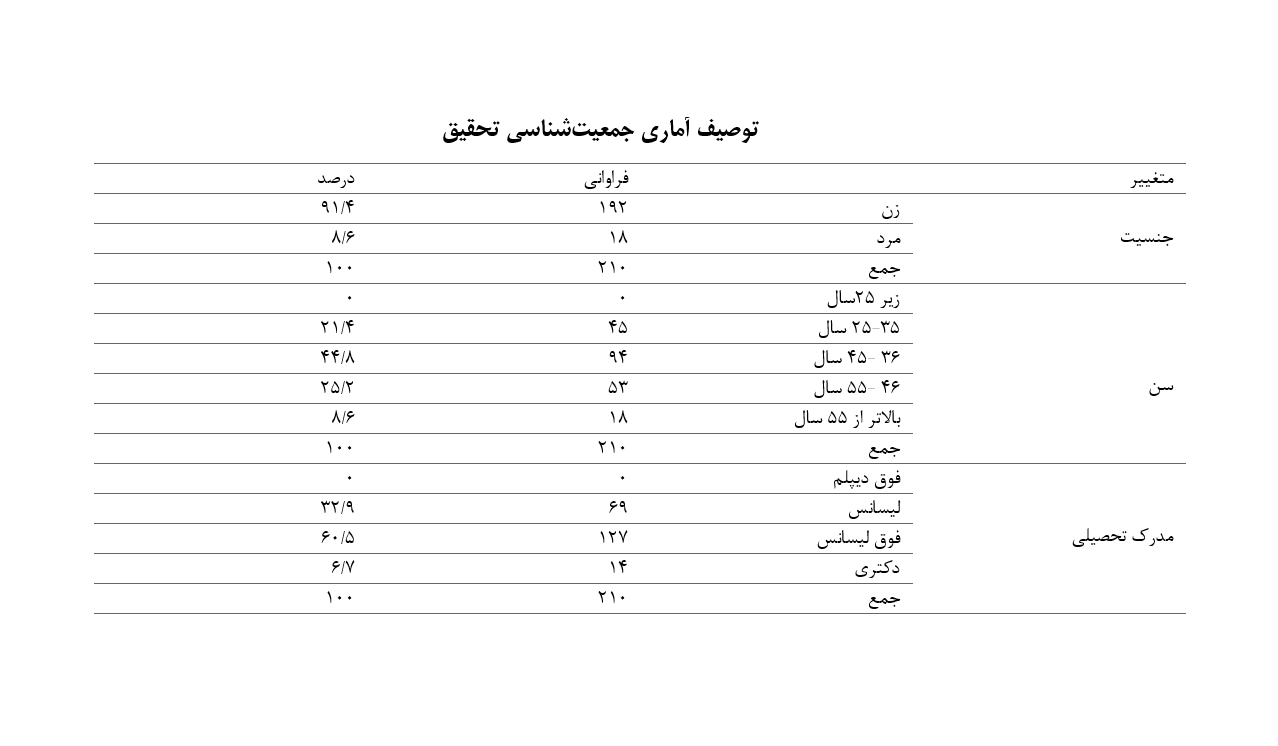
This study aimed to identify and structurally analyze glass ceiling barriers to women’s advancement to managerial positions and to examine the role of succession planning in overcoming these barriers in public organizations. This applied, descriptive–survey research targeted 210 female employees in public organizations, selected through purposive sampling. Data were collected using a researcher-designed questionnaire developed from theoretical frameworks and previous studies. Content validity and construct validity were confirmed through confirmatory factor analysis (convergent and discriminant validity), and reliability was verified by Cronbach’s alpha above 0.7. Data analysis was performed using SPSS and LISREL software through structural equation modeling. Findings revealed that cultural beliefs, male-dominated organizational structures, and the lack of formalized succession planning systems were the most significant barriers to women’s advancement. Key validated components included empowerment and skill development (factor loading 0.87), supportive organizational culture (0.91), talent identification (0.81), organizational initiative (0.63), and career progression (0.71). Competency-based succession planning and structured mentoring programs showed strong potential in overcoming glass ceilings. The proposed model demonstrated good fit indices (GFI>0.9, RMSEA<0.05). To break glass ceiling barriers and achieve gender equity in public organizations, structured and competency-driven succession planning programs are essential. Strengthening supportive organizational culture, systematically identifying female talent, and establishing clear career pathways can enhance women’s leadership development and improve overall organizational effectiveness.
References
Gallardo Pérez J, Torres M, Ruiz A. Women in EU managerial positions. European Management Journal. 2021;39(2):160-72.
Amin A, Asher B. Breaking glass ceilings in government organizations. Journal of Gender Studies. 2025;37(1):15-32.
Dowling J. Invisible barriers for women advancement. Leadership & Organization Development Journal. 2017;38(6):812-28. doi: 10.1108/LODJ-10-2015-0219.
Adamovic M, Leibbrandt A. Is there a glass ceiling for ethnic minorities to enter leadership positions? Evidence from a field experiment with over 12,000 job applications. The Leadership Quarterly. 2023;34(2):101655. doi: 10.1016/j.leaqua.2022.101655.
NaguibRabia R, Madeeha N. Making visible the invisible: Exploring the role of gender biases on the glass ceiling in Qatar's public sector. Women's Studies International Forum. 2023;98(3):102723. doi: 10.1016/j.wsif.2023.102723.
Chen S, Chen Y, Jebran K. Beyond the glass ceiling: Informal gender-based status hierarchy and corporate misconduct. Journal of Business Research. 2023;169:114281. doi: 10.1016/j.jbusres.2023.114281.
Baker J, Clark L, Nguyen T. Cultural barriers to women in management. Management Review Quarterly. 2022;72(4):489-507.
Ramazani R, Gholizadeh R, Mohammadpour T, Nazemi S, Khoramian Z, Heydari Z. Investigating the Impact of Glass Ceiling Beliefs on Barriers to Women's Advancement to Managerial Positions Among Elementary School Teachers in Esfarayen County in 2023. 2023.
Hashemipour M, Kakavand H. Title of the Article by Hashemipour. Management Research. 2023;14(2):88-104. doi: 10.4103/ijpvm.ijpvm_535_21.
Azar A, Khorami A. Providing a Framework of Success Factors for Succession Planning Programs in Knowledge-Based Organizations. 2020.
Zammit S. Building leadership pipelines for women in public administration. International Public Management Journal. 2021;24(5):589-610.
Bano Y, Omar S, Ismail F. Succession Planning Best Practices for Organizations: A Systematic Literature Review Approach. International Journal of Global Optimization and Its Application. 2022;1(1):39-48. doi: 10.56225/ijgoia.v1i1.12.
Padierna J, Lopez G, Santos E. Succession planning strategies for women. Journal of Organizational Change Management. 2020;33(4):675-92.
Akpa V, Smith J, Doe P. Women in leadership succession planning. International Journal of Public Administration. 2025;48(2):123-40.
Mahat R. Advancing women in government roles: Succession planning models. Government Leadership Journal. 2025;29(1):45-59.
Mofak M, Nazari R, Shahriari N. Explaining the Dimensions of the Glass Ceiling Facing Women in Sports Management (Qualitative Approach: Meta-Synthesis). Women in Development and Politics. 2022;20(1):109-30.
Lali Sarabi A. The Impact of Perceived Organizational Justice Reduction on the Glass Ceiling Hypothesis with Emphasis on the Role of Career Path Development. Management of Government Organizations. 2022;10(4):85-100.
Shabani M, Omidi M. Title of the Article by Shabani and Omidi. Human Resource Management. 2024;15(1):22-35.
Gano G, Boateng A. Career path and organizational behaviour impacts. African Journal of Business Management. 2012;6(4):68-75.
Imadoglu Y, Park H, Lee S. Women career advancement challenges in emerging markets. Asia Pacific Journal of Management. 2020;37(1):80-97.
Ramezani Z, Mehrpour M, Firoozian M. Examining the Impact of Glass Ceiling Beliefs on Succession Planning and Women's Leadership Styles in Managerial Positions (Case Study: Health Vice Presidency of Mashhad University of Medical Sciences). Women in Development and Politics. 2022;2(1):45-68.
Farah B, Elias R, De Clercy C, Rowe G. Leadership succession in different types of organizations: What business and political successions may learn from each other. The Leadership Quarterly. 2020;31(1):101-289. doi: 10.1016/j.leaqua.2019.03.004.
Downloads
Publication Timeline
- Submitted
- Revised
- Accepted
Issue
Section
License
Copyright (c) 2026 Mona Jahanian (Author); Farhad Nejad Haji Ali Irani (Corresponding author); Yahya Dadash Karimi, Esmaeil Omranzadeh (Author)

This work is licensed under a Creative Commons Attribution-NonCommercial 4.0 International License.