Identifying Key Priorities for Promoting Reading Culture in Generation Z: An Analysis of Family and School Dimensions Using the Fuzzy Delphi Method (A Case Study of Upper Secondary Teachers in Tehran)
DOI:
https://doi.org/10.61838/jsied.405Keywords:
Reading culture, Generation Z, Family, School, Fuzzy Delphi methodAbstract
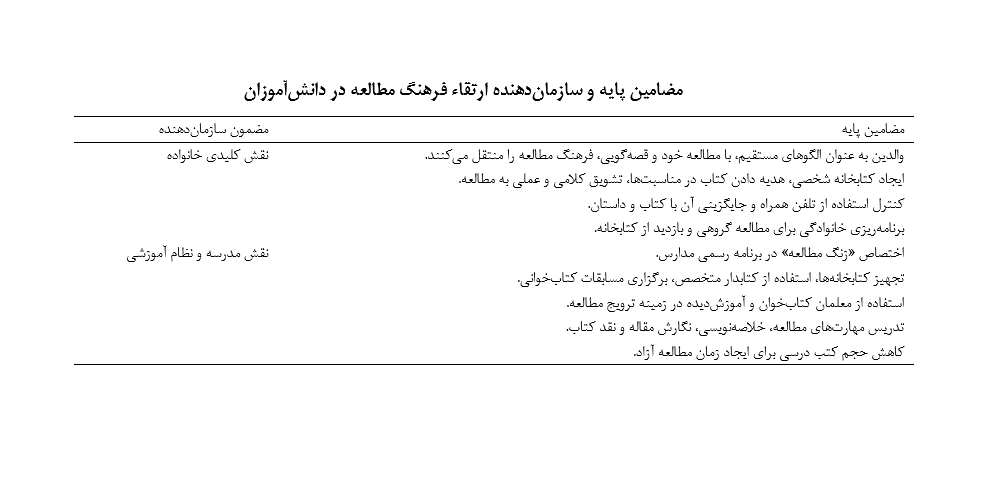
This study aims to identify and prioritize the key indicators for promoting reading culture among Generation Z with emphasis on family and school dimensions using a mixed-methods fuzzy Delphi approach. A mixed qualitative–quantitative design was employed; in the qualitative phase, 30 upper secondary teachers in Tehran were interviewed and thematic analysis yielded 40 preliminary indicators, which were subsequently validated and refined through two rounds of fuzzy Delphi involving 20 educational and cultural experts, followed by final prioritization using Friedman’s non-parametric test. Friedman test results indicated statistically significant differences among the priority levels of the reading culture indicators (p<0.01), with parental reading role modeling, committed and specialized teachers, and intrinsic reading motivation achieving the highest priority rankings, while family and school dimensions demonstrated significantly greater influence than media and individual motivational dimensions. The findings confirm that sustainable enhancement of reading culture in Generation Z fundamentally depends on strengthening family and school structures, with digital and media-based strategies functioning effectively only when anchored in these core institutional foundations.
References
Parsakia K, Rostami M, Saadati N, Navabinejad S. Analyzing the causes and factors of the difference between the girls of the generation Z and the previous generations in Iran from the perspective of social psychology. Psychology of Woman Journal. 2023;4(1):1-13. doi: 10.61838/kman.pwj.4.1.1.
Parsakia K, Rostami M, Darbani SA, Saadati N, Navabinejad S. Explanation of the concept of generation disjunction in studying generation z. Journal of Adolescent and Youth Psychological Studies (JAYPS). 2023;4(2):136-42. doi: 10.61838/kman.jayps.4.2.15.
Hammad H. Teaching the Digital Natives: Examining the Learning Needs and Preferences of Gen Z Learners in Higher Education. Transcultural Journal of Humanities and Social Sciences. 2025;6(2):214-42. doi: 10.21608/tjhss.2025.346098.1303.
Twenge JM, Campbell WK. Gen Z and Millennials: Contrasts in Reading Behavior and Media Consumption. The New Academics. 2024;15(3):210–28. doi: 10.3366/tna.2024.0027.
Dinar A. Factors of Financial Literacy, Personal Behavior, and Family on Investment Awareness of Generation Z Workers. Ecobisma (Jurnal Ekonomi Bisnis Dan Manajemen). 2024;11(2):95-109. doi: 10.36987/ecobi.v11i2.6053.
Farid AS. Dynamics of Changes in Literacy Culture in the Social Media Era: Comparative Study of the Millennial Generation and Generation Z. KnE Social Sciences. 2024;9(12):627–43. doi: 10.18502/kss.v9i12.15885.
Judijanto L, Lukmanul H, Wiwik SU, Aan A. The Impact of the BookTok Phenomenon on the Reading Habits of Generation Z. The Eastasouth Journal of Social Science and Humanities. 2025;2(02):152–60. doi: 10.58812/esssh.v2i02.473.
Blocksidge K, Primeau H. Adapting and evolving: Generation Z's information beliefs. The Journal of Academic Librarianship. 2023;49(3):102686. doi: 10.1016/j.acalib.2023.102686.
Widya J, Djunaidi A. The Effect of Language Style Selection in DETIK.COM Online News Headlines on Reading Interest of Gen Z. Ijassh. 2023;1(1):283-90. doi: 10.24912/ijassh.v1i1.25965.
Bilonozhko N, Syzenko A. Effective Reading Strategies for Generation Z Using Authentic Texts. 2020. doi: 10.31235/osf.io/rxmw7.
Ghanbari Baghestan A, Hosseinzadeh F, Gholami F. The Process of "Reduced" Identity Formation in Generation Z on Social Networks: A Case Study of Adolescent Girls in Mashhad. Cultural and Communication Studies. 2023;19(71):135-62.
Ziaee Ms, Nargesian J. Providing a Talent Retention Model among Generation Z Employees of Government Organizations. Journal of Human Resource Management. 2023;13(1):26-56. doi: 10.22034/jhrs.2023.391233.2055.
Buzzetto-More NA, Hill AJ, Banks TT. Early Findings of a Study Exploring the Social Media, Political and Cultural Awareness, and Civic Activism of Gen Z Students in the Mid-Atlantic United States [Abstract]. 2021:011. doi: 10.28945/4762.
Hoai LT, Du PT. The Impact of Cultural Factors on Online Consumer Behavior of Gen Z in Vietnam: A Study in Hanoi, Vietnam. Journal of Ecohumanism. 2025;4(2). doi: 10.62754/joe.v4i2.6567.
Downloads
Publication Timeline
- Submitted
- Revised
- Accepted
Issue
Section
License
Copyright (c) 2025 Ebrahim Kafshdar Toosi (Author); Mehran Samadi (Corresponding author); Hatef Pourrashidi Alibigloo (Author)

This work is licensed under a Creative Commons Attribution-NonCommercial 4.0 International License.