مدل حکمرانی امنیت سایبری نظام جمهوری اسلامی ایران در افق دهساله بر مبنای رویکرد آمیخته
DOI:
https://doi.org/10.61838/jsied.498کلمات کلیدی:
حکمرانی امنیت سایبری, مدلسازی ساختاری تفسیری, تحلیل MICMAC, حکمرانی دیجیتال, امنیت ملی, رویکرد آمیخته, جمهوری اسلامی ایرانچکیده
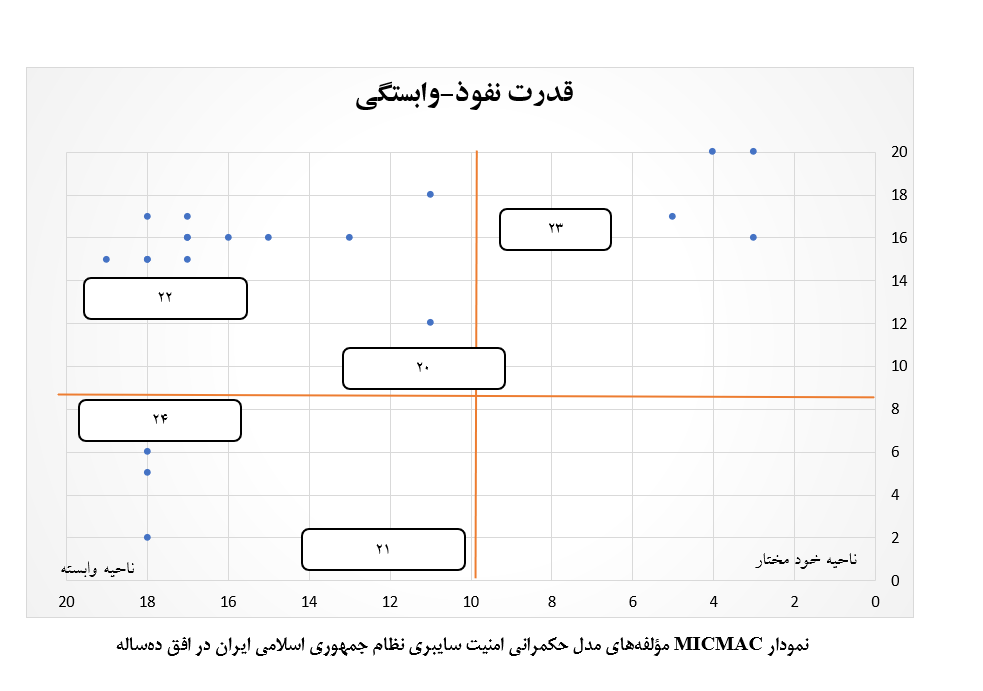
هدف پژوهش حاضر طراحی مدل حکمرانی امنیت سایبری نظام جمهوری اسلامی ایران در افق دهساله بر مبنای رویکرد آمیخته و تبیین روابط ساختاری میان مؤلفههای آن بود. پژوهش حاضر از نظر روش، آمیخته اکتشافی بود که در دو بخش کیفی و کمی انجام شد. در بخش کیفی، با استفاده از تحلیل مضمون و انجام مصاحبههای نیمهساختاریافته عمیق با 15 نفر از خبرگان حوزه امنیت سایبری، فناوری اطلاعات، سیاستگذاری و مدیریت راهبردی، ابعاد و مؤلفههای حکمرانی امنیت سایبری شناسایی شد. نمونهگیری بهصورت هدفمند و گلولهبرفی انجام گرفت و فرایند مصاحبهها تا اشباع نظری ادامه یافت. در بخش کمی، بهمنظور سطحبندی و تحلیل روابط میان مؤلفهها، از روش مدلسازی ساختاری تفسیری (ISM) و تحلیل MICMAC استفاده شد. دادههای کمی از طریق پرسشنامه مقایسه زوجی جمعآوری و روابط میان متغیرها بر اساس ماتریس خودتعاملی ساختاری، ماتریس دسترسی نهایی و تحلیل قدرت نفوذ–وابستگی بررسی گردید. یافتههای کیفی نشان داد که مدل حکمرانی امنیت سایبری دارای چهار مضمون سازماندهنده شامل تجربههای حکومتگرایی در انقلاب اسلامی، اجزا و ساختارهای مطلوب حکمرانی، هدفگذاری در افق دهساله و چالشهای حکمرانی امنیت سایبری است. نتایج ISM نشان داد که مدل دارای ساختاری هفتسطحی است که در آن مبانی ایدئولوژیک و نظری، ساختار کلان حکمرانی، نسبت دولت و جامعه و اهداف کلان دهساله بهعنوان پیشرانهای بنیادین در بالاترین سطح قرار دارند. همچنین، چالشهای فناورانه، مدیریتی، فرهنگی و ژئوپلیتیکی در پایینترین سطح مدل قرار گرفتند و بیشترین وابستگی را به سایر متغیرها داشتند. تحلیل MICMAC نیز نشان داد که متغیرهای ساختاری، سیاستی و نهادی در ناحیه نفوذی و متغیرهای زیرساختی و مدیریتی در ناحیه پیوندی قرار دارند و هیچ متغیری در ناحیه خودمختار مشاهده نشد. نتایج پژوهش نشان داد که حکمرانی امنیت سایبری در جمهوری اسلامی ایران ماهیتی چندسطحی، شبکهای و راهبردی دارد و تحقق امنیت پایدار سایبری مستلزم هماهنگی میان مبانی نظری، ساختارهای نهادی، سیاستگذاری، زیرساختهای عملیاتی، مدیریت بحران و مشارکت اجتماعی است. بر این اساس، طراحی یک مدل بومی، انعطافپذیر و آیندهنگر میتواند زمینه ارتقای تابآوری سایبری و کارآمدی حکمرانی دیجیتال کشور را فراهم سازد.
دانلودها
مراجع
1. Cowan CP, Cowan PA. When partners become parents: The big life change for couples: Lawrence Erlbaum Associates; 2020.
2. Hetherington EM, Kelly J. For better or for worse: Divorce reconsidered. 2020.
3. Lazarus A, Arun VM. Spiritual involvement, resilience, and positive mindset in adults. World Journal of Advanced Research and Reviews. 2025;26(1):799-806. doi: 10.30574/wjarr.2025.26.1.0951.
4. Cohen K, Baker S, Hoggard L. Religious coping, compassion and resilience in context of adversity. International Journal of Wellbeing. 2025.
5. Pirutinsky S, Cherniak AD, Rosmarin DH. COVID-19, mental health, and religious coping among American Orthodox Jews. Journal of Religion and Health. 2020;59(5):2288-301. doi: 10.1007/s10943-020-01070-z.
6. Chen N, Chen HC. Religion, marriage, and happiness: Evidence from Taiwan. Applied Research in Quality of Life. 2021;16(2):259-99. doi: 10.1007/s11482-019-09797-0.
7. Wheatley I. Religious service attendance and its association with well-being. Journal of Family and Community Studies. 2023;12(3):45-59. doi: 10.1080/12345678.2023.987654.
8. Kasdi A, Saifudin S. Resilience of Muslim families in the pandemic era: Indonesian millennial Muslim community's response against COVID-19. Jurnal Penelitian. 2020:81-94.
9. Fathoni A. Family resilience and implementation of Islamic family jurisprudence on millennial Muslim families in Gresik, Indonesia. Journal of Islamic Law. 2021;2(2):247.
10. Sholeh AN, Saputra N, Haymans A. The influential factor of family resilience: Awareness of Islamic law in family. Journal of Psychology and Education. 2021;38(1):3195-207.
11. Lüscher J, Pauly T, Gerstorf D, Stadler G. Having a good time together: The role of companionship in older couples' everyday life. Gerontology. 2022;68:1428-39.
12. Stadler G, Scholz U, Bolger N, Shrout PE, Knoll N, Lüscher J. How is companionship related to romantic partners' affect, relationship satisfaction, and health behavior? Using a longitudinal dyadic score model to understand daily and couple-level effects of a dyadic predictor. 2022. doi: 10.1111/aphw.12450.
13. Tong JPS, Lu S, Sing CY, Sze LCY, Lum TYS, Tse S. It was the deepest level of companionship: Peer-to-peer experience of supporting community-dwelling older people with depression: A qualitative study. BMC Geriatrics. 2022;22:443. doi: 10.1186/s12877-022-03121-4.
14. Boateng G, editor Towards real-time multimodal emotion recognition among couples. Proceedings of the 2020 International Conference on Multimodal Interaction; 2020.
15. Boateng G, Zurich E, Hilpert P, Bodenmann G, Neysari M, Kowatsch T. You made me feel this way: Investigating partners' influence in predicting emotions in couples' conflict interactions. 2021.
16. Koçak TM, Dibek BC, Polat EN, Kafesçioğlu N, Demiroğlu C. Automatic detection of attachment style in married couples through conversation analysis. EURASIP Journal on Audio, Speech, and Music Processing. 2023:26. doi: 10.1186/s13636-023-00291-w.
17. Birni G, Eryilmaz A. Enhancing well-being of the married: Investigating marital satisfaction, self-compassion and happiness increasing strategies. Turkish Psychological Counseling and Guidance Journal. 2022;12(67):650-68.
18. Carreno DF, Eisenbeck N, Greville J, Wong PTP. Cross-cultural psychometric analysis of the Mature Happiness Scale-Revised: Mature happiness, psychological inflexibility, and the PERMA model. Journal of Happiness Studies. 2023;24:1075-99.
19. Sattarzadeh Jahdi N, Hakimi S, Shakbaeifar M. The effect of sexual assertiveness training on marital satisfaction and happiness of Azari women: A semi-experimental study. Medical Journal of Tabriz University of Medical Sciences. 2024;46(2):188-98. doi: 10.34172/mj.2024.025.
20. Pudjiati SRR, Reksodiputro SHD, Purwono RU. Family resilience model: The influence of cultural identity, coping, family strain, socioeconomic status, and community support on family resilience among the Batak Toba ethnic group. Makara Human Behavior Studies in Asia. 2021;25(2):153-69. doi: 10.7454/hubs.asia.1131121.
21. Nurdin R, Ridwansyah M, Iskandar Z. Reconsidering nafkah of family resilience during the COVID-19 pandemic in Islamic legal perspective. Journal Ilmu-Ilmu Keislaman. 2021;45(1).
22. Hidayati TW, Susilawati U, Sriani E. Dynamics of family fiqh: The multiple roles of women in realizing family resilience. Wacana Hukum Islam dan Kemanusiaan. 2022;22(2):219-38.
23. Tan W, Guo B, Zhang Q. Cybersecurity Governance and Corporate Market Value: Perspectives from Investor Trust and Supply Chain Trust. Pacific-Basin Finance Journal. 2025;90:102646.
24. Xu J. Cybersecurity Governance and Corporate Innovation: Evidence from China. Finance Research Letters. 2025;82:107619.
25. Qudus L. Cybersecurity Governance: Strengthening Policy Frameworks to Address Global Cybercrime and Data Privacy Challenges. International Journal of Science and Research Archive. 2025;14(1):1146-63.
26. Bokhari SAA, Myeong S. The Influence of Artificial Intelligence on E-Governance and Cybersecurity in Smart Cities: A Stakeholder’s Perspective. IEEE Access. 2023.
27. Adaji C, Bello A, Ukatu C, Okika N, Agboola O, Amomo CG. AI-Powered Cybersecurity Governance: The Role of Business Analysts in Ethical AI Deployment. International Journal of Innovative Science and Research Technology. 2025;10(3):1384-96.
28. Martínez EM, Castro SV, Buenaño JEJ, Meléndez MCE, Armas DGA, Portero RN. An Approach to Artificial Intelligence Tools and the Legal Basis for Cybersecurity Governance. Intelligent Sustainable Systems: Selected Papers of WorldS4 2025, Volume 3. 32026. p. 63.
29. Pan Q, Luo W, Liu Z, Zhang JZ. Digital Platform Governance: Literature Review and Research Outlook. Journal of Organizational Computing and Electronic Commerce. 2025;35(4):407-31.
30. Abyati A, Ahmadi M, editors. Emerging Security Threats in Cyberspace: A Case Study of the 2019 Protests. Specialized Conference on Monitoring Emerging Military Threats in the Second Step of the Islamic Revolution; 2021; Qom.
31. Akhtari K, Mousavi SAA. A Comparative Comparison of Cybersecurity and Information Security Maturity Models and Identification of Common Cybersecurity Indicators. Passive Defense Quarterly. 2023;13(4):21-38.
32. Tatar U, Karabacak B, Gheorghe A. An Assessment Model to Improve National Cyber Security Governance. 11th International Conference on Cyber Warfare and Security: ICCWS20162016. p. 312.
33. Fidler B. Cybersecurity Governance: A Prehistory and Its Implications. Digital Policy, Regulation and Governance. 2017;19(6):449-65.
34. Singh M, Srivastava S, Mahanandia R. Leadership and Cybersecurity Governance: Building a Human-Centric Protective Culture in the Digital Age. The Human Dimension of Cybersecurity: Cultivating a Protective Organizational Culture: IGI Global Scientific Publishing; 2026. p. 1-28.
35. Mijwil M, Filali Y, Aljanabi M, Bounabi M, Al-Shahwani H. The Purpose of Cybersecurity Governance in the Digital Transformation of Public Services and Protecting the Digital Environment. Mesopotamian Journal of Cybersecurity. 2023;2023:1-6.
36. Melaku HM. A Dynamic and Adaptive Cybersecurity Governance Framework. Journal of Cybersecurity and Privacy. 2023;3(3):327-50.
37. Khoshhalpour E. A Review of Cyberspace Layering Models and the Proposal of a New Model. Science and Technology Policy Letter. 2025;15(2):96-114.
38. Sepehrnia R, Alborzi M, Kermanshah A, Azar A, Sepehrnia R. A Creative Model of Good Governance Transparency for Policy-Making Organizations in Iran. Innovation and Creativity in Human Sciences. 2019;9(2):77-102.
39. Ambarwati R, Mudjib AW, Lestariana FF, Handiwibowo GA. The Implications of Good Governance of Village Government Office in Sidoarjo. Binus Business Review. 2019;10(3):147-58.
40. Montazeri M, Bahmani A, Fathizadeh A. The Model of Good Governance from the Perspective of Nahj al-Balagha: A Step toward Explaining the Islamic-Iranian Model of Progress. Islamic-Iranian Progress Model. 2018;6(11):133-55.
41. Kyere M, Ausloos M. Corporate Governance and Firms Financial Performance in the United Kingdom. International Journal of Finance & Economics. 2021;26(2):1871-85.
42. Khatib SF. An Assessment of Methods to Deal with Endogeneity in Corporate Governance and Reporting Research. Corporate Governance: The International Journal of Business in Society. 2025;25(3):606-30.
43. Mishra N. The Trade: (Cyber) Security Dilemma and Its Impact on Global Cybersecurity Governance. Journal of World Trade. 2020;54(4).
44. Jomo KS, Chowdhury A. World Bank Financializing Development. Development. 2019;62(1):147-53.
45. Talebi, Taghavi, Rahmati. A Human-Centered Cognitive Model of Cybersecurity. Defense Human Capital Management. 2022;2(2).
46. Gani ABD, Fernando Y. The Cybersecurity Governance in Changing the Security Psychology and Security Posture: Insights into E-Procurement. International Journal of Procurement Management. 2021;14(3):308-27.
47. Hasan KF, Hughes W, Rahman Tory A, Campbell C, Turkay S. Game On: A Developmental Approach to UNSW Cyber Escape Room for Cybersecurity Governance and Policy Education. Education Sciences. 2026;16(1):133.
48. Della Spina L. Community Branding and Participatory Governance: A Glocal Strategy for Heritage Enhancement. Heritage. 2025;8(6):188.
دانلودها
گاهشمار انتشار
- ارسال
- بازنگری
- پذیرش
شماره
نوع مقاله
مجوز
حق نشر 2025 Hossein Jangravi (Author); Jamal Aberoumand (Corresponding author); Mohammad Reza Arab baferani (Author)

این پروژه تحت مجوز بین المللی Creative Commons Attribution-NonCommercial 4.0 می باشد.