Identifying Dimensions and Multidimensional Explanation of Managerial Competencies among Heads of Academic Departments in Higher Education: A Grounded Theory Approach with Empirical Confirmation through Q Analysis
DOI:
https://doi.org/10.61838/jsied.351Keywords:
Group Manager, Competency Dimensions, Delphi Method, Q-Analysis, Higher EducationAbstract
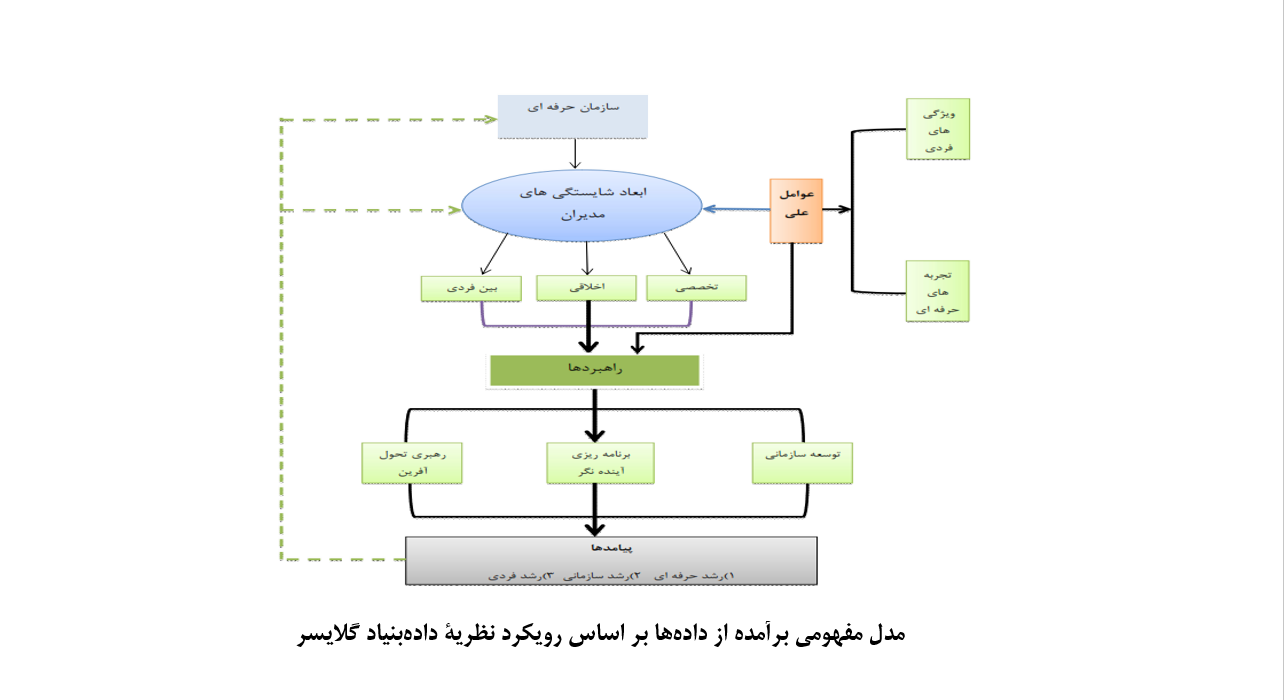
The present study was conducted with the aim of identifying and explaining the multidimensional competencies of department heads in universities and higher education institutions in Iran. The necessity of this research arises from the fact that in many universities, the appointment of department heads is often based more on academic seniority or teaching experience than on managerial and leadership competencies. This issue highlights the need to develop an evidence-based framework for the selection and professional development of academic department heads. The study is exploratory in nature and follows a qualitative grounded theory approach using the Glaserian method. Data were collected through in-depth semi-structured interviews with 20 experts, department heads, faculty members, and higher education specialists. Theoretical saturation was achieved after the fifteenth interview, but data collection continued up to the twentieth participant to ensure accuracy. Sampling was conducted purposefully and relatively stratified among public universities in Tehran. Data analysis was carried out in three stages—open, theoretical, and selective coding—according to Glaser’s model. To validate and stabilize the extracted concepts, the Delphi method was applied, followed by Q analysis in the final step. Findings revealed that the managerial competencies of academic department heads can be explained within six main dimensions: ethical, interpersonal, technical, professional, organizational, and executive–managerial competencies. Each dimension includes components such as professional commitment and integrity, self-awareness, continuous learning, research ability, strategic decision-making and planning, resource management, educational leadership, effective communication, and conflict management. The integration of the Glaserian qualitative approach with the Delphi process and Q analysis in this study led to conceptual coherence and ensured the theoretical robustness of the developed model—a methodological combination rarely employed in higher education leadership competency research. The results indicated that the final model enjoys desirable content validity and composite reliability, and can serve as an evidence-based framework for merit-based selection, professional development of academic department heads, and the enhancement of educational and research quality in universities.
Downloads
References
Parker J, Ventura HR, Hendon CI. Academic leadership in career colleges: Styles, style adaptability, preparedness, and prior experience. The Community College Enterprise. 2022;28(2):35-54.
Kruse SD. Department chair leadership: Exploring the role’s demands and tensions. Educational Management Administration & Leadership. 2022;50(5):739-57. doi: 10.1177/1741143220953601.
Kruse SD, Hackmann DG, Lindle JC. Academic leadership during a pandemic: Department heads leading with a focus on equity. Frontiers in Education. 2020;5:614641. doi: 10.3389/feduc.2020.614641.
Kinnunen P, Ćukušić M, Karjalainen A, Soini T. Bringing clarity to the leadership of teaching and learning in higher education: A systematic review. Journal of Applied Research in Higher Education. 2024. doi: 10.1108/JARHE-06-2022-0200.
Taheri M. Identification of required competencies of academic department heads in Iranian universities. Quarterly Journal of Research and Planning in Higher Education. 2020;26(2):115-40.
Aboramadan M, Dahleez K. Inclusive leadership in higher education: An approach to encourage management innovation and a climate for creativity. In: Marques J, Dhiman S, editors. Leading with diversity, equity and inclusion: Springer; 2022.
Mohamed Jais IR, Azman AM, Ghani EK. Quantifying the higher education leadership competency framework for talent management in Malaysia. Journal of Education and e-Learning Research. 2022;9(4):288-95. doi: 10.20448/jeelr.v9i4.4303.
Niewiesk S. The academic leadership framework: A guide for improving administrative processes within a university. Journal of Organizational Excellence. 2021. doi: 10.1002/joe.22083.
Balwant PT. Transformational instructor-leadership in higher education teaching: A meta-analytic review and research agenda. Journal of Leadership Studies. 2016;9(4):20-42. doi: 10.1002/jls.21423.
Gigliotti RA. The impact of COVID-19 on academic department chairs: Heightened complexity, accentuated liminality, and competing perceptions of reinvention. Innovative Higher Education. 2021;46(4):429-44. doi: 10.1007/s10755-021-09545-x.
Philip J, Gilli K, Knappstein M. Identifying key leadership competencies for digital transformation: Evidence from a cross-sectoral Delphi study of global managers. Leadership & Organization Development Journal. 2023;44(3):392-406. doi: 10.1108/LODJ-02-2022-0063.
Mobley JS. 4 essential leadership competencies department chairs need to lead in the new normal. Academic Impressions. 2022.
Khorsandi M, Ahmadi H, Rezaei S. Designing a competency model for faculty deans with an emphasis on university governance. Iranian Journal of Higher Education Research. 2025;17(2):45-68.
Fathi Vajargah K. Beyond reconceptualization: Recontextualization and multicontextualization of curriculum studies in Iran (Toward new curriculum ecosystems). Transnational Curriculum Inquiry. 2020;17(2):57-72.
Fathi Vajargah K. The re/multicontextualization of curriculum studies in the new century. Journal of Curriculum Studies. 2022;17(65):7-26. doi: 20.1001.1.17354986.1401.17.65.2.0.
Wolverton M, Gmelch WH. College department chairs: Leading at the crossroads of pedagogy and management. Hoboken, NJ: Wiley; 2021.
Abdollahī S. Investigating the Managerial Competencies of Educational Group Managers in Medical Sciences Faculties. Quarterly Journal of Health System Management. 2022;10(3):45-66.
Naderifar M, Goli H, Ghaljaie F. Snowball sampling: A purposeful method of sampling in qualitative research. Strides in Development of Medical Education. 2017;14(3):e67670. doi: 10.5812/sdme.67670.
Tāherī M. Identifying the Required Competencies for Educational Group Managers in Iranian Universities. Quarterly Journal of Research and Planning in Higher Education. 2020;26(2):115-40.
Gidman W. Developing the academic department head role: Exploring required competencies and challenges. Higher Education Management and Policy. 2023;35(1):45-67.
Humphrey-Murto S, Varpio L, Wood TJ, Gonsalves C, Ufholz LA, Mascioli K, et al. The use of Delphi and other consensus group methods in medical education research: A review. Academic Medicine. 2017;92(10):1491-8. doi: 10.1097/ACM.0000000000001812.
Younger M, Gascoine L, Menzies V, Torgerson C. A systematic review of the role of senior academic leaders in higher education. Educational Management Administration & Leadership. 2017;45(6):1021-42.
Zabala A, Sandbrook C, Mukherjee N. When and how to use Q methodology to understand perspectives in conservation research. Conservation Biology. 2018;32(5):1185-94. doi: 10.1111/cobi.13123.
Kinnunen P. Bringing clarity to the leadership of teaching and learning in higher education. Journal of Applied Research in Higher Education. 2024;16(1). doi: 10.1108/JARHE-06-2022-0200.
Fathi Vajargah K. Toward third wave of curriculum studies in Iran: A re-contextualisation movement. Journal of Higher Education Curriculum Studies. 2019;9(2).
Fathi Vajargah K. Theoretical foundations of re/multicontextualisation of curriculum studies ecosystems: From the idea of aquarium curriculum to a theory of multiverse curriculum studies. Journal of Curriculum Studies. 2021;11(22):89-98.
Creswell JW. Research design: Qualitative, quantitative, and mixed methods approaches. 4th ed2014.
Lincoln Y, Guba E. Naturalistic inquiry. Beverly Hills: Sage; 1985.
Creswell JW, Poth CN. Qualitative inquiry & research design: Choosing among five approaches: SAGE; 2018.
Fathi Vajargah K. Exploring lived curriculum in higher education: Toward a conceptual model. Journal of Techniques, Technologies and Education Management. 2011;6(1):83-91.
Corbin J, Strauss A. Basics of qualitative research: Techniques and procedures for developing grounded theory: SAGE; 2015.
Charmaz K. Constructing Grounded Theory. 3rd ed: SAGE Publications; 2021.
Birks M, Mills J. Grounded theory: A practical guide2022.
Glaser BG. Getting out of the data: Grounded theory conceptualization: Sociology Press; 2020/2011.
Aboramadan M. Inclusive leadership and extra-role behaviors in higher education: Does organizational learning mediate the relationship? International Journal of Educational Management. 2022;36(4):397-417. doi: 10.1108/IJEM-06-2020-0290.
Bedi A, Alpaslan CM, Green S. A meta-analytic review of ethical leadership and its relationships with leader, member, and organizational outcomes. Journal of Business Ethics. 2016;139(3):517-36. doi: 10.1007/s10551-015-2625-1.
Bryson JM. Strategic Planning for Public and Nonprofit Organizations: Jossey-Bass; 2018.
Brinkley-Etzkorn KE, Lane I. From the ground up: Building a system-wide professional development and support program for academic department chairs. Studies in Higher Education. 2019;44(3):571-83. doi: 10.1080/03075079.2017.1389877.
Alīzādeh S, Sohrābī Z, Soltāni-Arabshāhī K, Kouhpāyezādeh Esfahāni J, Kouhestānī HR. Core Competencies for Academic Leaders in Iran University of Medical Sciences: A Delphi Study. Iranian Journal of Medical Sciences. 2019;26(6):857-68.
Abbaspour M, Emami Meybodi A, Rahimian A, Ghiasi Nodooshan M. Designing a leadership competency model in public universities of Tehran. Human Resource Management Researches. 2019;11(2):137-66.
Gilli K, Nippa M, Knappstein M. Leadership competencies for digital transformation: An exploratory content analysis of job advertisements. German Journal of Human Resource Management. 2023;37(1):50-75. doi: 10.1177/23970022221087252.
Niță V, Guțu I. The role of leadership and digital transformation in higher education students' work engagement. International Journal of Environmental Research and Public Health. 2023;20(6):5124. doi: 10.3390/ijerph20065124.
Marzban A, Ahmadi. A study on the relation between development and organizational commitment in Marvdasht Islamic Azad University faculty members. Archives des Sciences. 2012;65(2):215-28.
Downloads
Publication Timeline
- Submitted
- Revised
- Accepted
Issue
Section
License
Copyright (c) 2025 Fatemeh Marzban (Author); Kourosh Fathi Vajargah (Corresponding author); Ali Khorsandi Taskoh, Abbas Abbaspour (Author)

This work is licensed under a Creative Commons Attribution-NonCommercial 4.0 International License.