Designing a Leadership Skills Development Model Using Neuro-Linguistic Programming (NLP) in Government Companies
DOI:
https://doi.org/10.61838/jsied.372Keywords:
Leadership skills, Developing leadership skills, Neuro-linguistic programming (NLP)Abstract
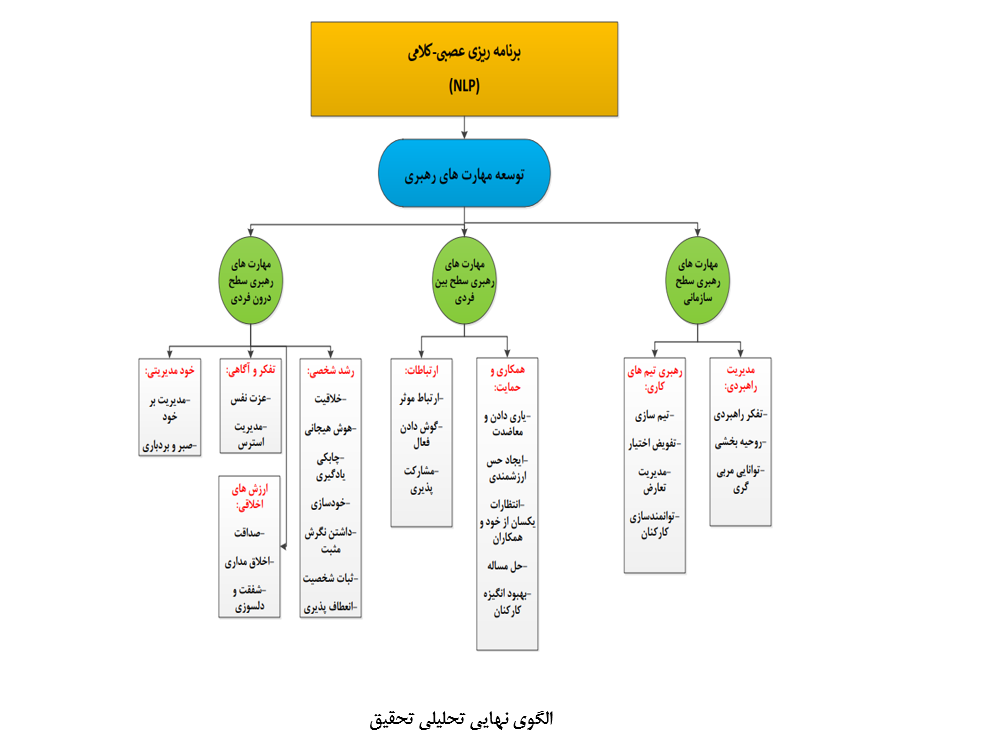
This study aimed to design and validate a leadership skills development model using neuro-linguistic programming (NLP) techniques in state-owned companies, focusing on Iran Insurance Company. This developmental and quantitative research was conducted in two phases. In the first phase, key indicators, components, and dimensions of leadership skill development were identified through a systematic review and a Delphi process involving 25 NLP experts. In the second phase, a researcher-made questionnaire was distributed among 152 managers of Iran Insurance Company, and data were analyzed using inferential statistics such as KMO and Bartlett’s tests, confirmatory factor analysis (CFA), and analytic hierarchy process (AHP). The Cronbach’s alpha of 0.87 and a CVR value above 0.37 confirmed the reliability and validity of the instrument. The designed NLP-based leadership development model consisted of three dimensions (intrapersonal, interpersonal, and organizational), eight components, and 29 indicators. AHP results revealed that intrapersonal leadership skills ranked highest (weight = 0.279), followed by organizational (0.254) and interpersonal (0.172) skills. Among components, “self-management” (0.433) and “thinking and awareness” (0.421) held the highest importance. CFA confirmed the model’s goodness of fit with the data. NLP techniques effectively enhance leadership skills among managers in governmental organizations. Integrating NLP-based training into leadership development programs can strengthen individual, interpersonal, and organizational competencies, leading to improved performance, adaptability, and innovation in public sector leadership.
Downloads
References
Kouzes J, Posner B. The Leadership Challenge. Asgari N, Qurani F, editors. Tehran: Danesh-e Mandegar-e Asr Publishing; 2023. 403 p.
Muschard B, Rozenfeld H, Guzmán VE, Gerolamo M, Kohl H, editors. Characteristics and Skills of Leadership in the Context of Industry 4.0. Procedia Manufacturing; 2020.
Dowlen A. NLP-help or hype? Investigating the uses of neuro-linguistic programming in management learning. Career Development International. 1996;1(1):27-34. doi: 10.1108/13620439610111408.
Lazarus J. NLP for Business Success: How to get better results faster at work. London: Hodder& Stoughton Ltd; 2011. 220-4 p.
Larson A. Nlp:The Essential Guide to Neuro-linguistic Programming (Fast and Easy Neuro Linguistic Programming Techniques to Change Your Life)2023.
Jackson B, Parry K. A Very Short, Fairly Interesting and Reasonably Cheap Book about Studying Leadership. Australia: SAGE Publications Ltd; 2018. 200 p.
McCleskey JA. Situational, Transformational, and Transactional Leadership and Leadership Development. Journal of Business Studies Quarterly. 2014;5(4):117-30.
Taherpour F, Nasehian H. Analyzing the Relationship Between Sustainable Leadership Skills and Co-creation with the Mediation of Cognitive Trust Among Faculty Members of Birjand University. Quarterly Journal of Public Management Perspective. 2022;13(4):35-59. doi: 10.52547/jpap.2022.227484.1194.
Godarzvand Chegini M, Yousefi S. Explaining the Relationship Between Managers' Leadership Styles and Organizational Health (Case Study: Rasht Municipality). Biannual Journal of Psychological Research in Management. 2018;4(1):127-49.
Manfred FRdVK. Developing Leaders and Leadership Development. SSRN Electronic Journal. 2010.
Amandeep N. Role of Neuro Linguistic Programming (NLP) in Training and Development of Employees. Global journal of Enterprise Information System. 2018;10(3).
O'Connor J. The NLP Book Guidelines2001. 1-295 p.
Lavan I. NLP in business-or more than a trip to the zoo. Industrial and Commercial Training. 2002;34(5):182-7. doi: 10.1108/00197850210437102.
Yemm G. Can NLP help or harm your business? Industrial and Commercial Training. 2006;38(1):12-7. doi: 10.1108/00197850610645990.
Ahmed H. Improving Leadership Skills by Using Neuro Linguistic Programming (NLP). VAASA: University Of VAASA, Faculty Of Business Studies Department; 2017.
Akhtar F. Impact of Neuro-Linguistic Programming and Coaching on Employee Learning. P J M H S. 2019;13(4).
Nurhayati AS, Irmawan R. The Role of Leader in coaching through Neuro-Linguistic Programming approach. budapest International Research and Critics Institute-Journal (BIRCI-Journal). 2022;5(2):12082-94.
Mohamed Mahdy F, Binzafrah F, Alqahtani M. A Structural Framework for Neuro-Linguistic Programming (NLP) and its Consequence on Leadership Succession Planning Strategy Applying to the Leaders of King Khalid University and Qualified Personnel for Leadership Position. business Ethics and Leadership. 2022;6(2):24-43. doi: 10.21272/bel.6(2).24-43.2022.
Muller CR, Pelse TG. A proposed leadership skills development model for African FMCG business-Networks. South African Journal of Economic and Management Sciences. 2022;25(1). doi: 10.4102/sajems.v25i1.4303.
Binder M. How to Use Neuro-linguistic Programming (NLP) Techniques2025.
Sonqishe LE. Neuro-Linguistic Programming (NLP) in Professional Development: A Guide in 8 Steps2023.
Ahmed A, Pollitt A. The Support Model for interactive assessment. Assessment in Education Principles Policy and Practice. 2010;17(2):133-67. doi: 10.1080/09695941003694425.
Hosseinpour M, Hasani F. Comparing the Effectiveness of Neuro-Linguistic Programming (NLP) Training and Transactional Analysis on the Managerial Efficacy of Managers. Management Studies for Improvement and Transformation. 2021;30(102):376.
Ebrahimi Moghaddam H, Noei Sagarloo A, editors. Determining the Effectiveness of Neuro-Linguistic Programming (NLP) Skills on Anxiety and Resilience. Annual Conference on New Research Approaches in Humanities; 2015.
Seifi P. Investigating the Impact of Neuro-Linguistic Programming (NLP) on Employee Job Satisfaction (Case Study: Pasargad Insurance). Tehran: Payame Noor University of Tehran Province, West Tehran Payame Noor Center; 2018.
Anjam Shoa MR, Faheim Dovin H, Esmaeilzadeh MR, Keshtidar M. The Effect of a Training Course in Neuro-Linguistic Programming, Ethical Teachings, and Aquatic Exercise on Job Stress, Positive Organizational Behavior, and Job Motivation of Physical Education Teachers in Razavi Khorasan. Quarterly Journal of Sports Sciences. 2019;11(33).
Jose Hejase H, Hashem F, El Majzoub Dit Tartozi MI. Neuro-Linguistic Programming And Leadership: An Explorotary Study On Lebanese Management. European Journal of Business and Social Sciences. 2015;4(09):121-55.
Verlinden N. 18 Key Leadership Competencies for 2025 Success2025.
Joey L, Yazdanifard R. Can Neuro-Linguistic Programming (NLP) be used as contemporary and effective skill for an exceptional manager in an organization? International Journal of Management, Accounting and Economics. 2015;2(5):457-66.
Kotera Y, Van Gordon W. How Japanese managers use NLP in their daily work. In: Machado C, Davim P, editors. Emotional intelligence and neuro-linguistic programming: New insights for managers and engineers2019. p. 53-72.
Yousaf M, Chaudhry H, Haider A, editors. Leading Through NLP. International Conference on Information Management and Engineering; 2009.
Hedayat N, Raissi R, Azizzadeh Asl S. Neuro-linguistic Programming and Its Implications for English Language Learners and Teachers. Theory and Practice in Language Studies. 2020;10(9):1141-7. doi: 10.17507/tpls.1009.19.
Kazemi N, Heidari M. The Relationship Between Ethical Leadership, Organizational Legitimacy, Organizational Hypocrisy, and Work-Related Outcomes of Teachers. Journal of Educational Leadership and Management. 2021;15(2):97-119.
Oberholzer C. The role of NLP in improving organizational leadership through intrapersonal communication development. Pretoria: University of Pretoria-faculty of economic and management sciences; 2013.
Downloads
Publication Timeline
- Submitted
- Revised
- Accepted
Issue
Section
License
Copyright (c) 2025 Alireza Nikmaram (Author); Nour mohammad Yaqhoubi (Corresponding author); Habibollah Salarzehi, Esmaeel Asadi, Abdolsamad khodami (Author)

This work is licensed under a Creative Commons Attribution-NonCommercial 4.0 International License.