Developing an Optimal Model for Virtual Citizenship Education Based on the Fundamental Transformation Document of Education and Upstream Documents: A Grounded Theory Approach
DOI:
https://doi.org/10.61838/jsied.397Keywords:
development document of the government's seventh plan, national curriculum , fundamental transformation document , Educating a virtual citizenAbstract
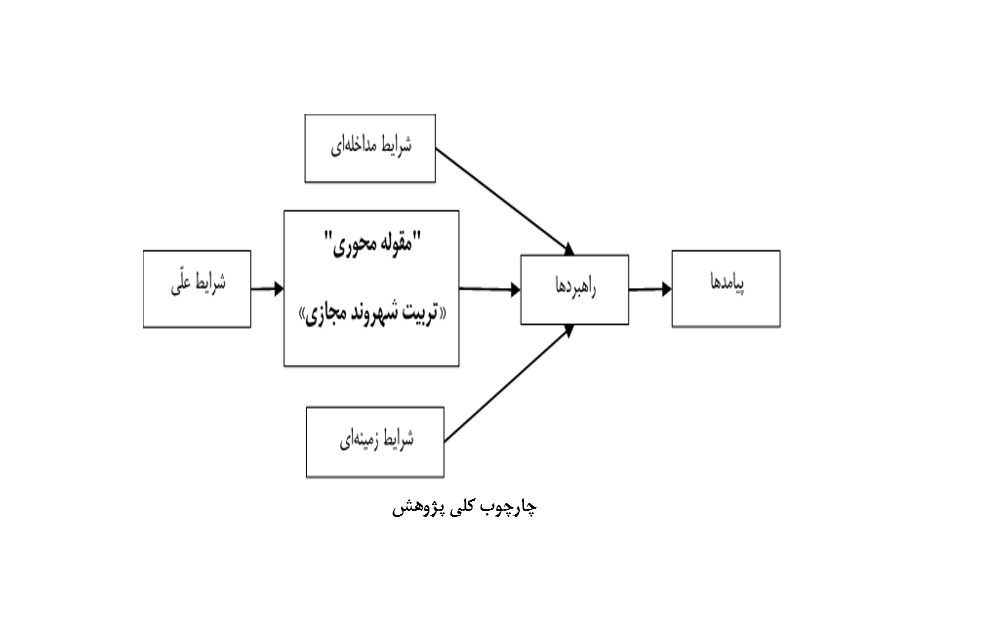
This study aimed to develop an optimal model of virtual citizenship education based on the Fundamental Transformation Document of Education and other upstream policy documents. This applied research employed a qualitative grounded theory methodology. Data were extracted through content analysis of three key documents: the Fundamental Transformation Document of Education, the National Curriculum, and the Seventh Development Plan Document. Open, axial, and selective coding were performed to identify initial components. To validate the extracted components, the Delphi technique and purposive sampling were used, involving semi-structured interviews with 20 academic and executive experts in the field of education. The final model was constructed by classifying components across causal, contextual, intervening, strategic, and consequential dimensions. Analysis initially identified 92 indicators, which were refined to 75 final indicators following the integration of overlapping items. These indicators were organized into five major dimensions: causal factors, contextual factors, intervening conditions, strategic actions, and consequences. Across three Delphi rounds, experts demonstrated strong consensus regarding the importance and prioritization of components (Kendall’s coefficient in the third round ranged from 0.741 to 0.803). The final structural model conceptualizes the interrelationships among the components and explains how virtual citizenship can be effectively developed within the education system. Findings indicate that upstream educational documents possess substantial implicit and explicit capacity for guiding virtual citizenship education. Combining document analysis with expert validation resulted in a comprehensive and coherent model aligned with the practical needs of the educational system. Successful implementation of this model requires attention to technological infrastructure, student self-awareness, effective school management, digital regulations, and strategies that enhance social responsibility.
Downloads
References
Webster J. Sociotechnical Imaginaries in a Postdigital World: Teachers' Perceptions of Digital Citizenship Education. Postdigit Sci Education. 2025. doi: 10.1007/s42438-025-00557-w.
Lomachinska I, Dobrodum O, Ishchuk O, Patlaichuk O, Stupak O, Shnitser M, et al. Digital Citizenship and Knowledge Management in Education: Strategic Pathways to Sustainable Development. European Journal of Sustainable Development. 2025;14(2):747. doi: 10.14207/ejsd.2025.v14n2p747.
Hosseini Al-Madani SA. The Relationship Between Using Virtual Networks and Mental Health and Isolationism Among Female Secondary School Students. Sociology of Education. 2019(11):32-40.
Zamani Dashti M. The Rate of Social Network Use and its Relationship with Parent-Child Conflict and Tendency towards High-Risk Behaviors among First-Level Secondary School Students in Shahrekord County: Islamic Azad University, Khomein Branch; 2017.
Badakhshan Taraghi E, Soleimanpour M, Fazli R. Meta-Synthesis of Factors for Quality Improvement of Education in Multi-Grade Primary Classrooms. Scientific-Research Quarterly of Education. 2023;39(2):161-84.
Haqiri Limoudehi R, Abdollahi M, Habibi S. Presenting an E-Learning Implementation Model with an Omnichannel Approach in Second-Level Secondary Schools. Research and Innovation in Education and Development. 2024;4(5):139-56. doi: 10.61838/jsied.4.5.8.
Najafi F. Investigating the Effectiveness of Self-Care Education in Virtual Space for Students on Dimensions of Health (Physical, Psychological, and Social): Payame Noor University: Zarrin Shahr Branch; 2024.
Gholami A, Pirhadi M. Challenges of Reputation Restoration in Virtual Space. Scientific-Research Bimonthly of Religion and Communication. 2017;24(2):15-28.
Taheri Mobarakeh M, Salami M, Hashemian MR, Norouzi A. The Impact of Social Networks on the Mental Health of Library Users at Al-Zahra Educational-Medical Center of Isfahan University of Medical Sciences in 2015. Health Management. 2016;19(66):71-80.
Javahəri SA, editor Computer and Virtual (Cyber) Crimes and Solutions for Detecting These Crimes with an Approach to Digital Currency. The First International Conference on Law, Management, Educational Sciences, Psychology, and Educational Planning Management; 2023; Tehran.
Razeghipour Y, Hashemi SA, Ranjbar M, Gholtash A. Presenting a Desirable Model for E-Citizen Education with Attention to the Philosophical Foundations of Citizenship Education. Islamic Lifestyle with a Focus on Health. 2021;5(2):152-66.
Farhadi E, Kasraei MS, Tavasoli Roknabadi M. Citizenship Education in the Fundamental Transformation Document of the Education System of the Islamic Republic of Iran. Political Sociology of the Islamic Revolution. 2023;4(2):211-31.
Razeghipour Y, Hashemi A, Ranjbar M, Gholtash A. Explaining the Principles and Philosophical Foundations of E-Citizen Education. Political Sociology Monthly. 2022;5(10):2223-39.
Hosseini SM, Fathi Vajargah K, Haghani M, Arefi M, Rezaeizadeh M. The Status of Virtual Citizen Education in the Official Curricula of the Primary School Period of Iran's Educational System. Educational Sciences. 2021;28(1):229-52.
Garaei Garavand Y, Asmandareh H, Garaei Garavand P. Analysis of Challenges and Obstacles to Digital Citizen Education and Training in the Educational System (A Qualitative Study). Journal of New Advances in Behavioral Sciences. 2022;7(55):237-46.
Cheraghi Kazerouni R, Alborzi M, Khoshbakht F. Developing an Educational Package for Citizenship Education in the Field of Social Relations for Primary School Students. National Studies Quarterly. 2023;24(2):57-74.
Zarimoghadam Z, Davoodi H, Ghaffari K, Jamilian HR. The Effectiveness of Psychological Self-Care Education on Mental Health and Academic Engagement of Second-Level Secondary School Students. Arak University of Medical Sciences Journal. 2021;24(1):150-67. doi: 10.32598/jams.24.1.6155.1.
Hatami J, Shahabi SS, Talaei E, Sajjadi SM. Designing and Validating a Desirable Curriculum Model for Digital Citizenship Education with an Integrated Approach in the Secondary School Period. Management and Planning in Educational Systems. 2023;16(2):89-112.
Hosseinzadeh R, Ali Asgari M, Abbasi E, Ghaderi M. Designing an E-Citizen Education Curriculum for the Primary School Period. Research in Curriculum Planning. 2024;20(2):1-23.
Abbasi K. Internet Fear: A Virtual Whirlpool, A Look at the Negative Aspects of Using Virtual Space. Roshd School Counselor Education. 2023;18(65):17-21.
Shariari H, Rahbar S. Digital Citizen and its Relations with the State in the Digital Age (With a Look at Objective Examples). Political and International Approaches. 2023;14(4):229-53.
Davoodian OL, Panahian M, Sattari A. Comparative Comparison of Citizenship Education Components in Virtual and Real Space with a Look at Opportunities and Threats. New Educational Thoughts. 2020;16(4):183-216.
Esfandiari M, Imankhan N. Analysis of Bank Customers' Behavior: A Grounded Theory Approach. Economic Modeling Quarterly. 2019;13(1):93-114.
Hamedi Nasab S, Bakhshi Parikhani S. Designing a Model for Digital Citizen Components in Birjand County. Technology Growth. 2021;17(68). doi: 10.52547/jstpi.20903.17.68.34.
Radmehr A. Analysis of Challenges and Opportunities in E-Citizen Education in the Primary School Period (A Phenomenological Study). Technology and Knowledge Research in Education. 2021;1(1):45-53.
Cheraghian Dehkordi M. The Effectiveness of Self-Care Education in Virtual Space on Religious Orientation and Acceptance of Social Norms in Female First-Level Secondary School Students in District 2 of Shahrekord: Islamic Azad University, Borujen Branch; 2024.
Salari B. Investigating the Relationship Between Virtual Education and Learning E-Citizen Concepts, E-Ethics, and E-Health Among Male Fourth-Grade Primary School Students in District Four of Mashhad. Journal of Psychology and Educational Sciences Studies. 2022;5(47):1-37.
Downloads
Publication Timeline
- Submitted
- Revised
- Accepted
Issue
Section
License
Copyright (c) 2025 Ali Saffari Mohammadabadi, Mehdi Mahmoudi, MohammadReza Sarmadi, Mehran Farajollahi (Author)

This work is licensed under a Creative Commons Attribution-NonCommercial 4.0 International License.