Design and Validation of a Social–Political Education Curriculum Model for Iranian Upper Elementary Students
DOI:
https://doi.org/10.61838/jsied.452Keywords:
second-year elementary school, political education , Model design , social education, curriculumAbstract
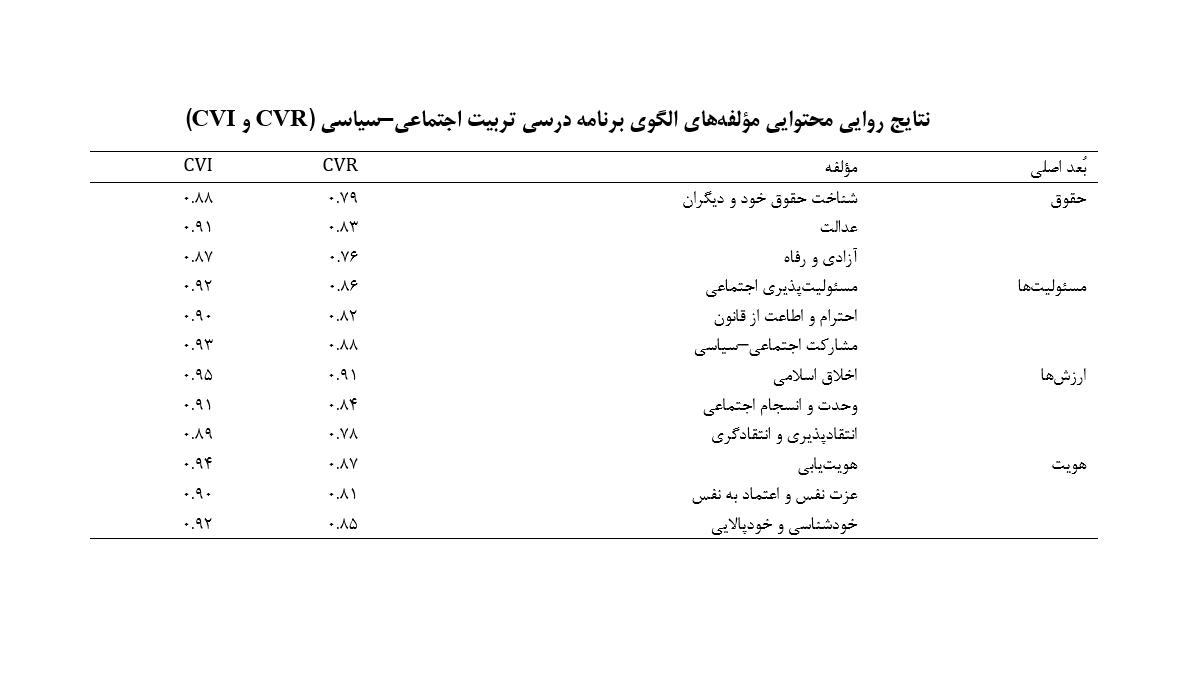
This study aimed to design and validate a curriculum model for social–political education tailored to the characteristics of Iranian upper elementary school students. This applied study employed an exploratory mixed-methods design. In the qualitative phase, data were collected through the analysis of upstream policy documents, authoritative academic sources, and semi-structured interviews with 40 university faculty members and educational planning experts. Data were analyzed using thematic content analysis with open coding, leading to the development of an initial curriculum model. In the quantitative phase, a researcher-developed questionnaire consisting of 133 items was designed to validate the proposed model and administered to 38 university experts and specialists from educational research and planning institutions. Face and content validity were confirmed using expert judgment and the Content Validity Ratio (CVR), while reliability was assessed using Cronbach’s alpha. Inferential statistical analyses were conducted using SPSS and R software. Statistical analyses indicated that all components and elements of the social–political education curriculum model—including objectives, content, teaching–learning strategies, and assessment methods—were statistically significant and confirmed (p < 0.05). Cronbach’s alpha coefficients for all dimensions were within acceptable to high ranges, demonstrating strong internal consistency and supporting the structural validity of the proposed model. The validated curriculum model demonstrates strong scientific credibility and practical applicability and can serve as a comprehensive, context-sensitive framework for designing, implementing, and evaluating social–political education curricula in Iranian upper elementary schools.
Downloads
References
Zhang Y, Md Nasir ANB. Evaluating core competency frameworks for general education curriculum in China's TVET: A systematic review of competency indicators and their implications. International Journal of Asian Social Science. 2025;15(6):108-22. doi: 10.55493/5007.v15i6.5466.
Tan C. Research on the Path of Sports Sociology Curriculum From the Interdisciplinary Perspective. Mobile Information Systems. 2022;2022:1-8. doi: 10.1155/2022/3415257.
Lal Alizadeh M. Political Sociology. Tehran: Payame Noor University Press; 2018.
Bangura M. Sociology Learning Curriculum for Sustainable Development: The Sierra Leone Rural and Urban Social Observation. British Journal of Education Learning and Development Psychology. 2023;6(3):37-51. doi: 10.52589/bjeldp-lj85tsnv.
Shahmoradi M, Yousefzadeh Chousari MR. Presenting a political education curriculum model based on the socio-political domain of the Fundamental Reform Document for first secondary students. Journal of Research in Social Studies Education. 2020;5(1):173-206. doi: 10.29252/qaiie.5.1.173.
Jokar E, Molaei SN, Anarinejad A, Jokar A. Evaluating the effectiveness of the educational system in socio-political education from the perspective of Farhangian University students. Educational-Research Journal. 2017(9):9-27.
Abdullah A, Zare M. Analysis of factors affecting the political education of citizens (Case study: Shiraz). Journal of Political Science. 2017(25):123-50.
Seif S, Kadivar P, Karami Nouri R, Lotfabadi H. Developmental Psychology. 26th ed. Tehran: SAMT Publications; 2018.
Kiamanesh A, Mohammadi Gorgani A, Dortaj F. Effectiveness of social-emotional skills training on academic performance components of female students. Journal of Education and Evaluation. 2019(45):133-50.
Tabatabaei M. Investigating political education components in elementary social studies textbooks. Journal of Research in Islamic Education Issues. 2018(40):119-36.
Akbaripourang M, Mohammadipourang M, Alipour M. Teachers' perceptions of the curriculum's role in improving citizenship education of elementary students. Journal of Research in Social Studies Education. 2020(5):27-36.
Rizwan S, Huma A, Hanif RH. Content Analysis of Peace Education Themes in English Textbooks from Elementary Curriculum in Punjab. Dialogue Social Science Review (DSSR). 2025;3(1):1120-33.
Moloney M, Ma C, Lee A, Pierre S, Parkes S, Pulat D, et al. A Protocol of a Randomized Control Trial to Test the Feasibility and Efficacy of the EMPOWER Social-Emotional Learning Curriculum for Youth Aged 11–14 Years in After-School Settings. Plos One. 2025;20(3):e0319398. doi: 10.1371/journal.pone.0319398.
Osman H, Mumo R, Gori JM. Team Building as a Lens for Instructional Leadership and Curriculum Supervision: Insights From Secondary Schools in Garissa Sub-County, Kenya. Asian Journal of Education and Social Studies. 2025;51(9):916-26. doi: 10.9734/ajess/2025/v51i92426.
Yazdani F, Abbasi E, Hasani M, Ali-Asgari M. Designing and validating a social education curriculum model in secondary education with emphasis on upstream documents. Research in School and Virtual Learning. 2018;6(22):95-117.
Jafarifar S, Torabi M. Future studies of socio-political education of students based on the Fundamental Reform Document of Education. Sepehr-e Siyasat Quarterly. 2021(28):96-116.
Eftekhari J, Eftekhari H, Samavi SA, Shamshiri B. Content analysis of social studies textbooks based on Ryff's scales of psychological well-being. New Thoughts on Education. 2021(59):137-60.
Amini Z, Ahmadi G, Osareh A, Ahmadi Tabatabaei MR. Designing and validating a proposed curriculum model for political literacy education in the first secondary period. Tehran: Shahid Rajaee Teacher Training University; 2018.
Yūsef Zādeh K, Shāhmorādī H. Presenting a Political Education Curriculum Model Based on the Socio-Political Education Dimension of the Fundamental Transformation Document of Education for First-Level Secondary School Students. Scientific-Research Quarterly of Applied Issues of Islamic Education and Training. 2020;5(1):173-206. doi: 10.29252/qaiie.5.1.173.
Amiri F, Faghihi A. Investigating socio-political education in the formal curriculum of the first secondary period. Journal of Research in Social Studies Education. 2020(6):115-41.
Rabiei Gouransarab M, Fayyaz I, Mahrouzadeh T, Bakhtiari A, Khorsandi A. A comparative study of social education goals and methods in the elementary systems of Iran and Japan to provide suitable solutions. Tehran: Allameh Tabataba'i University; 2020.
Mazaheri Forushani E, editor Challenges of multicultural curriculum in Iranian education with an emphasis on clarifying concepts such as multicultural education, multicultural class, multicultural teaching and multicultural curriculum. The second international conference on sociology, social sciences and education with a future perspective; 2024.
Liu Z. Research on the Path of Integrating Curriculum Ideological and Political Into Physical Education Teaching in Colleges and Universities in the Era of Artificial Intelligence. Applied Mathematics and Nonlinear Sciences. 2024;9(1). doi: 10.2478/amns-2024-0675.
Huang W. The Effect Evaluation of Curriculum Ideological and Political Elements Based on AHP Model. 2023:661-9. doi: 10.2991/978-94-6463-238-5_87.
Kargarzar M, Talaei I, Shobeiri SM, Mehrmohammadi M. Environmental education and its position in the second elementary curriculum of Iran's educational system. Journal of Environmental Education and Sustainable Development. 2020(26):115-32.
Alizadeh M. Investigating national identity components in elementary Persian textbooks. Journal of National Studies. 2020(83):65-84.
Kafshchian Moghadam A, Maleki H, Sadeghi A. Designing a Citizenship Rights Curriculum Model for the Second Period of Elementary Education. Iranian Journal of Educational Sociology. 2024;7(2):1-7. doi: 10.61838/kman.ijes.7.2.1.
Pour-Salim A, Arefi M, Fathi Vajargah K. Designing a global citizenship education curriculum model for the Iranian elementary system: A grounded theory model. New Thoughts on Education. 2017;13(3):36-7.
Ghazi Ardekani R, Maleki H, Sadeghi A, Dortaj F. Designing a research-oriented curriculum model in elementary social studies to foster thinking and creativity. Initiative and Creativity in the Humanities. 2017;7(3):63-106.
Bahrami-Pour M, Kian M, Niknam Z. Analyzing the dimensions of the null social studies curriculum in the seventh grade. Journal of Education. 2017(31):9-34.
Ahmadi P, Keshavarz Dizajini S. The position of citizenship education and rights in the elementary social studies curriculum. Bioethics Journal (Special Issue on Citizenship Rights). 2018;8(29):48-55.
Taheri SM, Darabi A. Investigating political development components in first and second secondary textbooks. Journal of Education. 2021(145):73-88.
Downloads
Publication Timeline
- Submitted
- Revised
- Accepted
Issue
Section
License
Copyright (c) 2025 Samad Keshavarz Kherameh, Hasan Maleki, Alireza Sadeghi (Author)

This work is licensed under a Creative Commons Attribution-NonCommercial 4.0 International License.