Validation of a Native Consumption Culture Model with Emphasis on Household Waste Management in Rasht Metropolis
DOI:
https://doi.org/10.61838/jsied.477Keywords:
Consumption culture, Household waste management, Structural equation modeling, Model validation, Rasht metropolisAbstract
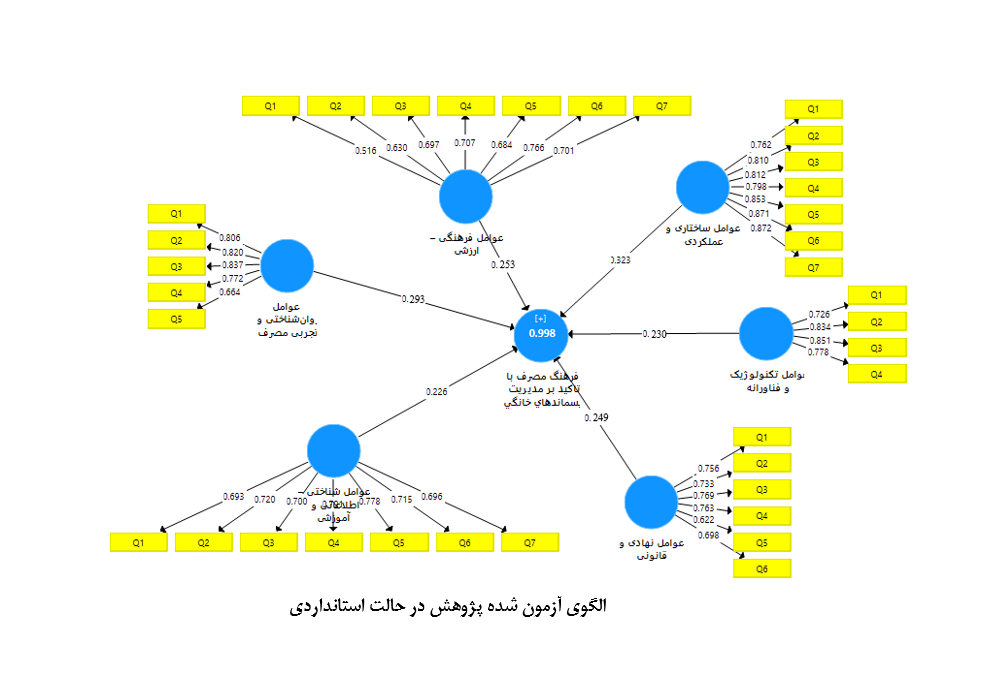
The present study aimed to quantitatively validate a native consumption culture model with emphasis on household waste management in Rasht metropolis. This applied study employed a quantitative descriptive-survey design. The statistical population consisted of managers and experts of Rasht municipality in the field of household waste management, from which 100 participants were selected using a census method. Data were collected using a researcher-made questionnaire developed based on the conceptual model, covering cultural–value, psychological–experiential, cognitive–informational, institutional–legal, technological, and structural–functional factors. Content validity and confirmatory factor analysis confirmed validity, while Cronbach’s alpha verified reliability. Data analysis was conducted using SPSS and partial least squares structural equation modeling (PLS-SEM) . Results indicated that all studied variables had a positive and statistically significant effect on consumption culture with emphasis on household waste management (p < 0.01). The strongest effect was related to structural–functional factors (β = 0.323), followed by psychological–experiential factors (β = 0.293). Cultural–value, cognitive–informational, institutional–legal, and technological factors also demonstrated significant effects. The overall model fit index (GOF = 0.61) confirmed an acceptable model fit and adequate explanatory power. The findings suggest that consumption culture and household waste management are multidimensional phenomena influenced by the interaction of individual, cultural, institutional, and technological factors. Therefore, improving waste management requires integrated policymaking, infrastructure development, technological advancement, and effective institutional mechanisms rather than relying solely on educational interventions.
Downloads
References
1. Boateng S, Amoako P, Appiah DO, Poku AA, Garsonu EK. Comparative Analysis of Households Solid Waste Management in Rural and Urban Ghana. Journal of Environmental and Public Health. 2016. doi: 10.1155/2016/5780258.
2. Ramos A. Sustainability assessment in waste management: An exploratory study of the social perspective in waste-to-energy cases. Journal of Cleaner Production. 2024;143693. doi: 10.1016/j.jclepro.2024.143693.
3. Gaur TS, Yadav V, Prakash S, Panwar A. Integration of industry 4.0 and circular economy for sustainable E-waste management. Management of Environmental Quality: An International Journal. 2025;36(5):1304-25. doi: 10.1108/MEQ-07-2024-0277.
4. Singh A, Goel A, Chauhan A, Singh SK. Sustainability of electronic product manufacturing through e-waste management and reverse logistics. Sustainable Futures. 2025;9(3):77-95. doi: 10.1016/j.sftr.2025.100490.
5. Haq ZF. Household Waste Management Behavior in the Blunyahrejo Village, Yogyakarta: Insights From the Theory of Planned Behavior and Social Capital. Bio Web of Conferences. 2024;132:02001. doi: 10.1051/bioconf/202413202001.
6. Jafari E. Sociological Study of the Impact of Social Capital on Household Waste Management in Urban Areas with Emphasis on Bourdieu's View (Case Study: Women in Sirjan County). Tehran: Islamic Azad University, Science and Research Branch; 2022.
7. Kavil YN, Alshemmari H, Alkasbi MM, Alelyani SS, Orif MI, Al-Farawati RK. Electronic waste and environmental diplomacy: How GCC E-waste management interfaces with the Stockholm Convention. Journal of Hazardous Materials Advances. 2025;17(1):25-46. doi: 10.1016/j.hazadv.2025.100610.
8. Hosseinpour AK, Ghorbanpour A, Shahbandarzadeh H. Evaluating the efficiency of the circular economy in the Gulf Cooperation Council countries regarding urban solid waste management. Quantitative Economics Journal. 2024;21(1):87-106.
9. Nwafor GU, Okamgba UC. Communicating Solid Waste Management Information through Social Media Platforms for Sustainable Development in Nigeria: A Review of Anambra Broadcasting Service Facebook Messages. International Journal of Advanced Multidisciplinary Research Studies. 2024;4(6):1269-77. doi: 10.62225/2583049X.2024.4.6.3598.
10. Kusolchoo S, Ueasangkomsate P, editors. Digital Technologies for Food Loss and Waste in Food Supply Chain Management. 2024 Joint International Conference on Digital Arts, Media and Technology with ECTI Northern Section Conference on Electrical, Electronics, Computer and Telecommunications Engineering (ECTI DAMT & NCON); 2024.
11. Ortiz C, Quezada L, Oddershede A. Industrial process management model to improve productivity and reduce waste. Sustainability. 2024;16:1606. doi: 10.3390/su16041606.
12. Kakouei M, Modiri M, Abbaspour Esfandan G. Presenting an Optimization Model for Reverse Logistics to Reduce Environmental Impacts Based on Waste Management. 2024.
13. Sumiyati S, Samadikun BP, Widiyanti A, Budihardjo MA, Al Qadar S, Puspita AS. Life cycle assessment of agricultural waste recycling for sustainable environmental impact. Global Journal of Environmental Science & Management (GJESM). 2024;10(2).
14. Parsakia K. Resource Management Strategies in the Hospitality Industry: Balancing Profit and Sustainability. Journal of Resource Management and Decision Engineering. 2024;2(4):17-23.
15. Pourmoghadam M, Gholamzadeh D, Vaddadi A, Amirkabiri A. Designing an interpretive structural model (ISM) of digital transformation culture drivers using a contextual approach in Tehran Province Water and Wastewater Company. Technology in Entrepreneurship and Strategic Management. 2025;13(4):223-37.
16. Saeedzadeh M. Electronic Recycling and Management of Electronic Waste. Environmental Sciences and Geography. 2025;11(1):1-14.
17. Jami R, Shahryari Z. Management of Electronic Waste. New Research in Civil Engineering. 2024;14(1):265-78.
18. Sarhadi E. Investigating the Impact of the Theory of Constraints on Reducing Normal and Abnormal Waste in Tire Manufacturing Companies. Quarterly Journal of Strategic Management Accounting. 2025;2(1):54-69.
19. Sarhadi E. Examining the Effect of Theory of Constraints on Reducing Normal and Abnormal Waste in Tire Manufacturing Companies. Strategic Management Accounting Quarterly. 2026;2(1):54-69.
Downloads
Publication Timeline
- Submitted
- Revised
- Accepted
Issue
Section
License
Copyright (c) 2025 Alireza Hajipour (Author); Zolfaghar Rashidi (Corresponding author); Rozita Sepehrnia (Author)

This work is licensed under a Creative Commons Attribution-NonCommercial 4.0 International License.