The Effect of Teaching the “Religious Topics” Course through the Successful Intelligence Approach on Academic Motivation and Sustainable Learning among Female Students
DOI:
https://doi.org/10.61838/jsied.489Keywords:
Successful intelligence, Religious topics, academic motivation, learning sustainabilityAbstract
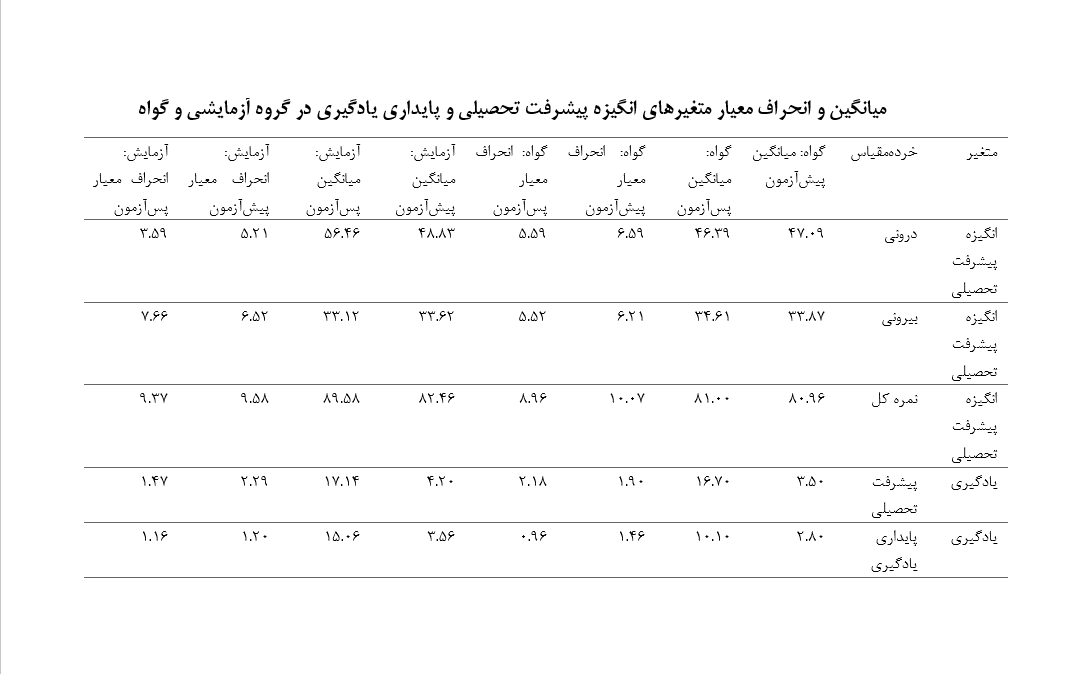
The present study aimed to investigate the effect of teaching the “Religious Topics” course through the Successful Intelligence approach on academic motivation and sustainable learning among fifth-grade female elementary school students compared with traditional teaching methods. This study employed a quasi-experimental pretest–posttest design with a control group. The statistical population consisted of fifth-grade female elementary school students in District 4 of Ahvaz, Iran. Two classes were randomly selected and assigned to the experimental and control groups. The experimental group received instruction based on the Successful Intelligence approach, whereas the control group was taught through conventional methods. Data collection instruments included the Academic Motivation Scale developed by Vallerand et al. (1992) and researcher-made tests to assess academic achievement and sustainable learning. Data were analyzed using multivariate and univariate analysis of covariance (MANCOVA and ANCOVA). The results of multivariate covariance analysis revealed a significant difference between the experimental and control groups in at least one dependent variable (F=7.32, P=0.000). Univariate covariance analysis indicated that the Successful Intelligence approach increased students’ academic motivation; however, the difference was not statistically significant compared with the traditional teaching method (P=0.15). In contrast, the findings demonstrated a significant positive effect of the Successful Intelligence approach on sustainable learning, with the experimental group outperforming the control group significantly in this variable (P=0.004). The findings suggest that teaching the “Religious Topics” course through the Successful Intelligence approach can facilitate deeper and more sustainable learning among students. Although this approach did not produce a statistically significant improvement in academic motivation compared with traditional teaching methods, it significantly enhanced learning sustainability. Therefore, integrating the Successful Intelligence approach into classroom instruction may improve educational quality, promote active student engagement, and strengthen analytical, creative, and practical abilities in learners.
Downloads
References
1. Snow RE, Kyllonen PC, Marshalek B. The Topography Ability and Learning Correlation. In: Sternberg RJ, editor. Advances in the Psychology of Human Intelligence. 2nd ed. Hillsdale, NJ: Erlbaum; 1984. p. 47-104.
2. Sternberg RJ. What Is Intelligence, Really? The Futile Search for a Holy Grail. Journal of Intelligence. 2024. doi: 10.1016/j.intell.2024.10191.
3. Sternberg RJ. The Theory of Successful Intelligence. Review of General Psychology. 1997;3:292-316.
4. Sternberg RJ. The Theory of Successful Intelligence. Revista Interamericana de Psicologia / Interamerican Journal of Psychology. 2005;39(2):189-202.
5. Sternberg RJ. Successful Intelligence: A Model for Testing Intelligence beyond IQ Tests. European Journal of Education and Psychology. 2015;8:76-84.
6. Sternberg RJ. Raising the Achievement of All Students: Teaching for Successful Intelligence. Educational Psychology Review. 2002;14(4):383-93.
7. Sternberg RJ. College Admissions for the 21st Century. Cambridge, MA: Harvard University Press; 2010. 224 p.
8. Sternberg RJ, Grigorenko E. Successful Intelligence in the Classroom. Theory into Practice. 2004;43(4):274-80.
9. Sternberg RJ, Grigorenko EL. Teaching for Successful Intelligence: To Increase Student Learning and Achievement: Corwin Press, A Sage Publications Company; 2007.
10. Sternberg RJ. Adaptive Intelligence: Intelligence Is Not a Personal Trait but Rather a Person × Task × Situation Interaction. Journal of Intelligence. 2021;9(4):58. doi: 10.3390/jintelligence9040058.
11. Yu Y, Xu Y, Wu Y. Developing Successful Intelligence in Global Academia: A Triarchic Framework for EAP Pedagogy. Journal of Intelligence. 2025;13(11):134. doi: 10.3390/jintelligence13110134.
12. Santrock. Educational Psychology. Saeedi S, Iraq M, Daneshfar, editors. Tehran: Rasa Publications; 2014.
13. Steinmayr R, Spinath B. The Importance of Motivation as a Predictor of School Achievement. Learning and Individual Differences. 2009;19:80-90.
14. Ghasemi Ahari A. The Relationship between Religious Attitude and Academic Achievement Motivation among Students of Allameh Tabataba'i University. Tehran: Allameh Tabataba'i University; 2009.
15. Babaei A, Maktabi G. The Effect of Successful Intelligence Training on Academic Achievement Motivation and Teacher Self-Efficacy among Student Teachers at Farhangian University. Psychological Methods and Models. 2017;8(30).
16. Hojjati M. The Effectiveness of Successful-Intelligence-Based Intervention on Academic Motivation of Students. Regional Journal Article. 2023.
17. Hashemi B, Ghazanfari A, Sharifi T, Ahmadi R. The Effectiveness of Successful Intelligence Components Training on Academic Achievement Motivation of Female Students. Educational Psychology Studies. 2019;16(36):189-203.
18. Sharbafzade A, Abedi A. Impact of the Program of Training Successful Intelligence on the Intrinsic and Extrinsic Educational Motivation of the High School Female Students of Isfahan. International Journal of Basic Sciences & Applied Research. 2014;3(10):741-6.
19. Sharbaf Zadeh A, Abedi A, Yousefi Z, Aghababaei S. The Effect of Successful Intelligence Training Program on Academic Motivation and Academic Engagement Female High School Students. International Journal of Psychological Studies. 2014;6(3):425-40.
20. Saw KNN, Han B. Effectiveness of Successful Intelligence Training Program: A Meta-Analysis. PsyCh Journal. 2021;10(10):323-39. doi: 10.1002/pchj.443.
21. Ghobadi L, Habibi Kaleybar R, Farid A, Mesrabadi J. The Effect of Training Successful Intelligence Components on Creativity and Academic Performance of Elementary School Students. Journal of Innovation and Creativity in Human Sciences. 2021;11(1):45-66.
22. Nazari A, Saadipour E, Ebrahimi Ghavam S, Asadzadeh Dehraei H. Designing and Validating Sternberg Successful Intelligence Training Package and Its Effectiveness on Academic Vitality of Students. Journal of Educational Psychology Studies. 2023;20(51):138-51. doi: 10.22111/JEPS.2023.44995.5338.
23. Mohkamkar A, Shaterian F, Nikookar A. The Effectiveness of Successful-Intelligence-Based Training on Emotional Self-Awareness and Academic Engagement of Upper Secondary Students. Journal of Sociology of Education. 2024;10(1):305-13.
24. Stemler S, Sternberg RJ, Grigorenko EL, Jarvin L, Sharpes DK. Using the Theory of Successful Intelligence as a Framework for Developing Assessments in AP Physics. Contemporary Educational Psychology. 2009;34:195-209.
25. Grigorenko EL, Jarvin L, Sternberg RJ. School-Based Tests of the Triarchic Theory of Intelligence: Three Settings, Three Samples, Three Syllabi. Contemporary Educational Psychology. 2002;27:167-208.
26. Al-Sharawy SAM. Using a Successful Intelligence-Based Program for Developing English Writing Skills among Preparatory Students. Natural Science Publishing / Educational Research. 2024.
27. Li C, Yan J, Ma X, Chen X, Liu Z. Assessment of Gifted Students for Identification Purposes: New Techniques for a New Millennium. Journal of Intelligence. 2022;4(4):120. doi: 10.3390/jintelligence10040120.
28. Nazerieh A, Bayanfar F, editors. Predicting Academic Achievement Motivation Based on Critical Thinking with the Mediating Role of Successful Intelligence. Proceedings of the First National Scientific Student Conference on Psychology; 2021; Ardabil.
Downloads
Publication Timeline
- Submitted
- Revised
- Accepted
Issue
Section
License
Copyright (c) 2026 Ali Babaei (Corresponding author)

This work is licensed under a Creative Commons Attribution-NonCommercial 4.0 International License.