شناسایی چالشهای تحصیلی دانشآموزان مدارس استعدادهای درخشان (سمپاد): یک مطالعه فراترکیب
کلمات کلیدی:
چالشهای تحصیلی، دانشآموزان، استعدادهای درخشان، فراترکیبچکیده
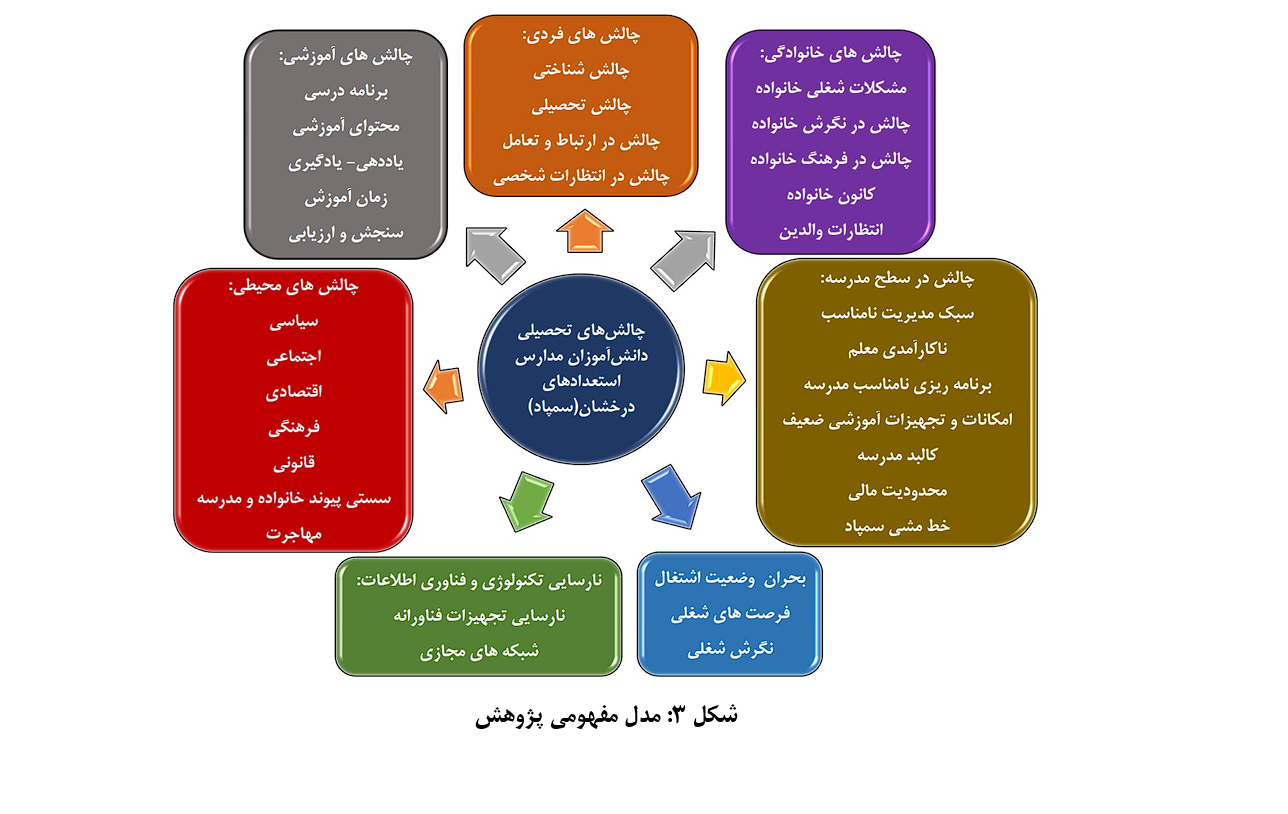
پژوهش حاضر در راستای شناسایی چالشهای تحصیلی دانشآموزان مدارس استعدادهای درخشان (سمپاد) انجام گرفته است. رویکرد روششناسی پژوهش کیفی و به روش پژوهش فراترکیب هفت مرحلهای باروسو و ساندلوسکی میباشد. پژوهشگران به جستوجوی سیستماتیک مطالعات مرتبط باهدف پژوهش در پایگاههای علمی جهاد دانشگاهی، نورمگز، مگیران، پرتال جامع علوم انسانی و سیویلیکا، علم نت بین سالهای 1403- 1395 پرداختند. از 184 منبع اولیه 20 مطالعه به روش تحلیل مضمون، مورد تجزیهوتحلیل قرار گرفت. پایایی شاخصها با ضریب کاپا در نرمافزار SPSS, 26 برابر با 813/0 محاسبه گردید. از تحلیل محتوای منابع منتخب، 196 کد اولیه استخراج گردید که شامل 32 مقوله فرعی بود که در قالب 7 مقوله اصلی: چالشهای فردی (چالش شناختی، چالش تحصیلی، چالش در ارتباط و تعامل، چالش در انتظارات شخصی)؛ چالشهای خانوادگی(مشکلات شغلی خانواده، چالش در نگرش خانواده، چالش در فرهنگ خانواده، کانون خانواده، انتظارات والدین)؛ چالش در سطح مدرسه (سبک مدیریت نامناسب، ناکارآمدی معلم، برنامهریزی نامناسب مدرسه، امکانات و تجهیزات آموزشی ضعیف، کالبد مدرسه، محدودیت مالی، خطمشی سمپاد)؛ چالشهای آموزشی (برنامه درسی، محتوای آموزشی، یاددهی- یادگیری، زمان آموزش، سنجش و ارزیابی)؛ چالشهای محیطی (سیاسی، اجتماعی، اقتصادی، فرهنگی، قانونی، سستی پیوند خانواده و مدرسه، مهاجرت)؛ نارسایی تکنولوژی و فناوری اطلاعات (نارسایی تجهیزات فناورانه، شبکههای مجازی) و بحران وضعیت اشتغال (فرصتهای شغلی، نگرش شغلی) طبقهبندی شدند. یافتههای پژوهش حاکی از آن است که بهبود وضعیت سمپاد نیازمند تحولی همهجانبه است که بدون این تغییرات افت کیفیت آموزش و فرسودگی دانشآموزان مستعد، دور از انتظار نخواهد بود.
دانلودها
مراجع
Milan L, Reis SM, Zanetti MA, Renzulli JS. How Italian, European and American frameworks contribute to promoting talent Development in Italian schools. International Journal for Talent Development and Creativity. 2019;7(1-2):99-112.
Nijs S, Gallardo-Gallardo E, Dries N, Sels L. A multidisciplinary review into the definition, operationalization, and measurement of talent. Journal of World Business. 2014;49(2):180-91. doi: 10.1016/j.jwb.2013.11.002.
Cotton N. Using an Interdisciplinary Approach with Problem-Based Learning for Gifted Learners. Learning to Teach Language Arts, Mathematics, Science, and Social Studies Through Research and Practice. 2019;8(1).
Pawilen GT, Manuel SJ. A Proposed Model and Framework for Developing a Curriculum for the Gifted in the Philippines. International Journal ofCurriculum and Instruction. 2018;10(2):118-41.
Reis M, Renzulli S. Is there still a need for gifted education? An examination of current research. Learning and Individual Differences. 2010;20(4):308-17. doi: 10.1016/j.lindif.2009.10.012.
Tansley C. What do we mean by the term "talent" in talent management? Industrial and commercial training. 2011;43(5):266-74. doi: 10.1108/00197851111145853.
Jokar MH. Pathology of schools for gifted students (Sampad) in junior secondary school from the perspective of students. The Scientific Quarterly Journal of New Research in Education. 2024;5(1):79-89.
Al-Malah DKAR, Jinah HHK, Alrikabi HTS. Enhancement of educational services by using the internet of things applications for talent and intelligent schools. Periodicals of Engineering and Natural Sciences. 2020;8(4):2358-66.
Rahmani Barouji P, Ezati M, Pourkarimi J, Arjmandnia AA. Presenting a Comprehensive Conceptual Model to Identify the Talents of Students (A Meta-Synthesis Study). Journal of New Approaches in Educational Administration. 2024. doi: 10.30495/jedu.2024.33427.6714.
Rinn N, Bishop J. Gifted Adults: A Systematic Review and Analysis of the Literature. Gifted Child Quarterly. 2015;59(4):213- 35. doi: 10.1177/0016986215600795.
Rahmani Barouji P, Ezati M, Pourkarimi J, Arjmandnia AA. Presenting a conceptual model for identifying effective factors in students' talent identification (Meta Synthesis Approach). MEO. 2024;13(2):6. doi: 10.61186/meo.13.2.121.
Abolghasemi M, Zeinalipour H, Sheikhi Fini AA, Asare AR. The study of present and optimum educational contents among gifted students of Isfahan based on a differentiation approach. Journal of Educational Psychology Studies. 2017;14(27):1-28. doi: 10.22111/jeps.2017.3418.
Rashidi B, Abedi A, Noruozi G. Synthesis Research of Pathology of the Educational System of Gifted School and Developing a Curriculum Improvement Indicators Model. Journal of Theory and Practice in Curriculum. 2022;10(19):205-36.
Yazdanshenas F, Parsa A, Mehralizadeh Y. Challenges of separation of the gifted and talented students: A mixed approach. Journal of Curriculum Research. 2019;9(1):260-98. doi: 10.22099/jcr.2019.5222.
Matta M, Gritti ES, Lang M. Personality assessment of intellectuallygifted adults: A dimensional trait approach. Personality and IndividualDifferences. 2019;140:21-6. doi: 10.1016/j.paid.2018.05.009.
Ang RP, Huan VS. Academic expectations stress inventory:Development, factor analysis, reliability, and validity. Educational and Psychological Measurement. 2006;66(3):522-39. doi: 10.1177/0013164405282461.
Wahyuningsih P, Usman O. The Effect of Enterpreneurship Education,Motivation, and Self-Efficacy of Entrepreneurs Interest in Students ofFaculty of Economics, State University of Jakarta. 2020.
Davis GA, Rimm SB, Siegle D. Grouping, differentiation, and enrichment. Education of the gifted and talented2014. p. 147-76.
Ünlü Ö, Karadaş Y. Challenges faced by gifted students in the school environment and proposed solutions. International Journal of Turkish Educational Studies. 2023;11(21):1032-71. doi: 10.46778/goputeb.1336214.
Abdul Aziz AR, Ab Razak NH, Sawai RP, Kasmani MF, Amat MI, Shafie AA. Exploration of challenges among gifted and talented children. Malaysian Journal of Social Sciences and Humanities (MJSSH). 2021;6(4):242-51. doi: 10.47405/mjssh.v6i4.760.
Kanapathy S, Hazir NM, Hamuzan HA, Menon P, Woon YH. Gifted and talented students "underachievement" and intervention: A case study. European Journal of Education and Pedagogy. 2022;3(5):114-22. doi: 10.24018/ejedu.2022.3.5.453.
Kalobo L, Settalentoa W. Navigating challenges in gifted education: A teacher's perspective on overcoming barriers. Athens Journal of Education. 2024;11(1):1-20. doi: 10.30958/aje.X-Y-Z.
Zimmer L. "Qualitative meta-synthesis: a question of dialoguing with texts". Journal of Advanced Nursing. 2006;53(3):311-8. doi: 10.1111/j.1365-2648.2006.03721.x.
Paterson B, Thorne S, Calnan C, Jillings C. Meta-study of qualitative health research: a practical guide to meta-analysis and meta-synthesis. California: Sage; 2001.
Sandelowski M, Barroso J. Handbook for synthesizing qualitative. research. New York: Springer Publishing Company; 2007.
Herber OR, Barroso J. Lessons learned from applying Sandelowski and Barroso's approach for synthesising qualitative research. Qualitative research. 2020;20(4):414-31. doi: 10.1177/1468794119862440.
Ludvigsen MS, Hall EOC, Meyer G, Fegran L, Aagaard H, Uhrenfeldt L. Using Sandelowski and Barroso's Meta-Synthesis Method in Advancing Qualitative Evidence. Qualitative Health Research. 2016;26(3):320-9. doi: 10.1177/1049732315576493.
Nazari M, Seadatee Shamir A, Bagheri Noaparast K, Rezaei S. Identifying the Scientific and Philosophical Foundations of Educating Gifted Students in Finland and Iran and Providing a Pattern for Iran. Educational Psychology. 2021;17(61):77-104. doi: 10.22054/jep.2021.62013.3400.
Ghaedrahmati E, Taheri Goodarzi H, Mahdian MJ. Teaching-learning Model of Moral Education for Students of the Second Term of Schools of Exceptional Talents of Tehran Province based on the Iranian-Islamic Model of Progress. Research in Islamic Education Issues. 2024;32(62):169-96.
Etemaidifard SM, Salehi A. Sociological Analysis of the Inconsistencies of Elitism in NODET Schools (Case Study: Students of NODET Schools in Tehran). Quarterly of Social Studies and Research in Iran. 2024;12(4):573-87. doi: 10.22059/jisr.2023.363310.1424.
Olamaa Far MM, Hemmati MJ, Movaleli G. An overview of teaching methods for gifted students. Iranian Journal of Psychology and Behavioral Sciences. 2020;32(5):117-31.
Rezaei M, Sheikh M, Shahzaei H, Shahoozaei T. Gifted students in schools. Quarterly magazine of strategic research in education. 2023;9(1):299-310.
Naghdi N, Behpajooh A. Meeting the Needs of Gifted and Talented Students: Case Study of a Virtual Learning Lab in a Rural Middle School. Rooyesh-e-Ravanshenasi. 2019;8(1):117-36.
Nejatifar S, aghaziarati A, Abedi A. Developing a Model of Academic Satisfaction in Gifted Students based on the Factors Affecting It: A Grounded Theory Study. Psychology of Exceptional Individuals. 2021;11(43):141-74. doi: 10.22054/jpe.2022.59758.2298.
Naghdi Dorbati V, Sanaei M. Developing the Personality System of Elite Youth Based on Social Development: A Comparison of Training the Dimensions of Developed Personality in Normal and SAMPAD School Students. Journal of Social Development and Welfare Planning. 2024;14(57):125-70. doi: 10.22054/qjsd.2023.67468.2350.
Abolghasemi M, Zeinalipour H, Sheikhi Fini AA, Asare AR. Designing teaching-learning strategies based on a differentiated approach in SAMPAD schools: A mixed-method study. Journal of Curriculum Research. 2018;8(2(16)):145-71. doi: 10.22099/jcr.2019.5122.
Raissi Ahovan Y, Shaykhei Fini AA, Zain Alipour H. A comparative study of the impact of the hidden curriculum components on non-cognitive (affective) characteristics of learning of students in different types of high schools (public, non-public, magnet & exceptional talents high schools). Journal of Theory and Practice in Curriculum. 2021;9(17):281-321.
Pakatchy A, Sajadi H. Analyzing the Cultural Dimensions of Elite Educational Centers Based on the Ego and Alter Dynamics. Religion & Communication. 2018;24(2):75-104. doi: 10.30497/rc.2018.2099.
Ghaffari M, Karamipour M. Providing a conceptual framework for developing an educational program for gifted students (Research example: SAMPAD Schools in the West of Mazandaran Province). Journal of Curriculum Development and Educational Planning Research. 2021;20(11):143-56.
GhahremanLoo H, Atashpour SH, Arefi M. Development of Structural Model of Academic Variables of Students of Brilliant Talent Schools. Educational Development of Judishapur. 2017;8:142-8.
Nejatifar S, Abedi A, Ghamarani A, Asanjarani F. Analyzing the Facilitating Factors of the Application of Hybrid Homeschooling in Iran's Educational System: A New Approach in Educating Gifted Students. Journal of Management and Planning In Educational System. 2023;16(2):113-36. doi: 10.48308/mpes.2023.103246.
Nasiran S, Iravani MR. Investigating the problems of gifted students in SAMPAD schools from the perspectives of students and parents. Quarterly Journal of Psychological Studies and Educational Sciences (Takestan University). 2016;2(2):1-27.
Pierson CA. Make your peer reviews more organized and systematic with checklists [Internet]. Journal of the American Association of Nurse Practitioners. 2016;28:637-8. doi: 10.1002/2327-6924.12435.
Kamali Y. The Methodology of Met synthesis and Implication for Public Policy. Political Quarterly. 2017;47(3):721-36. doi: 10.22059/jpq.2017.62861.
Abedi Jafari H, Taslimi MS, Faghihi A, Sheikhzadeh M. Thematic analysis and thematic networks: a simple and efficient method for exploring patterns embedded in qualitative data municipalities. Strategic Management Thought (Management Thought). 2011;5(2):151-98. doi: 10.30497/SMT.2011.163.
Abadi M, Noushadi N, Momtahan E. Evaluation of critical thinking skills in ordinary and gifted secondary math curricula. Technology of Education Journal (TEJ). 2018;13(1):40-8. doi: 10.22061/jte.2018.2997.1764.
Alam M, Yazdi Feyzabadi V, Nematolahzadeh Mahani K. A study of Psychological Disorders on Ordinary, Talented and Orphan Students in High Schools of Kerman City in 2010. JRUMS. 2013;12(7):571-82.
Arjmandnia AA, Hosseini AS, Valizadeh S. The Effect of Emotional Self-Regulation Training on Decreasing Behavioral Problems in Gifted Students with Minor Educational Achievements. 2018.
Deputy of P, School M. Summary of Statistics, Indicators, Regulations, and By-Laws. National Organization for Development of Exceptional Talents (NODET), 2022.
Ebrahimi S, Nateghi F, Faghihi A. Analytical review of Gifted students' schools Evaluating the Quality of Context and input in First-Class Secondary Gifted School based on CIPP evaluation model, school in Khuzestan. Journal of Research in Educational Systems. 2018;12:785-97.
Garavand H, Abdollahi Moghadam M, Sabzian S. Developing a causal model of Loneliness with Academic Self-handicapping In Gifted Female Students' of the Second High School: the Mediation of Academic Alienation. JOEC. 2023;23(3):6.
Shojaee S, Khamooshi M. A Critical-Analytical Review on Misdiagnosis of Gifted and Talented Students. J Child Ment Health. 2015;2(3):105-15.
Ranjbar S, Afrooz GA, Ghasemzadeh S, Ghobari Bonab B. Development of a Family-Centered Emotion Regulation Program and Evaluation of Its Effectiveness on the Social, Emotional, and Academic Adjustment of Gifted Adolescents at Risk of Emotional and Behavioral Problems. Pajouhan Sci J. 2024;22(3):191-201. doi: 10.32592/psj.22.3.191.
Research Center of the Islamic Consultative A. A review of the status of gifted students in school education and higher education. 2021.

دانلود
چاپ شده
ارسال
بازنگری
پذیرش
شماره
نوع مقاله
مجوز
حق نشر 2025 Parinaz Rahmani Barouji (Corresponding author); Jamal Haji (Author)

این پروژه تحت مجوز بین المللی Creative Commons Attribution-NonCommercial 4.0 می باشد.