Explaining the Foundations of Organizational Citizenship Behavior Based on the Conduct of Amir al-Mu’minin, Peace Be upon Him, in Nahj al-Balagha: Presenting a Conceptual Model Using Thematic Analysis
Keywords:
Content analysis, organizational citizenship behavior, Nahj al-BalaghaAbstract
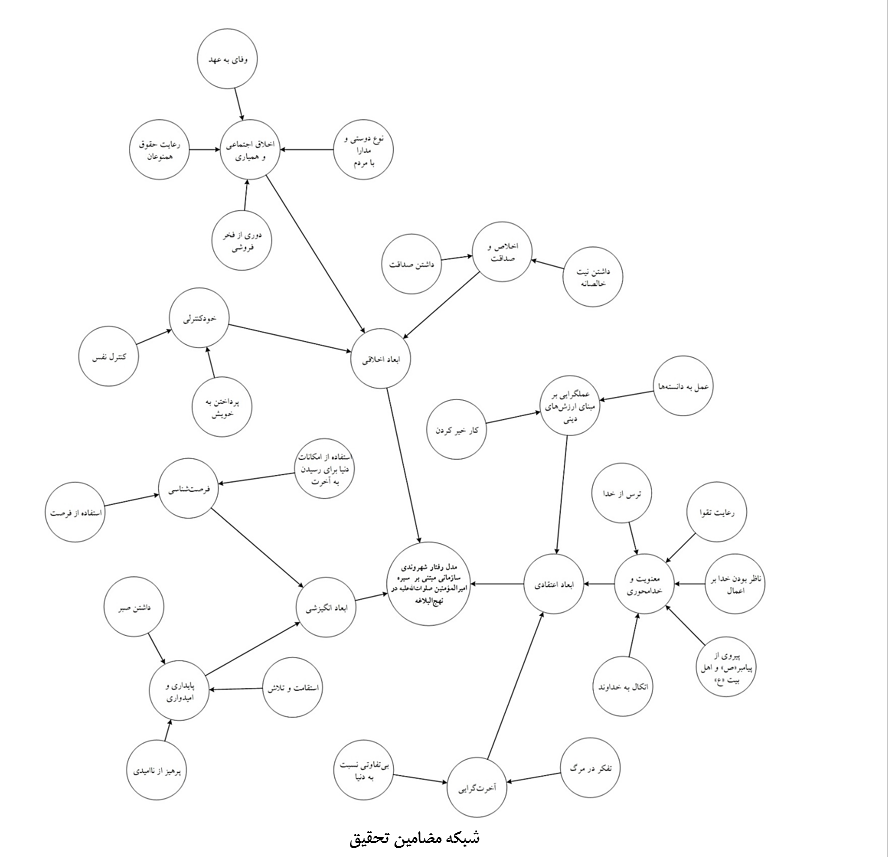
This study aimed to identify and explain the foundations of organizational citizenship behavior based on the conduct of Amir al-Mu’minin, peace be upon him, in Nahj al-Balagha and to present an indigenous Islamic conceptual model. This qualitative study was conducted within an interpretivist paradigm using thematic analysis. The research data consisted of the text of Nahj al-Balagha, including sermons, letters, and aphorisms, examined through Mohammad Dashti’s translation, Subhi al-Salih’s edition, and the commentary Payam-e Imam Amir al-Mu’minin. Meaning units related to extra-role behaviors, responsibility, social cooperation, altruism, self-control, and ethical commitment were identified and coded using MAXQDA 2020. To enhance trustworthiness, continuous textual review, expert judgment, thick description, direct reference to data, and audit trail documentation were employed. The thematic analysis indicated that, after refining 624 initial codes, 547 final codes were extracted and categorized into 22 basic themes, 8 organizing themes, and 3 global themes. The global themes consisted of motivational, belief-based, and ethical dimensions. The motivational dimension comprised perseverance and hopefulness, as well as opportunity recognition. The belief-based dimension included eschatological orientation, action based on religious values, and spirituality and God-centeredness. The ethical dimension consisted of sincerity and honesty, social ethics and cooperation, and self-control. The extracted model demonstrates that organizational citizenship behavior in Nahj al-Balagha is not merely an organization-centered behavior, but a value-oriented and human-centered phenomenon formed through the integration of motivation, religious belief, and practical ethics. This model can provide a theoretical basis for developing indigenous organizational behavior frameworks in Islamic-Iranian contexts.
Downloads
References
1. Fan Q, Wider W, Chan CK. The brief introduction to organizational citizenship behaviors and counterproductive work behaviors: A literature review. Frontiers in Psychology. 2023;14:1181930. doi: 10.3389/fpsyg.2023.1181930.
2. Barati H, Oreyzi H, Dorry B. Investigating patterns of effective variables on organizational change-oriented citizenship behavior through mediating role of reaction to change. Transformation Management Journal. 2016;8:67-87. doi: 10.22067/pmt.v8i15.47671.
3. Ataei M, Alinezhad A, Rahmany N. The relationship between organizational citizenship behavior and human resource productivity: Case study. Journal of Development & Evolution Management. 2015;7(21):1-10.
4. Mousavi M. Designing and explaining the moral model of organizational citizenship behavior. Ethics in Science and Technology. 2018;13(1):154-63.
5. Oreyzi HR, Mohammadi M, Amiri S. Investigation of relationship among organizational citizenship behavior with organizational commitment and propensity to stay in Saipa company. Social Psychology Research. 2011;1(1):13-30.
6. Popescu AM, Deaconu A, Popescu T. Organization's age and organizational citizenship behavior (OCB), performance criteria at SMEs level: Case study, Bucharest-Ilfov development region. Procedia Economics and Finance. 2015;22:645-54. doi: 10.1016/S2212-5671(15)00278-6.
7. Ranaei Kord Shuli H, Shokr A, Pourmola SMH, Shahidian ZS. Explaining organizational citizens behaviors based on the Islamic teachings. Scientific Journal of Islamic Management. 2014;21(1):45-82.
8. Javad Saljoughi M. Development and validation of indices and dimensions of organizational citizenship behavior. Resource Management in Police Journal of the Management Dept. 2018;6(22):143-64.
9. Jahromi F, Abbasi R. An investigation of the concept of organizational citizenship behavior from the viewpoint of Nahjolbalagheh and Rights Thesis of Imam Sajjad (Peace be upon him). Psychological Research in Management. 2018;4(2):149-85.
10. Shahsavarani AM. Social Exchange Theory (SET): A theory of communication and interpersonal interactions within the society. The Quarterly Journal of Media Research. 2018;1(1):51-70.
11. Bakhti M, Torabi M, Gholipour A. Identifying the impact of organizational citizenship behavior as a mediator on the relationship between perceived organizational support and social capital. Management Studies in Development and Evolution. 2011;21(66):25-46.
12. Moradi M, Hakimi I. Investigating the impact of Islamic values on organizational citizenship behavior: The role of member-leader relationship and organizational commitment. Scientific Journal of Islamic Management. 2019;26(4):159-82.
13. Riadi F, Riani D, Sunarsi D, Munna AS. Islamic work ethics-based organizational citizenship behavior to improve the job satisfaction and organizational commitment of higher education lecturers in Indonesia. International Journal of Educational Administration, Management, and Leadership. 2025;1(1):17-28.
14. Makarem Shirazi N. Ethics in the Quran. Qom: Imam Ali ibn Abi Talib (AS) Seminary; 2007.
15. Makarem Shirazi N. Payam-e Imam Amir al-Mu'minin (AS): A New and Comprehensive Commentary on Nahj al-Balagha. Qom: Imam Ali ibn Abi Talib (AS) Seminary; 2011.
16. Imam Ali ibn Abi T. Nahj al-Balagha. Dashti M, editor. Tehran: Payam-e Edalat; 2019.
17. Ebrahimi H, Bagherpour SM, editors. Political governance in the life of Amir al-Mu'minin Ali (AS): With a view on the system of dismissal and appointment of managers in Islamic society. Congress on Rereading the Personality Dimensions of Amir al-Mu'minin Ali (AS); 2019; Isfahan.
18. Moeini Abadi Bidgoli H. Thematic analysis of the political actions of rulers in Nahj al-Balagha. Quarterly Journal of Nahj al-Balagha Research. 2021;9(35):37-54. doi: 10.22084/nahj.2021.23637.2618.
19. Ahmadian K, Bastami M, Mahmoodi K. Presenting the model of antecedents of organizational citizenship behavior. Innovation Strategy & Operational Excellence. 2024;1(1):1-25.
20. Jamshidi M, Jalalkamali M, Sayadi S, Fatehi Rad N, Mohammad Bagheri M. Designing a desirable model of organizational citizenship behavior based on the employee service compensation system. Journal of Public Administration Researches & Novel Theories. 2023;1(4):1-14.
21. Attari R, Zakariaei M, Hosseini SV. Providing a model for the development of organizational citizenship behavior of managers in the education organization. Educational Leadership & Administration. 2021;15(3):103-36.
22. Rezaeian S, Nazem F, Imani MN. Formulation of a qualitative model for the development of organizational citizenship behavior and its managerial solutions and validation. International Journal of Innovation Management and Organizational Behavior. 2024;4(3):143-54. doi: 10.61838/kman.ijimob.4.3.17.
23. Tohidast Shahkhali M, Goudarzvand Chegini M, Bagher Salimi S, Doostar M. Presenting a sustainable organizational citizenship behavior development model in the banking system. Mieaoi. 2024;13(47):237-61.
24. Baneshi E, Ahmadi Kahnali R, Ameri Siyahooei R, Ghasemipoor B. Designing model of organizational citizenship behavior towards the environment. Iranian Evolutionary Educational Psychology Journal. 2024;6(1):232-55. doi: 10.22034/6.1.232.
25. Mihandoost M, Madani A, Mohebbi S. Design a qualitative model for the development of Islamic organizational citizenship behavior in Tax Affairs Organization in Iran. Behavioral Studies in Management. 2023;14(35):96-115.
26. Hairuddin MA, Shohib MW, Mohd Burhan I. Validating a model of organizational citizenship behavior from Islamic perspective for Indonesian Islamic higher education institutions: A structural equation modeling approach. IIUM Journal of Educational Studies. 2021;9(2):64-88. doi: 10.31436/ijes.v9i2.317.
27. Altalebi M, Sadeghi M, AlMurshidi R, Sharifi S. Evaluate the relationship between the categories of organizational citizenship model in the education of Babol Province in Iraq Country. Sociology of Education. 2024;10(1):64-72. doi: 10.22034/ijes.2024.2020446.1527.
28. Namjofard HR, Kamali MJ, Sabokrou M, Anjam Shoaa Z, Babaei H. Designing a Political Behavior Management Model Based on Organizational Citizenship Behavior. Journal of Management and Education Perspective. 2025;7(1):256-81.
29. Bal M, Alhnaity R. Organizational citizenship behavior. In: Bal M, editor. Elgar Encyclopedia of Organizational Psychology. Cheltenham, UK: Edward Elgar Publishing; 2024. p. 422-7.
30. Saadat V, Ghlichlee B, Rezaian A, Tabarsa G. Applying the content analysis approach in presenting a model for consequences of leaders' ambiguity tolerance. Public Administration Perspective. 2022;13(3):15-34. doi: 10.52547/jpap.2022.226090.1164.
31. Hosseini MS, Rezaeian A, Pourezzat AA. Identifying and compiling indicators for evaluating the ethical performance of employees of the Imam Khomeini Relief Committee in the light of Imam Ali's life (AS) and conduct with a focus on observing justice in dealing with the target community. Biannual Journal of Studies of Religion, Spirituality & Management. 2023;10(18):125-42. doi: 10.30471/im.2021.7518.1238.

Downloads
Published
Submitted
Revised
Accepted
Issue
Section
License
Copyright (c) 2025 Heydar Hadizadeh (Author); Mohammad Jalalkamali (Corresponding author); Yaser Salari, Shiva Madahian, Mahdi MohammadBagheri (Author)

This work is licensed under a Creative Commons Attribution-NonCommercial 4.0 International License.