تأثیر پنهانکاری در استفاده از هوش مصنوعی مولد بر بهزیستی روانشناختی کارکنان با نقش میانجی ترس از قضاوت شغلی و تعدیلگری امنیت روانشناختی
کلمات کلیدی:
هوش مصنوعی مولد, پنهانکاری, بهزیستی روانشناختی, ترس از قضاوت شغلی, امنیت روانشناختیچکیده
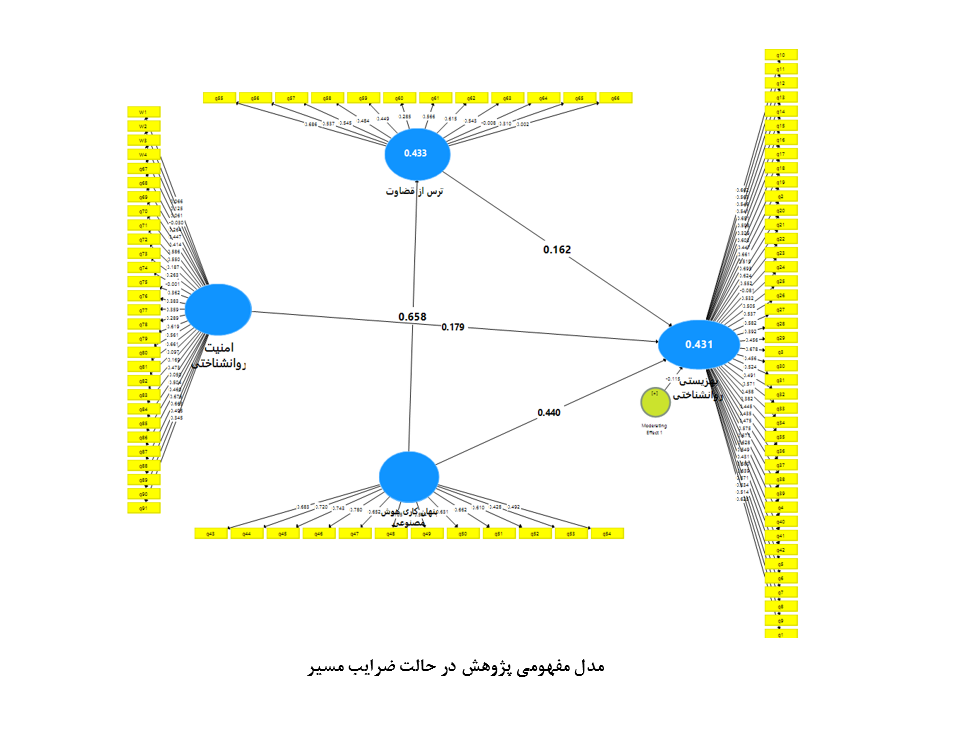
پژوهش حاضر با هدف بررسی تأثیر پنهانکاری در استفاده از هوش مصنوعی مولد بر بهزیستی روانشناختی کارکنان با نقش میانجی ترس از قضاوت شغلی و نقش تعدیلگر امنیت روانشناختی انجام شد. این پژوهش از نظر هدف کاربردی و از نظر روش توصیفی-همبستگی بود و با استفاده از مدلسازی معادلات ساختاری مبتنی بر حداقل مربعات جزئی انجام شد. جامعه آماری شامل کارکنان بانک ملی ایران در شعب شهر تهران بود که 384 نفر با استفاده از روش نمونهگیری خوشهای و بر اساس جدول کرجسی و مورگان انتخاب شدند. ابزارهای گردآوری دادهها شامل پرسشنامه 12 گویهای پنهانکاری در فناوری اطلاعات و ارتباطات، مقیاس 42 گویهای بهزیستی روانشناختی ریف، مقیاس 12 گویهای ترس از ارزیابی منفی و مقیاس 29 گویهای امنیت روانشناختی بود. روایی ابزارها از طریق روایی محتوایی و روایی همگرا و پایایی آنها با استفاده از آلفای کرونباخ و پایایی ترکیبی بررسی شد. تحلیل دادهها با استفاده از نرمافزار SmartPLS انجام گرفت. نتایج نشان داد پنهانکاری در استفاده از هوش مصنوعی مولد اثر مثبت و معناداری بر ترس از قضاوت شغلی داشت (β=0.658، T=12.436). ترس از قضاوت شغلی نیز اثر مثبت و معناداری بر بهزیستی روانشناختی نشان داد (β=0.162، T=3.214). اثر مستقیم پنهانکاری بر بهزیستی روانشناختی مثبت و معنادار بود (β=0.440، T=8.127) و امنیت روانشناختی نیز اثر مثبت و معناداری بر بهزیستی روانشناختی داشت (β=0.179، T=3.586). اثر تعدیلگری امنیت روانشناختی منفی و معنادار بود (β=-0.115، T=2.417). همچنین، اثر غیرمستقیم پنهانکاری بر بهزیستی روانشناختی از طریق ترس از قضاوت شغلی معنادار بود (β=0.107، T=2.563) که نشاندهنده میانجیگری جزئی بود. یافتهها نشان دادند که پنهانکاری در استفاده از هوش مصنوعی مولد با تجربه روانشناختی کارکنان ارتباط معناداری دارد و بخشی از این رابطه از طریق ترس از قضاوت شغلی تبیین میشود، در حالی که امنیت روانشناختی میتواند شدت این رابطه را تعدیل کند؛ بنابراین، ایجاد فضای سازمانی امن و تدوین سیاستهای شفاف درباره استفاده از هوش مصنوعی میتواند به استفاده سالمتر و مسئولانهتر از این فناوری کمک کند.
دانلودها
مراجع
1. Yu B, Kumbier K. Artificial intelligence and statistics. Frontiers of Information Technology & Electronic Engineering. 2018. doi: 10.1631/FITEE.1700813.
2. Chakoory O. DeepMPTB: A vaginal microbiome-based deep neural network as artificial intelligence strategy for efficient preterm birth prediction. Biomarker Research. 2024. doi: 10.1186/s40364-024-00557-1.
3. Bankins S, Ocampo AC, Marrone M, Restubog SLD, Woo SE. A multilevel review of artificial intelligence in organizations: Implications for organizational behavior research and practice. Journal of Organizational Behavior. 2024;45(2):159-82. doi: 10.1002/job.2735.
4. Budhwar P, Chowdhury S, Wood G, Aguinis H, Bamber GJ, Beltran JR, et al. Human resource management in the age of generative artificial intelligence: Perspectives and research directions on ChatGPT. Human Resource Management Journal. 2023;33(3):606-59. doi: 10.1111/1748-8583.12524.
5. Dwivedi YK, Hughes L, Ismagilova E, Aarts G, Coombs C, Crick T, et al. Artificial intelligence (AI): Multidisciplinary perspectives on emerging challenges, opportunities, and agenda for research, practice and policy. International Journal of Information Management. 2021;57:101994. doi: 10.1016/j.ijinfomgt.2019.08.002.
6. Wach K, Duong CD, Ejdys J, Kazlauskaitė R, Korzynski P, Mazurek G, et al. The dark side of generative artificial intelligence: A critical analysis of controversies and risks of ChatGPT. Entrepreneurial Business and Economics Review. 2023;11(2):7-30. doi: 10.15678/EBER.2023.110201.
7. Capraro V, Lentsch A, Acemoglu D, Akgun S, Akhmedova A, Bilancini E, et al. The impact of generative artificial intelligence on socioeconomic inequalities and policy making. PNAS Nexus. 2024;3(6):pgae191. doi: 10.1093/pnasnexus/pgae191.
8. Chen X, Zhang Y, Li Y. ICT secrecy and its implications: Development and validation of a measurement scale. Computers in Human Behavior. 2021;123:106784. doi: 10.1016/j.chb.2021.106784.
9. Averkin A, Bazarkina D, Pantserev K, Pashentsev E, editors. Artificial intelligence in the context of psychological security: Theoretical and practical implications. 11th Conference of the European Society for Fuzzy Logic and Technology (EUSFLAT 2019); 2019: Atlantis Press.
10. Bazarkina D, Mikhalevich EA, Pashentsev E, Matyashova D. The threats and current practices of malicious use of artificial intelligence in psychological security in China. The Palgrave handbook of malicious use of AI and psychological security. Cham: Springer International Publishing; 2023. p. 335-75.
11. Elfeky R. The role of artificial intelligence in achieving psychological well-being and quality of life among university students. 2026.
12. Luan B, Li Y. How smart companions reshape psychological well-being in later life: The role of artificial intelligence technology in mental health during senior years. BMC Public Health. 2026. doi: 10.1186/s12889-026-26328-1.
13. Wang Y. How artificial intelligence influences psychological well-being and physical performance in sports. Journal of Visualized Experiments. 2026. doi: 10.3791/71763.
14. Soleimanpour S, Seddighi T, Fard M, Zamani K. The relationship between the use of artificial intelligence and anxiety, dependence, and psychological well-being of students. 2026.
15. Schilhabel S, Sankaranarayanan B, Subedi M, Muraski J. Exploring the impact of artificial intelligence on psychological well-being and inclusivity in higher education. Journal of Information Communication and Ethics in Society. 2026. doi: 10.1108/JICES-09-2025-0238.
16. Geruganti S. Mental health and sustainable policing: Integrating psychological well-being, occupational resilience, artificial intelligence, and organizational support for effective law enforcement. 2026.
17. Leary MR. A brief version of the Fear of Negative Evaluation Scale. Journal of Personality Assessment. 1983;47(1):66-71. doi: 10.1207/s15327752jpa4701_8.
18. Morton L, Cogan N, Kołacz J. A new measure of feeling safe: Developing psychometric properties of the Neuroception of Psychological Safety Scale (NPSS). Psychological Trauma: Theory, Research, Practice, and Policy. 2022;14(6):1105-14. doi: 10.1037/tra0001313.
19. Asonge L. Artificial intelligence readiness and service innovation performance in hospitality: The role of employee digital self-efficacy and psychological safety. International Journal of Social Sciences and Education Research. 2026. doi: 10.24289/ijsser.1772005.
20. Radianti J, Majchrzak TA, Fromm J, Wohlgenannt I. A systematic review of immersive virtual reality applications for higher education: Design elements, lessons learned, and research agenda. Computers & Education. 2020;147:103778. doi: 10.1016/j.compedu.2019.103778.
دانلودها
گاهشمار انتشار
- ارسال
- بازنگری
- پذیرش
شماره
نوع مقاله
مجوز
حق نشر 2025 Monire Noorbakhsh Moghadam (Author); Rokhsareh Banisafar (Corresponding author); Namdar Asghari, Hassan Salavati (Author)

این پروژه تحت مجوز بین المللی Creative Commons Attribution-NonCommercial 4.0 می باشد.