Identification and Ranking of the Fundamental Components of Peace Education Curriculum in Primary Schools from the Perspective of Experts
DOI:
https://doi.org/10.61838/jsied.369Keywords:
Peace Education, Primary School, CurriculumAbstract
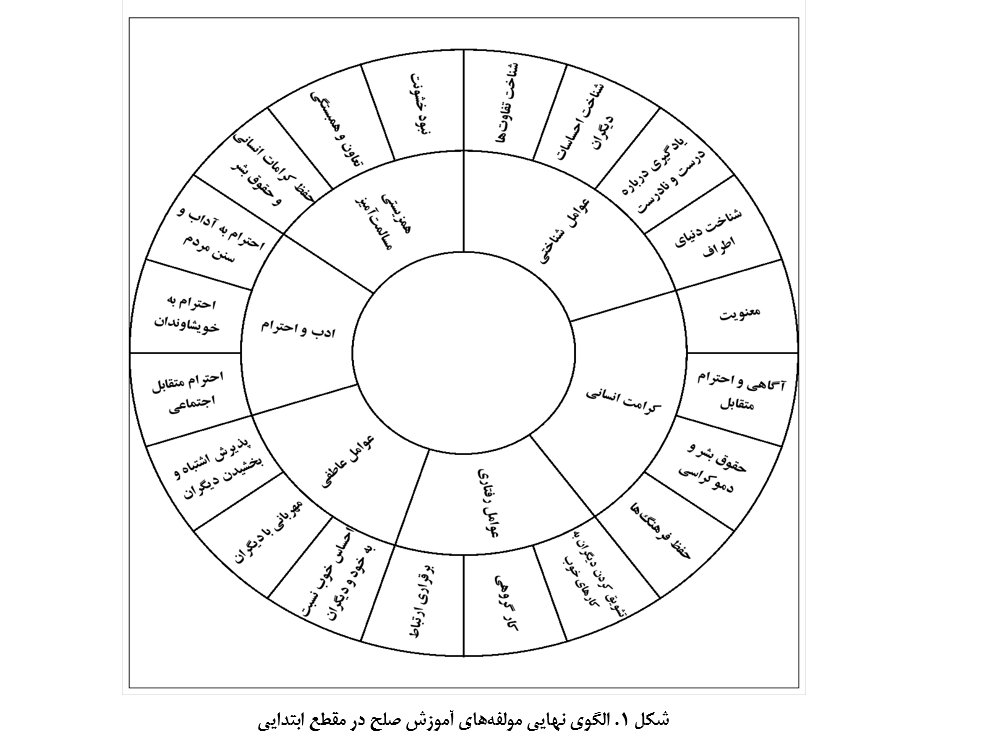
The study aimed to identify and rank the fundamental components of the peace education curriculum in primary schools from the perspective of experts. This applied research adopted a descriptive–analytical approach and a mixed exploratory design (qualitative–quantitative). In the qualitative phase, ten professors and Ph.D. students in curriculum studies at Allameh Tabataba’i University were selected through purposive sampling until theoretical saturation. Semi-structured interviews were analyzed using a three-stage thematic analysis method. In the quantitative phase, the statistical population comprised 890 primary school teachers in Khorramabad during the 2024–2025 academic year. A researcher-made questionnaire based on qualitative findings was distributed among 115 participants selected through convenience sampling. Data were analyzed using confirmatory factor analysis with PLS software. The qualitative findings identified five key components of peace education: peaceful coexistence, human dignity, cognitive factors, emotional factors, and behavioral factors. Quantitative results confirmed the significance of all components at the 99% confidence level. Among them, cognitive factors had the highest factor loading (0.85), followed by human dignity, behavioral factors, emotional factors, and peaceful coexistence. Peace education in primary schools is a multidimensional process requiring simultaneous attention to children’s cognitive, emotional, behavioral, and moral domains. The findings highlight that integrating peace education into the curriculum through cognitive development, emotional literacy, and social skill training can foster peace-oriented attitudes and responsible citizenship among young learners.
Downloads
References
Barash DP, Webel CP. Peace and conflict studies: Sage Publications; 2021.
Bano A, Ali S, Iqbal S. Individual Peacebuilding in the Elementary Schools: Voices of Punjab, Pakistan. Pakistan JL Analysis & Wisdom. 2024;3:37.
Sedighi MR. Peace and education: Examining the role of education in promoting sustainable peace. Tehran: Institute for Humanities and Cultural Studies; 2013.
Unesco. Learning for Lasting Peace: A Global Perspective on Peace Education in Schools. 2023.
Mohammadi M, Shafiei M, Khoshbakht F, Jamalabadi M. An empirical study of the impact of a peace-oriented curriculum on anger management in preschool children. Curriculum Studies. 2016;11(42):53-94.
Galtung J. Violence, peace and peace research. Organicom. 2018;15(28):33-56. doi: 10.11606/issn.2238-2593.organicom.2018.150546.
Barbey C. Soft justice for all three levels of peace. 2018.
Purwanto Y, Suprapto, Munaf DR, Albana H, Marifataini LD, Siregar I, et al. The peace education concept and practice at universities: A systematic review. Cogent education. 2023;10(2):2260724. doi: 10.1080/2331186X.2023.2260724.
Zembylas M, Charalambous C, Charalambous P. Peace education in a conflict-affected society: Cambridge University Press; 2016.
Moradian A, Ghodusi A, Mohammadzadeh Moghadam F, Dehnavi A, editors. Examining the role of teachers in promoting a culture of peace and peaceful coexistence. 19th National Conference on Management and Humanities Research in Iran; 2024; Tehran.
Abdullah MRTL, Isa MPM, Sabian NAA, Siraj S, editors. Peace education curriculum objectives for Malaysian higher tertiary education: A fuzzy delphi approach. SHS Web of Conferences; 2021.
Shakibaei D, Iranpanah A, Ahui N, Faghirzehi Motlagh O, editors. Multicultural education and its impact on peaceful coexistence in schools. 20th National Conference on Law, Social Sciences and Humanities, Psychology and Counseling; 2025; Shirvan.
Rizwan S, Huma A, Hanif RH. Content Analysis of Peace Education Themes in English Textbooks from Elementary Curriculum in Punjab. Dialogue Social Science Review (DSSR). 2025;3(1):1120-33.
Mousavi Nadoushan FS, Nili Ahmadabadi MR, Nistāni MR. A phenomenological exploration of teachers' core competencies for achieving the social and political education domain. Applied Sociology. 2022;33(4):29-48.
Valikhani K, Salehi A, Sajadi SM, Keshavarz S. Analysis of peace education components in the discursive documents of the Ministry of Education. Sociology of Social Institutions. 2022;9(20):59-80. doi: 10.22080/ssi.2022.24042.2023.
Zarbi Qaleh Hammami S. Qualitative content analysis of 7th-grade social studies textbooks based on UNESCO peace components. Research in Social Studies Education. 2022;4(3):51-78.
Sabzikarian Z, Aṭhari ZS. A comparative analysis of peace education components in social studies textbooks before and after the transformation document. Andisheh-haye Nowin-e Tarbeyati. 2024;19(3):25-40.
Abdollahi M, Mashinchi AA, Ghaltash A. The position of peace and human rights in social studies curriculum in lower secondary education. Legal Research. 2024;2(3):25-40. doi: 10.48300/jlr.2024.448618.2598.
Shekari A. Evaluating the education of human rights components in Iran's curriculum. International Human Rights Biannual. 2015;10(1):49-70.
Jalil MA. Exploring the Intersection of Sociology and Business for Global Peace: A Systematic Review of Contemporary Approaches. Pacific Journal of Business Innovation and Strategy. 2025;2(1):27-33. doi: 10.70818/pjbis.2025.v02i01.025.
Kleindienst P. The role of education on human dignity: Fostering peace and diminishing violence. Religions. 2024;15(1):66. doi: 10.3390/rel15010066.
Institute for E, Peace. Global Peace Index 2023: Measuring peace in a complex world. Sydney: IEP, 2023.
Özel Şen D. THE EFFECT OF PEACE EDUCATION PROGRAM ON CONFLICT RESOLUTION SKILLS OF 4TH GRADE STUDENTS. 2024.
Van Ryzin MJ, Roseth CJ. Effects of cooperative learning on peer relations, empathy, and bullying in middle school. Aggressive behavior. 2019;45(6):643-51. doi: 10.1002/ab.21858.
Velez G. Learning peace: Adolescent Colombians' interpretations of and responses to peace education curriculum. Peace and Conflict: Journal of Peace Psychology. 2021;27(2):146. doi: 10.1037/pac0000519.
Atsani LGMZ, Hadisaputra P. Promoting harmony and renewal: The transformation of peace education within the islamic education curriculum. Journal of Research in Instructional. 2024;4(1):1-11. doi: 10.30862/jri.v4i1.303.
Apriliana E, Junaedi M, Ikhrom I. Islamic religious education and the global ethics: opportunities and challenges towards peace education in Indonesia. LISAN AL-HAL: Jurnal Pengembangan Pemikiran Dan Kebudayaan. 2023;17(1):83-97. doi: 10.35316/lisanalhal.v17i1.83-97.
Gonda D, Tirpáková A, Pavlovičová G, Ďuriš V. The role of a team psychological safety feeling in teamwork in the classroom. Heliyon. 2024;10(18). doi: 10.1016/j.heliyon.2024.e37618.
Kozlowski SW. Enhancing the effectiveness of work groups and teams. Perspectives on Psychological Science. 2018;13(2):205-12. doi: 10.1177/1745691617697078.
Goetze C. The distinction of peace: A social analysis of peacebuilding: University of Michigan Press; 2016.
Rezaei S, Ramazan Zadeh Rostami A. Peace education through literary works in English language classes. Ofogh-haye Zaban. 2024;5(8):55-70.
Hayat Z, Sarwar M. An analytical study of secondary school textbooks with reference to peace values. Pakistan Journal of Distance and Online Learning. 2022;4(2).
Rubab U, Yousuf MI, Dahar MA. Analysis of Peace Education in Social Studies Curriculum at Elementary Level. Journal of Educational Sciences & Research. 2021;8(1).
Yastibas AE. Integrating peace education into English language teaching in primary schools. International Online Journal of Primary Education (IOJPE). 2021;10(2):308-18.
Kuter S, Sanal-Erginel S. An analysis of a social sciences curriculum from the perspective of critical peace education. Compare: A Journal of Comparative and International Education. 2025:1-17. doi: 10.1080/03057925.2025.2452456.
Nurhadi I, Amali M, Aulia RN. Peace Culture in School: Analyzing the Wahid Foundation's Peace School Program. Tribakti: Jurnal Pemikiran Keislaman. 2023;34(1):139-52. doi: 10.33367/tribakti.v34i1.3079.
Garshasbi E, Fathi Vajargah K, Arefi M. The place of ethnicity in the hidden curriculum of upper secondary education. Curriculum Studies. 2021;16(61):27-58.
Downloads
Publication Timeline
- Submitted
- Revised
- Accepted
Issue
Section
License
Copyright (c) 2025 Shahla Bahrami (Author); Hasan Maleki (Corresponding author); Mostafa Ghaderi (Author)

This work is licensed under a Creative Commons Attribution-NonCommercial 4.0 International License.