Identification and Prioritization of Media Influencing Indicators on Fashion and Clothing in Iran: A Qualitative Study
DOI:
https://doi.org/10.61838/jsied.408Keywords:
Fashion and clothing, media, Delphi technique, influencing indicators, media modelingAbstract
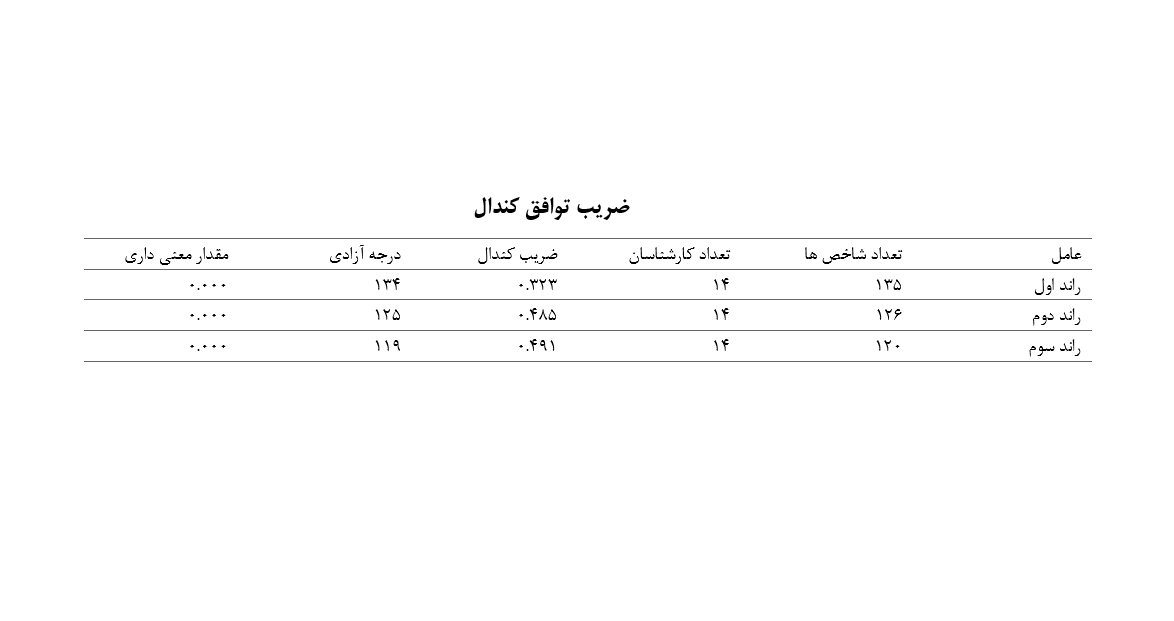
This study aimed to identify, prioritize, and conceptualize the indicators influencing media roles in shaping fashion and clothing patterns in Iran by developing a culturally grounded model. A qualitative Delphi-based design was applied, involving 14 experts from media, fashion, and clothing sectors, selected through purposive and snowball sampling. An initial pool of 135 indicators extracted from meta-analysis was refined through three Delphi rounds to 120 final indicators. Open-ended and Likert-scale questionnaires were used for data collection. Kendall’s coefficient of concordance measured expert agreement, and Friedman’s test was employed to rank the indicators. Results revealed 14 key dimensions and 120 validated indicators significantly influencing media performance in the fashion domain. Kendall’s coefficient in the third round (W = 0.491, p = 0.000) indicated substantial agreement among experts. Friedman’s ranking showed “national branding,” “social media platforms,” “electronic commerce,” “virtual stores,” and “live shows” as top influential indicators. The final framework was structured into four layers: infrastructural, process-oriented, communicative, and outcome-oriented, with the outcome layer—particularly the “clothing” dimension—emerging as the strongest output factor affected by media. The study provides a comprehensive and indigenous analytical model that clarifies how media shape fashion consumption, cultural identity, and clothing preferences in Iran. The findings highlight the central role of national branding, digital media ecosystems, and cultural identity-building in guiding strategic policy, content production, and the development of native media platforms in the fashion industry.
Downloads
References
Entwistle J. The fashioned body: Fashion, dress and modern social theory: Polity Press; 2015.
Unctad. Creative economy outlook: Trends in international trade in creative industries. United Nations, 2021.
Hesmondhalgh D. The cultural industries: Sage; 2019.
Gerbner G. Living with television: The violence profile. Journal of Communication. 1976;26(2):172-99. doi: 10.1111/j.1460-2466.1976.tb01397.x.
McLuhan M. Understanding media: The extensions of man: McGraw-Hill; 1964.
Rocamora A. Mediatization and digital media in the field of fashion. Fashion Theory. 2017. doi: 10.1080/1362704X.2016.1173349.
Berg SH, Rocamora A. Influencers, visual culture, and fashion consumption in algorithmic media environments. Fashion Theory. 2024;28(3):415-38.
Moro S, Rita P. Brand management and consumer motivations: A study on fashion engagement in social media. Journal of Retailing and Consumer Services. 2018;44:311-20.
Nash J. Investigating the impact of social media on fashion consumer decisions. Journal of Marketing and Fashion Management. 2018:269-86.
Nobre H, Ferreira A, Luis S. Social media platforms and sustainable fashion consumption: The role of digital persuasion. Journal of Retailing and Consumer Services. 2024;76:103692.
Vladimirova K, Evans C. Exploring the influence of social media on sustainable fashion consumption: A systematic literature review and future research agenda. Journal of Global Fashion Marketing. 2023. doi: 10.1080/20932685.2023.2237978.
Moridi M, Rahgozar M. Aesthetic developments in fashion in Iran after the revolution. Iranian Social Studies. 2016:129-50.
Moeini M. Identifying the causes and consequences of women's tendency towards fashion with a grounded theory approach. Women's Psychosocial Studies. 2020:31-60.
Afrough A, Mehrabanifar M. Prioritizing fashion media policy in Iran. Quarterly Journal of Culture-Communication Studies. 2017;19:15-45.
Hajishams M. Analysis of the status of fashion and apparel media in Iran. Quarterly Journal of Cultural and Communication Studies. 2018;15(4):75-96. doi: 10.1080/14791420.2018.1435083.
Yaghooti N. Studying the economic and cultural development strategy of the fashion industry in Iran. Quarterly Journal of Cultural and Art Economics Research. 2019:57-76.
Zomorodian A, Lu J. The role of Instagram in the increase of clothing sales: A case study. International Journal of Digital Marketing. 2018;4(1):112-25.
Downloads
Publication Timeline
- Submitted
- Revised
- Accepted
Issue
Section
License
Copyright (c) 2025 Farhad Amirkhani (Author); Mahnaz Ronaghi Notash (Corresponding author); Abdorreza Shahmohammadi (Author)

This work is licensed under a Creative Commons Attribution-NonCommercial 4.0 International License.