Identifying the Dimensions, Components, and Indicators of Cultural Management from the Perspective of Nahj al-Balaghah
Keywords:
Cultural management, Nahj al-Balaghah, cultural governance, thematic analysis, Islamic managementAbstract
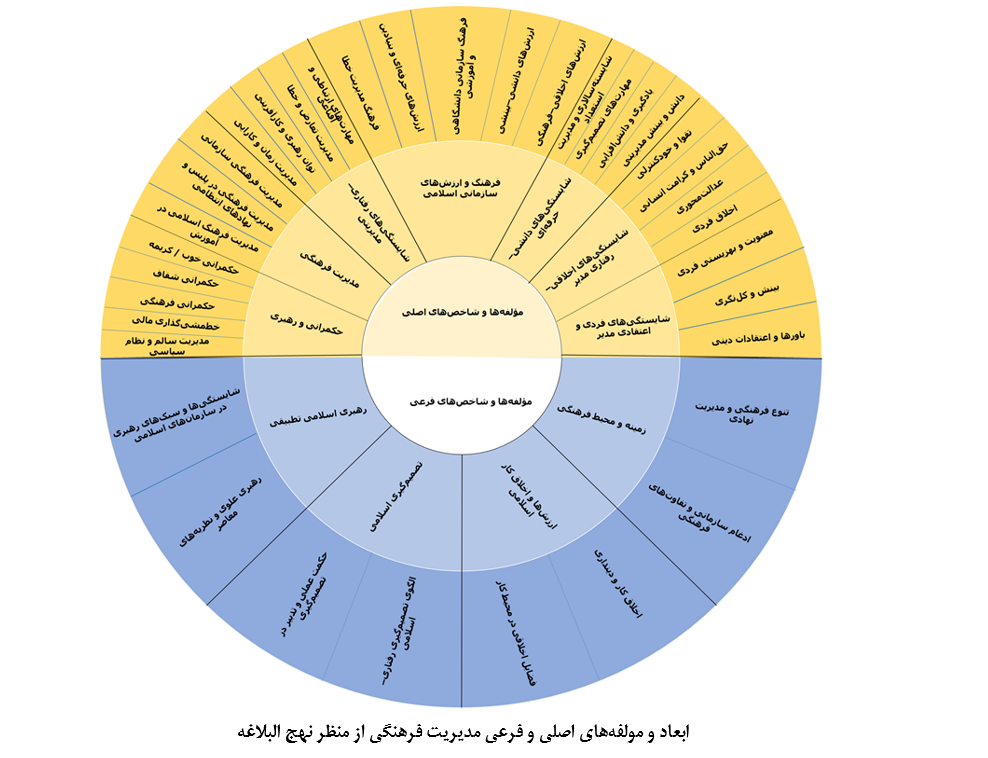
This study aims to systematically identify and conceptualize the main and subsidiary dimensions, components, and indicators of cultural management based on the teachings of Nahj al-Balaghah. Adopting a qualitative and applied approach, the study employed thematic analysis. Fifteen experts—including university and seminary scholars familiar with Islamic texts and experienced cultural managers—were selected through purposive and snowball sampling. Data were collected via semi-structured interviews and analyzed following Braun and Clarke’s thematic analysis framework using MAXQDA 2020. Credibility was enhanced through prolonged engagement with the data, follow-up questioning, member checking, and triangulation of perspectives. The analysis yielded 140 basic themes, 28 organizing themes, and 7 global themes as the core elements of cultural management: managers’ individual and belief-based competencies, ethical–behavioral competencies, knowledge–professional competencies, behavioral–managerial competencies, Islamic organizational culture and values, governance and leadership, and cultural management. Additionally, 42 basic themes, 8 organizing themes, and 4 global themes were identified as subsidiary elements, namely cultural context and environment, Islamic work values and ethics, Islamic decision-making, and adaptive Islamic leadership. These findings indicate a multilayered, value-driven model of cultural management rooted in Islamic teachings. Cultural management from the perspective of Nahj al-Balaghah constitutes an integrated system grounded in a theocentric worldview, justice, human dignity, and ethical leadership, offering a comprehensive framework for cultural policymaking and governance in Islamic societies.
Downloads
References
Tylor EB. The science of culture [1873]. Readings for a history of anthropological theory2021. p. 19-31.
Kovalenko Y. The Culture of Economic Life of Society: Essence, Basic Values, Management. Socio-Cultural Management Journal. 2022;5(2):38-67. doi: 10.31866/2709-846X.2.2022.267514.
Rahmani. Necessities of Strategic Cultural Management in Seminaries in the Era of Globalization. Strategic Studies in Public Policy. 2011;2(2):19-46.
Najafbeigi R, Azizabadi Farahani F. Designing a Model for Measuring the Impact of National Media on Cultural Development. Cultural Management Journal. 2008;2(2):1-22.
Bonyanian H. The Role of Government in Cultural Affairs, Interview and Discussion. Cultural Engineering Journal. 2006(4):16-9.
Makarem Shirazi N. Management and Leadership in Islam. 3rd ed. Qom: Hadaf; 1989.
Anaqeh A, Karami H, Aghasi S. Islamic Management with an Alawi Perspective. Management and Entrepreneurship Studies Quarterly. 2016(3).
Rajai Z, Shabani M. Analyzing Some Essentials of Islamic Management and Governance in Letter 53 of Nahj al-Balagha. Governance and Development. 2025;4(1):115-36. doi: 10.22111/jipaa.2024.426390.1145.
NoorAlizadeh M. Characteristics of Cultural Management from the Perspective of Nahj al-Balagha. Tehran: Islamic Republic of Iran Broadcasting, Political Deputy: Department of Political Research; 2019.
Shakeri M. The Impact of Ethics on Management: A Perspective from Nahj al-Balagha. Cultural Affairs Management. 2025;6(2):183-90.
Nikzadeh H, Hajibabaei HR, Rezazadeh Asgari Z, Valikhani M, Vahid J. Presenting a Competency Model for Cultural Managers from the Perspective of Nahj al-Balagha. Applied Issues in Islamic Education and Training. 2023;8(3):103-28.
Faramarznasab R, Khodri M, Heidari R. Characteristics of Imam Ali's (AS) Disciples as Cultural Managers and Educators. Strategic Research in Education and Training. 2025;21:19-43.
Kordheidari R, Amini SJ. Examining the Visionary, Attitudinal, and Behavioral Characteristics of Managers from the Perspective of Nahj al-Balagha: A Meta-Analysis of Texts. Quarterly Journal of Religion, Spirituality, and Management. 2025;11(21):61-85. doi: 10.30471/rsm.2024.10350.1394.
Mamhoori DA. Timeless Leadership: Insights from Selected Letters of Imam Ali in Nahj al-Balagha and Their Comparison with some Contemporary Leadership Theories. SSRN Electronic Journal. 2025. doi: 10.2139/ssrn.5250156.
Nilchi M, Khanifar H, PourAzat AA. Designing a Cultural Governance Evaluation Model in Light of Nahj al-Balagha. Scientific Journal of Organizational Culture Management. 2025. doi: 10.22059/jomc.2024.380906.1008698.
Munkar AMRN, Shodiq JF, Walid A. An Exploration of Islamic-Based Institutional Management Models in Madura: Between Cultural Diversity and Organizational Effectiveness. JUMPA: Jurnal Manajemen Pendidikan. 2023;4(2):82-96. doi: 10.33650/jumpa.v4i2.9281.
Sheikh Mohammadi K. Examining the Value Components of Cultural Management in Nahj al-Balagha [Master's Thesis]: Islamic Azad University, Tehran Central Branch; 2014.
Pourkiani M, Soozanchi H, Hajipour Karimi MS. Analyzing the Concept of Human in Cultural Policy Approaches. Interdisciplinary Civilizational Studies of the Islamic Revolution. 2023;1(4):33-56.
Mouliniere P, Hashemi Gilani A. Professional Training for Cultural Managers. Tehran: Center for Fundamental Research Publications; 1993.
Azimi N, Nouroozi MT, Rahimi MR. Designing and Explaining the Entrepreneurial Management Model from an Islamic Perspective (With Emphasis on the Quran and Nahj al-Balagha). Quran and Science. 2025;19(36):319-51. doi: 10.22034/qve.2025.17936.1716.
Downloads
Publication Timeline
- Submitted
- Revised
- Accepted
Issue
Section
License
Copyright (c) 2025 Mahmood Zamani Qomi, Ali Akbar Rezaie, Fateme Azizabadi Farahani (Author)

This work is licensed under a Creative Commons Attribution-NonCommercial 4.0 International License.