Explaining Realism Based on the Holy Qur’an and Its Educational Implications for the Elementary Education System
DOI:
https://doi.org/10.61838/jsied.472Keywords:
Quranic teachings, primary education, educational themes, moral development, ontological realismAbstract
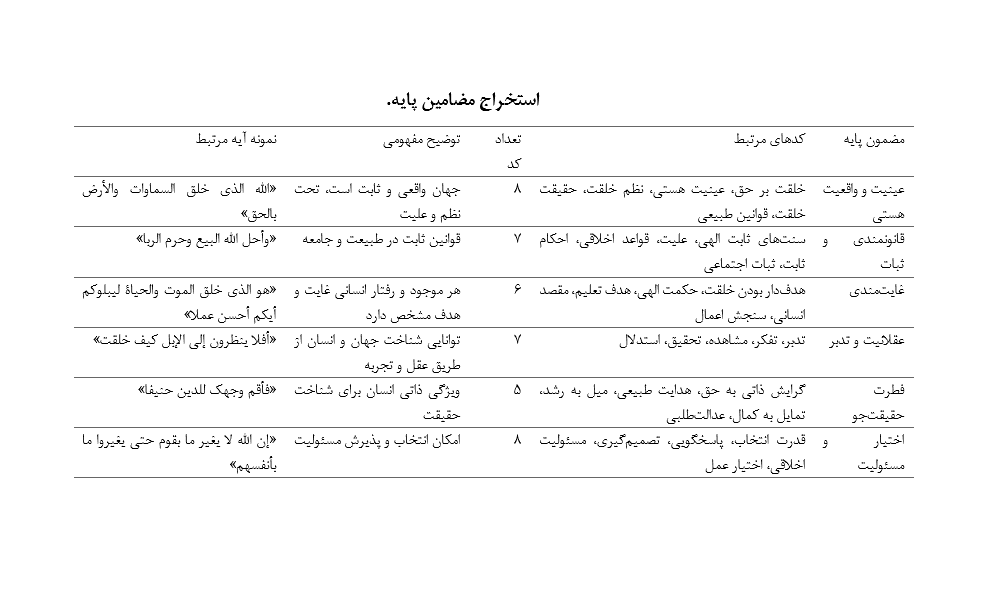
The present study aimed to identify, conceptualize, and validate Qur’an-based dimensions of realism and to formulate their educational implications for curriculum design and educational practices in elementary education. This mixed-methods study employed both qualitative and quantitative approaches. In the qualitative phase, 30 selected Qur’anic verses were analyzed through open and axial coding to extract foundational, organizing, and overarching educational themes. In the quantitative phase, a 30-item questionnaire was developed based on the extracted components. Data collected from elementary school teachers and students were analyzed using SmartPLS, confirmatory factor analysis, Average Variance Extracted (AVE), and Composite Reliability (CR) indices. The inferential findings revealed the extraction of 30 educational components, 6 basic themes, 5 organizing themes, and 6 overarching educational themes. The final framework consisted of ontological realism, epistemological realism, anthropological realism, developmental growth and experiential learning, social responsibility, and ethics and benevolence. Structural validation results demonstrated satisfactory convergent validity and internal consistency across all dimensions, with AVE values ranging from 0.66 to 0.72 and CR coefficients ranging from 0.83 to 0.88, indicating strong construct validity and reliability of the proposed model. The findings suggest that Qur’anic teachings provide a coherent and comprehensive foundation for educational theory and practice in elementary schooling. The proposed model integrates cognitive, moral, social, and developmental dimensions and offers a scientifically grounded framework for curriculum development, instructional planning, and character education. Its application may contribute to nurturing responsible, reflective, ethical, and reality-oriented learners within contemporary elementary education systems.
Downloads
References
1. Hamedi AK, Rezaei S, Osareh A, Karimi Khoigani RH. Education of student-teachers at Farhangian University with emphasis on the Holy Quran. Quran and Medicine. 2021;6(2):73-83.
2. Gholami N, Marivani QH. A look at the foundations of education for students with special needs from the perspective of the Quran. Quranic Science Studies. 2021;3(3):138-66.
3. Abbasian A, Hajizad M, Mirian Akandi SA. Investigating the philosophical foundations of human education in the Holy Quran. Islamic Life Style Centered on Health. 2022;6(4):372-81.
4. Alizadeh F, Hosseini Mirsafi MS, Shirazi MR. De-bordering the Quranic concept of education: In pursuit of providing a novel explanation of Quranic education. Research in Islamic Education Issues. 2023;31(60):237-58.
5. Afchangi M, Alimohammadi A, Mirani A, Mousavi SR. Luqmanic education in the conduct of the leaders of the Islamic Revolution, within the approach of the Holy Quran. Journal of Islamic Revolution Research. 2022;11(1):147-67.
6. Mousavi SN. An analysis of education based on the sixth verse of Surah At-Tahrim. Research in Islamic Education Issues. 2025;33(66):113-32.
7. Hatefi Ardakani J, Shamrizi SH, Ghaemi M. Explaining the principles of effective teaching in all-round education from the perspective of the Quran and narrations. Educational Teachings in the Quran and Hadith. 2024;10(2):23-43.
8. Dayalameh N. Educational implication research in the Quranic theory of social lawfulness. Educational Teachings in the Quran and Hadith. 2022;8(1):143-58.
9. Ejlali Z, Momeni Mahmooei H, Ali M. Quranic stories as religious education content for the elementary period in the Philosophy for Children (P4C) content approach. Educational Teachings in the Quran and Hadith. 2022;8(1):123-41.
10. Pourmohammadi SR, Morovati S, Ehsani K. Explaining the concept of spiritual intelligence in the verb "Yahdi" extracted from Quranic verses and the role of its components in spiritual education. Educational Teachings in the Quran and Hadith. 2021;7(2):1-23.
11. Beheshti S, Maleki H, Asadzadeh H, Fatemi M. Educational strategies derived from Quranic anthropology with emphasis on the role of tendencies in human existence. Journal of Quranic Knowledge. 2022;13(48):65-94.
12. Hakimi SY, Salashouri A, Fayyaz I. Implications of the semantic connection between life and education in verse 24 of Surah Al-Anfal and its impact on the foundations of Islamic education. Research in Islamic Education Issues. 2024;32(63):117-44.
13. Hakimi SY, Salashouri A, Fayyaz I. Framework of the Velayi education approach in the school of Imam Khomeini based on the Quranic metaphor of the "Good Tree" and the "Wisdom-Based" model of Luqman the Wise. Research in Islamic Education Issues. 2023;31(59):273-332.
14. Sohbatloo A. Comparison of religious education components in the Fundamental Reform Document of Education with the views of Avicenna. Research in Islamic Education Issues. 2024;32(63):61-90.
15. Niyaraeis SM, Saadatmand Z, Rahmani J. Analysis of the concept of moderation in Quranic teachings regarding individual and social health in order to provide educational requirements. Quran and Medicine. 2022;7(3):109-18.
16. Tavan A, Hafezi M. The status of the ethics of tolerance with learners and examining its components in Quranic education with emphasis on the exemplary role of Divine Prophets. Ethics Research. 2023;6(3):63-80.
17. Davoodi M. Indicators of faith and piety in the Quran and their implications for formulating a comprehensive approach to religious education. Islamic Education. 2025:41-72.
18. Barahman M, Hosseini M. Explaining educational principles regarding the correction of human behavioral pathology based on the Holy Quran. Research in Islamic Education Issues. 2025;33(69).
19. Ordo F, Arabzadeh E. Ideation in the academic education system; a culture-oriented comparison with verses of the Holy Quran. Educational Sciences. 2024;31(1):241-58.
20. Mehrjoo P, Jafarzadeh M, Masoumifard M. Explaining the nature of chaste education based on Quranic teachings and its implications in the field of education. Educational Teachings in the Quran and Hadith. 2025:e731433.
21. Samadi M. Identifying the consequences of memorizing Quranic verses on the performance of Quranic memorizers. Research in Islamic Education Issues. 2023;31(59):333-60.
Downloads
Publication Timeline
- Submitted
- Revised
- Accepted
Issue
Section
License
Copyright (c) 2025 Fatemeh Sahraii Parizi (Author); Irandokht Fayyaz (Corresponding author); Ahmad Salahshoori , Ahmad Borjali , Maryam Brahman (Author)

This work is licensed under a Creative Commons Attribution-NonCommercial 4.0 International License.