Design and Validation of a Competency-Based Individual Empowerment Model in Law Enforcement Organizations: A Case Study of the Law Enforcement Command of the Islamic Republic of Iran
Keywords:
Individual empowerment, professional competence, law enforcement command, human resource management, structural equation modeling, data-driven theory.Abstract
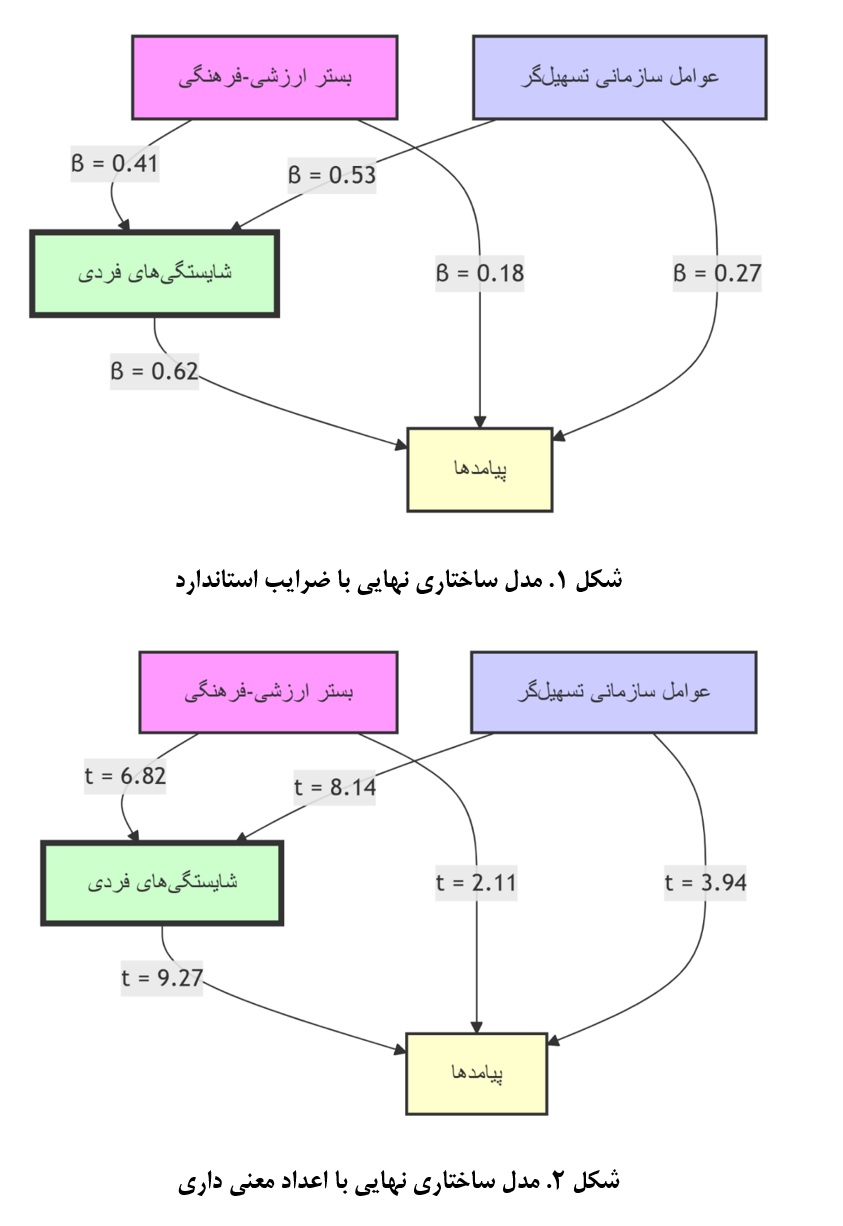
This study aimed to design and validate a competency-based individual empowerment model for personnel of the Law Enforcement Command of the Islamic Republic of Iran. This developmental-applied study employed an exploratory sequential mixed-methods design. In the qualitative phase, grounded theory based on the systematic Strauss and Corbin approach was used, and data were collected through semi-structured interviews with 10 senior managers, commanders, and experts in human resources and training until theoretical saturation was achieved. Qualitative data were analyzed through open, axial, and selective coding. In the quantitative phase, 371 law enforcement personnel were selected using proportional stratified sampling. A researcher-developed questionnaire derived from the qualitative findings was used for data collection. Confirmatory factor analysis, the Friedman test, and partial least squares structural equation modeling were used for data analysis. Qualitative analysis yielded 87 open codes, five major dimensions, and 25 components. The dimensions included value-cultural foundation, individual competencies, organizational facilitating factors, empowerment barriers, and outcomes. All factor loadings were statistically significant. Organizational facilitating factors ranked highest among the dimensions. Commander trust and support, ethical competence, and piety and integrity were the highest-ranked components within their respective dimensions. Organizational facilitating factors had a significant positive effect on individual competencies (β=0.53, p<0.001), while individual competencies had the strongest direct effect on outcomes (β=0.62, p<0.001). The overall goodness-of-fit index was 0.578, indicating satisfactory model fit. Competency-based individual empowerment in law enforcement is a multidimensional process shaped by the interaction of employees’ ethical and professional competencies with commander trust, appropriate autonomy, empowering training, organizational learning, and value-based organizational conditions. The proposed model demonstrated satisfactory empirical validity and can provide a framework for competency-oriented human resource development in law enforcement organizations.
Downloads
References
1. Heydarfard R, Rezayati A, editors. Employee Empowerment and Its Impact on Human Resource Performance and Organizational Productivity: A Review Study. 20th International Conference on Management and Humanities Research in Iran; 2025; Tehran.
2. Ameen AAM, Demire HG. Empowerment Strategy and Its Impact on Organizational. 2024.
3. Dyah Handayani DS, Hasanudin. Employee Empowerment as an Agent of Change toward a Sustainable Organization in the Green Economy Paradigm. Journal of Sustainable Development. 2024.
4. Llorente-Alonso M, García-Ael C, Topa G. A Meta-Analysis of Psychological Empowerment: Antecedents, Organizational Outcomes, and Moderating Variables. 2024;43(2):1759-84.
5. Park S, Kim E. The Role of Psychological Empowerment in Enhancing Organizational Performance: Evidence from Knowledge-Based Organizations. Sustainability. 2024;16(3):1287.
6. Oliveira M, Andrade JR, Ratten V, Santos E. Psychological Empowerment for the Future of Work: Evidence from Portugal. Global Business and Organizational Excellence. 2023. doi: 10.1002/joe.22194.
7. Nimran U, Al Musadieq M, Afrianty TW. Empowerment Effect on Competence and Organizational Commitments: Organizational Learning Culture as Moderating. 2024;7(2):2024038.
8. Mirzakhanzadeh M, Mokhtari A, editors. Examining the Necessity of Employee Empowerment in Iranian Public Organizations: A Case Study of the Mashhad Social Security Organization. Third International Conference and Sixth National Conference on Management, Psychology, and Behavioral Sciences; 2024.
9. Khoshhal F, Sargolzaei A, Vazifeh Z. Identifying the Components of an Administrative Employee Empowerment Model Based on Organizational Intelligence and Interpersonal Relations. Management and Education Perspective Quarterly. 2024;6(1):55-78.
10. Shafiei M, Jamshidi H, Ghiyasi M. Examining the Effect of Organizational and Individual Factors on Hospital Managers' Empowerment from the Perspective of Organizational Supervisory Levels. Management and Entrepreneurship Studies. 2024;10(47):231-46.
11. Smith TA. Empowering Environments: The Influence of Organizational Culture on Psychological Empowerment. Journal of Applied Psychology. 2024;109(1):50-67.
12. Pourghafari S, Manzari Tavakoli S, Salajegheh S, Dehghani S. The Impact of Organizational Culture on Employee Voice, with the Mediation of Employee Empowerment. Journal of Management Studies for Improvement and Transformation. 2024;32(108):223-73.
13. Alwali J. Innovative work behavior and psychological empowerment: the importance of inclusive leadership on faculty members in Iraqi higher education institutions. Journal of Organizational Change Management. 2024;37(2):374-90. doi: 10.1108/JOCM-03-2023-0084.
14. Supriyanto AS, Ekowati VM, Rokhman W, Ahamed F, Munir M, Miranti T. Empowerment Leadership as a Predictor of the Organizational Innovation in Higher Education. International Journal of Professional Business Review. 2023;8(2):e01538. doi: 10.26668/businessreview/2023.v8i2.1538.
15. Pourdavood MR, Aghighi A, editors. The Effect of Humble Leadership on Organizational Performance with the Mediating Role of Psychological Empowerment and Innovative Work Behavior. Proceedings of the Seventeenth International Conference on Management, Economics, and Development; 2023; Tehran.
16. Wang Y, Li X, Chen Z. Managerial Empowerment and Project Success in Complex Organizations: The Mediating Role of Collaborative Decision Making. Project Management Journal. 2025;56(1):72-89.
17. Nurcahyo SA. The Role of Organizational Learning Culture and Workplace Empowerment in Improving Workplace Spirituality Through Knowledge Sharing Behavior as a Mediation Variable. International Journal of Islamic Business Ethics. 2024;9(1):15. doi: 10.30659/ijibe.9.1.15-31.
18. Kranthi AK, Rai A, Showry M. Linking resonant leadership and learning organizations: The role of psychological empowerment as a mediator in faculty members among higher educational institutions in India. Acta Psychologica. 2024;248:104365. doi: 10.1016/j.actpsy.2024.104365.
19. Blaique L, Ismail H, Corbin Jr TP, Aldabbas H. Enhancing learning organizations through employee Toughness: Investigating the mediating influence of psychological empowerment. Journal of Workplace Learning. 2025;37(1):41-58. doi: 10.1108/JWL-02-2024-0033.
20. Taqavi Deilami Pour M, Pali S. The effect of psychological empowerment on teachers' job performance with the mediating role of professional identity and psychological well-being. Personal Development and Organizational Transformation. 2025;3(2):1-16. doi: 10.61838/kman.jpdot.152.
21. Kyei-Frimpong M, Kodwo Amoako E, Akwetey-Siaw B, Owusu Boakye K, Nyarko Adu I, Suleman AR, et al. Employee Empowerment and Organizational Commitment among Employees of Star-Rated Hotels in Ghana: Does Perceived Supervisor Support Matter? 2024;16(1):65-83.
22. Soltani R, Zarei Matin H, Parsian M. Investigating the factors affecting the empowerment of managers based on spiritual capital. Journal of Organizational Culture Management. 2025.
23. Baghery Z, Rahimi M. Presentation of an Intra- and Inter-Organizational Strategic Model for Self-Development of Human Resources in Government Organizations in Shiraz. Journal of Human Resource Empowerment. 2025;3:1-25.
24. Moradi A, Ahmadi K, Mousavi Jad SM, Ahmadi F. Examining the Relationship Between Human Resource Empowerment Approaches and the Effectiveness of Human Resource Empowerment Processes Based on Neuroscience Analysis: A Study of Government Organizations in Kurdistan Province. Behavioral Studies in Management Quarterly. 2025;16(41).
25. Mahdizadeh Rostam M, Kowsaryan S, Montazergahim S, Panahi H, Panahi M, Akbarpour Fard M, editors. Identifying and predicting empowerment factors based on organizational structure and knowledge management among employees of Bank Melli in Fars Province. First National Congress on Sustainable Development and Social Responsibility: Challenges and Solutions; 2024: Shiraz.
26. Ojaqi A, Saibani H, Savadi M. Designing a Human Resource Empowerment Model in Sports Organizations. Quarterly Journal of Sports Sciences. 2023.
27. Al-Mamouri MAK, Rahimi Sarshabadrani G, Dakheel AA, Nazari R. Designing an Empowerment Model for Managers of Iraqi Sports Organizations. Organizational Behavior Management Studies in Sport. 2024;11(1):31-42.
28. Dehkordian Nezhad M, Nobakht Ramezani Z, Mohammadian F. Designing a Conceptual Model for Professional Empowerment of Female Managers in Iranian Sport Organizations. Applied Research of Sport Management. 2024;12(4):77-90.
29. Zoubi FA, Alzoubi AA. Leadership Towards Innovation and Organizations Performance: Encouraging Employees Empowerment. International Journal of Theory of Organization and Practice (Ijtop). 2023;3(1):94-110. doi: 10.54489/ijtop.v3i1.246.
Additional Files
Publication Timeline
Issue
Section
License
Copyright (c) 2026 میثم عزیزآبادی (نویسنده); مژگان محمدی نائینی (نویسنده مسئول); ذبیح پیرانی (نویسنده)

This work is licensed under a Creative Commons Attribution-NonCommercial 4.0 International License.