واکاوی تجربیات زیسته مدیران مدارس هوشمند از چالشهای اخلاقی در عصر هوش مصنوعی
کلمات کلیدی:
تجربه زیسته, مدیران مدارس هوشمند, چالشهای اخلاقی, هوش مصنوعی در آموزش, پدیدارشناسیچکیده
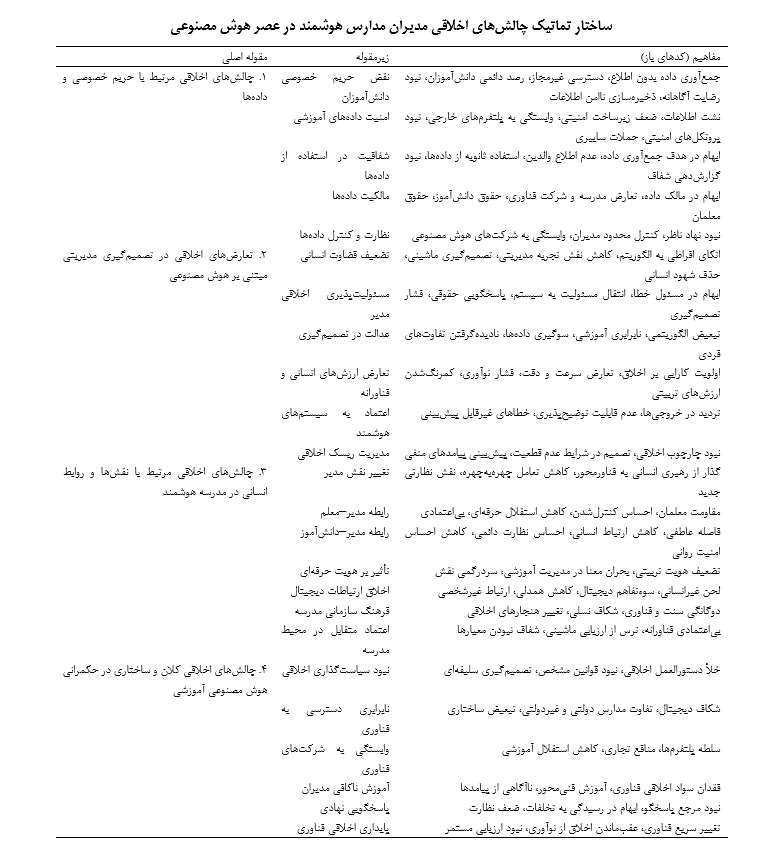
هدف این پژوهش واکاوی و تبیین چالشهای اخلاقی ناشی از بهکارگیری هوش مصنوعی در مدارس هوشمند از منظر تجربیات زیسته مدیران مدارس شهر تهران است. این مطالعه با رویکرد کیفی و مبتنی بر روش پدیدارشناسی تفسیری انجام شد. مشارکتکنندگان شامل ۱۸ نفر از مدیران مدارس هوشمند شهر تهران بودند که بهصورت هدفمند و تا رسیدن به اشباع نظری انتخاب شدند. گردآوری دادهها صرفاً از طریق مصاحبههای نیمهساختاریافته عمیق انجام گرفت. مصاحبهها ضبط، بهصورت کلمهبهکلمه پیادهسازی و با استفاده از تحلیل مضمون مورد بررسی قرار گرفت. برای ساماندهی دادهها و فرایند کدگذاری از نرمافزار NVivo استفاده شد. تحلیل دادهها به شناسایی چهار مقوله اصلی انجامید: چالشهای اخلاقی مرتبط با حریم خصوصی و دادهها، تعارضهای اخلاقی در تصمیمگیری مدیریتی مبتنی بر هوش مصنوعی، چالشهای اخلاقی مرتبط با نقشها و روابط انسانی در مدرسه هوشمند، و چالشهای اخلاقی کلان و ساختاری در حکمرانی هوش مصنوعی آموزشی. یافتهها نشان داد که مدیران با ابهام در مسئولیتپذیری اخلاقی، نگرانی از سوگیری الگوریتمی، تضعیف روابط انسانی و فقدان چارچوبهای سیاستی شفاف مواجهاند. نتایج حاکی از آن است که چالشهای اخلاقی هوش مصنوعی در مدارس هوشمند، ماهیتی چندبعدی و زمینهمند دارند و مستلزم توجه همزمان به سطوح مدیریتی، انسانی و سیاستی هستند.
دانلودها
مراجع
Gupta S, Sharma P, Vajrala KR, Fatima A, Sharma N. Integrating Artificial Intelligence in Education: Advancing Personalized Learning Within Ethical Frameworks: An Overview. EthAIca. 2025;4:418. doi: 10.56294/ai2025418.
García-López IM, González CSG, Ramírez-Montoya MS, Molina-Espinosa JM. Challenges of Implementing ChatGPT on Education: Systematic Literature Review. International Journal of Educational Research Open. 2025;8:100401.
Chen Z, Wenhao Z. Ethical Shifts and Innovative Approaches to Civic Education Under Generative Artificial Intelligence. 2024:181-7. doi: 10.2991/978-2-38476-263-7_25.
Adel A, Ahsan A, Davison C. ChatGPT Promises and Challenges in Education: Computational and Ethical Perspectives. Education Sciences. 2024;14(8):814.
Hadi MH, Jasim AA. Legislative and Ethical Foundations for Future Artificial Intelligence. Journal of the College of Basic Education. 2024;30(126):127-45. doi: 10.35950/cbej.v30i126.12231.
KarakuŞ N, Gedik K, Kazazoğlu S. Ethical Decision-Making in Education: A Comparative Study of Teachers and Artificial Intelligence in Ethical Dilemmas. Behavioral Sciences. 2025;15(4):469. doi: 10.3390/bs15040469.
Zhang DQW. Goal Progression, Trait Changes, and Practice Paths of Artificial Intelligence Ethics Education of Professional Courses in Higher Education. Jes. 2024;20(2):2151-60. doi: 10.52783/jes.1665.
Nwokocha S, Kennedy O, Yakpir G, Olori E, Nchindia C, Kachitsa C, et al. Commentary: artificial intelligence and the future of higher education—towards inclusive, ethical, and employability-driven learning ecosystems. Critique Open Research & Review. 2025;3(2):18-29. doi: 10.55640/corr-v03i02-04.
Huang Y, Wang D. Can ChatGPT serve as a writing collaborator? Insights from Chinese EFL learners. System. 2025;133:103775. doi: 10.1016/j.system.2025.103775.
Авшенюк Н, Lutsenko O, Svyrydiuk T, Seminikhyna N. Empowering Language Learners’ Critical Thinking: Evaluating ChatGPT’s Role in English Course Implementation. 2024. doi: 10.31235/osf.io/fh6v8.
Love AS. Artificial Intelligence in Public Health Education: Navigating Ethical Challenges and Empowering the Next Generation of Professionals. Health Promotion Practice. 2025. doi: 10.1177/15248399251320989.
Chen H. The Ethical Challenges of Educational Artificial Intelligence and Coping Measures: A Discussion in the Context of the 2024 World Digital Education Conference. Science Insights Education Frontiers. 2024;20(2):3263-81. doi: 10.15354/sief.24.re339.
Chidinma AE, Yinka KR. Undergraduate Students' Perception of Artificial Intelligence for Enhancing Educational Practices: Opportunities, Challenges, and Ethical Considerations. Global Journal of Social Sciences Studies. 2025;11(1):30-41. doi: 10.55284/gjss.v11i1.1411.
Shalevska E, Kostadinovska-Stojchevska B. Ethics in times of advanced AI: investigating students’ attitudes towards ChatGPT and academic integrity. Teacher. 2024(27):72-8. doi: 10.20544/teacher.27.08.
Wang Y. A study on the efficacy of ChatGPT-4 in enhancing students' English communication skills. Sage Open. 2025;15(1):21582440241310644. doi: 10.1177/21582440241310644.
Pham HTU, Dinh T, Tran X. The Impact of ChatGPT Voice on Non-Majored Students’ Willingness to Communicate in a Vietnamese University. Asiacall Online Journal. 2025;16(1):312-27. doi: 10.54855/acoj.2516116.
Evangelista E. Ensuring Academic Integrity in the Age of ChatGPT: Rethinking Exam Design, Assessment Strategies, and Ethical AI Policies in Higher Education. Contemporary Educational Technology. 2025;17(1):ep559. doi: 10.30935/cedtech/15775.
Lund BD, Wang T, Mannuru NR, Nie B, Shimray SR, Wang Z. ChatGPT and a new academic reality: artificial intelligence-written research papers and the ethics of the large language models in scholarly publishing. J Assoc Inf Sci Technol. 2023;74:570-81. doi: 10.1002/asi.24750.
Krueger L, Clemenson S, Johnson E, Schwarz L. ChatGPT in Higher Education: Practical Ideas for Addressing Artificial Intelligence in Nursing Education. Journal of Nursing Education. 2025;64(5):323-6. doi: 10.3928/01484834-20240424-02.
Onal S, Kulavuz‐Onal D, Childers M. Patterns of ChatGPT usage and perceived benefits on academic performance across disciplines: insights from a survey of higher education students in the united states. Journal of Educational Technology Systems. 2025;54(1):34-66. doi: 10.1177/00472395251341214.
Rivas P, Zhao L. Marketing with chatgpt: Navigating the ethical terrain of gpt-based chatbot technology. AI. 2023;4(2):375-84. doi: 10.3390/ai4020019.
Durkheim E. Foundations of Sociological Ethics. Tehran: Markaz Publishing; 2006.
Malinowski B. Family and Marriage in Primitive Society. Tehran: Scientific Publishing; 2006.
Javaheri F, Jalali SY. Paradoxes in Cultural Policy-Making in Iran: Proposing a Study Model. Quarterly Journal of Culture-Communication Studies. 2021;22(53):201-22. doi: 10.22083/jccs.2020.206939.2948.
Moradi R. Analysis of Family Cultural Policies in Post-Revolutionary Iran. Quarterly Journal of Culture-Communication Studies. 2021;22(53):223-48. doi: 10.22083/jccs.2019.193233.2858.
Ebadpour N. Challenges in Institutionalizing Government Power in Cultural Policies Regarding Family in Iran. Government Studies Quarterly. 2023;9(35):37-74. doi: 10.22054/tssq.2023.71684.1372.
Drobnič S, Huinink J, Kusnierz M. Family image, cultural values, and family policy from a global perspective. International Journal of Population Studies. 2024;11(3):105-24. doi: 10.36922/ijps.1993.
Lu HJ, Zhu N, Chen BB, Chang L. Cultural values, parenting, and child adjustment in China. International Journal of Psychology. 2024;59(4):512-21. doi: 10.1002/ijop.13100.
Parvaresh E, Hejazi SN, Haghighatian M. A Grounded Theory Model of Family Sustainability with an Emphasis on Cultural Structures (Case Study: The City of Isfahan). Iranian Evolutionary Educational Psychology Journal. 2025;7(3):0-.
Parvaresh M, Seifi N, Colleagues. The Role of Family Cultural Capital in Social Cohesion Among the New Generation. Quarterly Journal of Cultural Studies. 2025;18(1):77-102.
Gur A, Hindi TN, Krisi-Kadosh L. The Contribution of Family-Centered Services to Enhanced Quality of Life and Reduced Distress in Families of Children With Disabilities During the COVID-19 Pandemic. Focus on Autism and Other Developmental Disabilities. 2024;39(1):56-66. doi: 10.1177/10883576231202700.
Hwang W, Silverstein M. Intergenerational Solidarity and Family Functioning Within Korean Families in the Post‐Pandemic Transition. Family Process. 2025;64(3):e70072. doi: 10.1111/famp.70072.
Badaoui E, Matteazzi E. Cultural‐Policy Framework and Mothers' Earnings Penalty: A European Comparison. Kyklos. 2025. doi: 10.1111/kykl.70013.
Hajek K. Productive and hazardous: Investing in families in social policy. Critical Social Policy. 2024;44(1):87-105. doi: 10.1177/02610183231185760.
Fadaei H, Mehrmohammadi M, Salehi Amiri SR, Zolfagharezadeh MM. Family Participation in Educational Policy-Making: Identifying Intervening Factors. Behavioral Studies in Management Quarterly. 2023;13(30):40-63.
Fadaei S, Others. The Role of Family in Cultural Policy-Making: Challenges and Necessities. Cultural Policy Quarterly. 2023;9(2):33-56.
Qian Y, Hu Y. The digitalization of family life: A multilevel conceptual framework. Journal of Marriage and Family. 2024;86(5):1160-83. doi: 10.1111/jomf.12983.
Bagheri S, Motaharnezhad SM, Sadat Chavoshian SMH. Critical Review of Family Policy in Iran and Strategic Requirements for Family-Oriented Policy-Making. Cultural Social Studies of the Seminary. 2020;4(8):83-108. doi: 10.22081/scs.2021.72444.
Khan Mohammadi H, Asli Pour H, Yaghmaiyan M, Askari Baqerabadi M. Identifying Factors Affecting the Implementation of General Family Policies in Iran. Women's and Family Cultural-Educational Quarterly. 2025;19(66):133-56.
Madama I, Mercuri E. All in, against all odds. Path shift in family policy via cross‐party agreement: the case of the Single Universal Allowance reform in Italy. Social Policy & Administration. 2024;58(3):474-90. doi: 10.1111/spol.12981.
Gurín M, Kim JH. The multidimensionality of childcare policy change: novel policy approaches, competing policies and feedback tensions. Journal of Social Policy. 2025:1-18. doi: 10.1017/S0047279425100895.
Sandelowski M, Barroso J, Voils CI. Using qualitative metasummary to synthesize qualitative and quantitative descriptive findings. Research in nursing & health. 2007;30(1):99-111. doi: 10.1002/nur.20176.

دانلود
چاپ شده
ارسال
بازنگری
پذیرش
شماره
نوع مقاله
مجوز
حق نشر 2025 Maghsoud Esmaeilpour (Author); Haideh Ashuri (Corresponding author)

این پروژه تحت مجوز بین المللی Creative Commons Attribution-NonCommercial 4.0 می باشد.