The Effect of Person–Environment Fit on Organizational Silence with the Mediating Role of Organizational Mistrust and the Moderating Role of Ethical Leadership
Keywords:
Person-environment fit, organizational silence, organizational distrust, ethical leadership, pharmaceutical distribution companiesAbstract
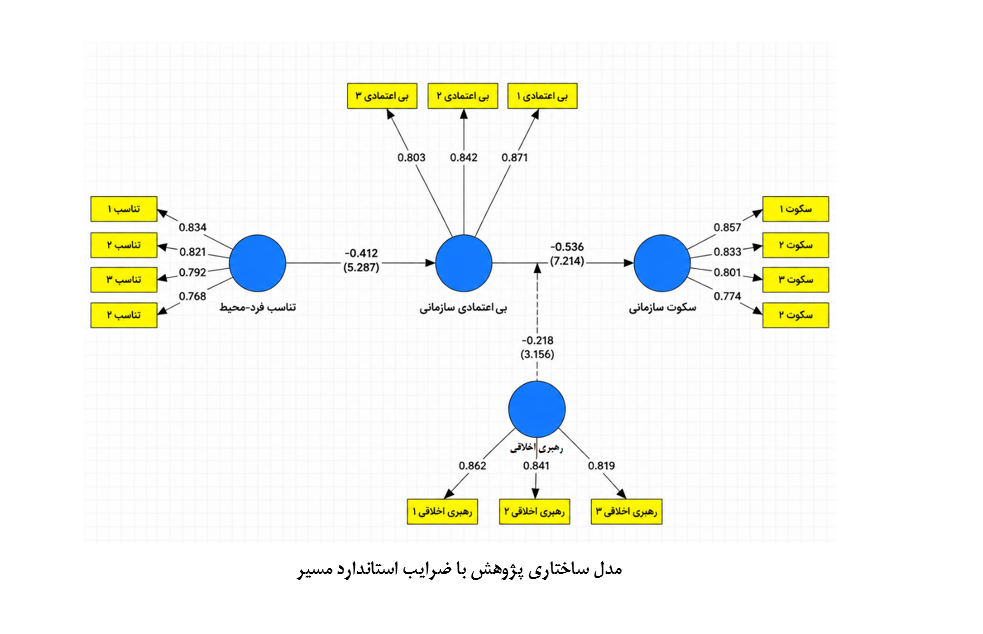
This study aimed to examine the effect of person–environment fit on organizational silence, considering the mediating role of organizational mistrust and the moderating role of ethical leadership among employees of pharmaceutical distribution companies. This applied, descriptive-survey, correlational study was conducted using structural equation modeling. The statistical population consisted of 780 employees working in pharmaceutical distribution companies, from whom 274 participants were selected through proportional stratified sampling. Data were collected using standardized questionnaires measuring person–environment fit, organizational mistrust, ethical leadership, and organizational silence. Data analysis was performed using SPSS version 26 for descriptive statistics and SmartPLS version 4 for partial least squares structural equation modeling. Inferential results indicated that person–environment fit had a negative and significant effect on organizational mistrust (β=-0.47, t=9.12, p<0.001). Organizational mistrust had a positive and significant effect on organizational silence (β=0.52, t=11.34, p<0.001). Person–environment fit also had a direct negative and significant effect on organizational silence (β=-0.41, t=7.28, p<0.001). In addition, ethical leadership had a negative and significant direct effect on organizational silence (β=-0.29, t=5.43, p<0.001). The indirect effect of person–environment fit on organizational silence through organizational mistrust was significant (β=-0.244, t=6.90, p<0.001), confirming the partial mediating role of organizational mistrust. Moreover, the interaction effect of organizational mistrust and ethical leadership on organizational silence was negative and significant (β=-0.18, t=3.41, p<0.001). The findings suggest that improving person–environment fit can reduce organizational silence both directly and indirectly by decreasing organizational mistrust. Ethical leadership also weakens the positive effect of mistrust on silence and serves as a protective organizational mechanism that encourages employee voice and participation.
Downloads
References
1. Wright PM, McMahan GC. Exploring Human Capital: Putting Human Back into Strategic Human Resource Management. Human Resource Management Journal. 2011;21(2):93-104. doi: 10.1111/j.1748-8583.2010.00165.x.
2. Morrison EW. Employee Voice and Silence: A Review and Directions for Future Research. Annual Review of Organizational Psychology and Organizational Behavior. 2014;1(1):173-97. doi: 10.1146/annurev-orgpsych-031413-091328.
3. Donoso LM, Demerouti E, Garrosa E. Consequences of Organizational Silence: Burnout, Job Satisfaction, and Turnover Intentions. Journal of Occupational Health Psychology. 2020;25(3):189-201.
4. Morrison EW. Employee Voice and Silence: What We Know and Where We Should Go Next. Academy of Management Annals. 2023;17(2):481-512.
5. Jian Z, Zhu X, Fu X, Zong X, Tang J, Chi C, et al. The Experiences of Organizational Silence Among Nurses: A Qualitative Meta-Synthesis. BMC Nursing. 2025;24(1). doi: 10.1186/s12912-024-02636-y.
6. Harris TB, Li N, Kirkman BL. Person-Environment Fit in the Modern Workplace: A Meta-Analysis of the Consequences of Fit Dimensions. Journal of Management. 2022;48(3):675-709.
7. Wang Y, Zhang J, Zhou F. Subjective Person-Environment Misfit and Defensive Silence: The Role of Threat to Self-Esteem. Frontiers in Psychology. 2020;11:1530.
8. Chen P, Sparrow P, Cooper C. The Impact of Person-Environment Fit on Organizational Withdrawal Behaviors: The Mediating Role of Work Alienation. Journal of Vocational Behavior. 2021;125:103528.
9. Khalili S, Rahimi Q. Analyzing the Effect of Person-Organization Fit on Employees' Organizational Silence in the Public Sector. Behavioral Studies in Management. 2023;14(1):23-40.
10. Rezaei M, Ahmadi A. Examining the Relationship between Person-Environment Fit and Employees' Passive Behaviors with Emphasis on the Mediating Role of Job Attitudes. Organizational Behavior Management Quarterly. 2022;9(3):45-62.
11. Costigan RD, Insinga RC, Gibbons AJ, Stankeviciute Z. The Effect of Organizational Distrust on Employee Voice and Silence. Journal of Business and Psychology. 2012;27(4):445-58.
12. Pendleton A, Robinson A, Wilson M. Organizational Silence and Employee Participation: The Role of Trust and Climate. Human Relations. 2019;72(10):1621-44.
13. Lee Y, Kim S, Park H. Organizational Distrust as a Mediator between Poor Person-Environment Fit and Defensive Silence. International Journal of Human Resource Management. 2022;33(12):2410-35.
14. Sharif S, Hassan S, Ahmad U. Unpacking the Link between P-E Fit and Employee Silence: The Mediating Role of Distrust. European Journal of Work and Organizational Psychology. 2023;32(4):512-27.
15. Newman A, Kiazad K, Booth S, Sholl M. Ethical Leadership and Employee Voice: The Mediating Role of Psychological Safety. Journal of Business Ethics. 2015;131(2):383-95.
16. Knoll M, Redman T. Does the Presence of Ethical Leadership Reduce Employee Silence? A Multi-Source Study. British Journal of Management. 2016;27(4):812-28.
17. Zare F, Mohammadi H. The Role of Ethical Leadership in Predicting Psychological Safety and Employees' Willingness to Speak Up. Human Resource Management Research. 2023;15(2):112-35.
18. Kim M, Beehr TA, Fritz C. Can Ethical Leadership Buffer the Negative Effects of Organizational Distrust on Employee Voice? Journal of Organizational Behavior. 2024;45(1):89-105.
19. Zhang L, Liu Y, Wang Z. Mitigating the Negative Effects of Distrust on Voice: The Role of Ethical Leadership and Psychological Safety. Leadership & Organization Development Journal. 2023;44(5):601-18.
20. Knoll M, Hall RJ, Weigelt O. The Consequences of Employee Silence: A Meta-Analytic Review of the Relationships between Silence and Employee Outcomes. Journal of Occupational and Organizational Psychology. 2021;94(3):523-56.
21. Sulphey MM, Jasim KM. Perceived Anomie, Organizational Silence, Compulsory Organization Citizenship Behavior, and Workplace Alienation as Antecedents of Knowledge Hiding. Knowledge and Process Management. 2025;32(4):174-89. doi: 10.1002/kpm.70001.
22. Panagiotounis F, Saiti A. The Silent Path to Cynicism: Knowledge Donating and Collecting as Mediators Linking Organizational Silence to Cynicism in Higher Education. 2026. doi: 10.21203/rs.3.rs-8854007/v1.
23. Panagiotounis F. The Sound of Silence: Examining the Mediating Roles of Management Support and Interpersonal Trust on Organizational Commitment in Greek Higher Education Institutions. 2026. doi: 10.21203/rs.3.rs-8853984/v1.
Downloads
Publication Timeline
- Submitted
- Revised
- Accepted
Issue
Section
License
Copyright (c) 2025 Mehdi Farahani, Samad Rahimi Aghdam (Author)

This work is licensed under a Creative Commons Attribution-NonCommercial 4.0 International License.