شرایط مرزی اثربخشی رهبری دوسوتوان: تحلیل تطبیقی کارآفرینی سازمانی در دانشگاههای دولتی و غیرانتفاعی
کلمات کلیدی:
رهبری دوسوتوان, کارآفرینی سازمانی, بافت نهادی, شرایط مرزی, تحلیل چندگروهی (PLS, MGA)چکیده
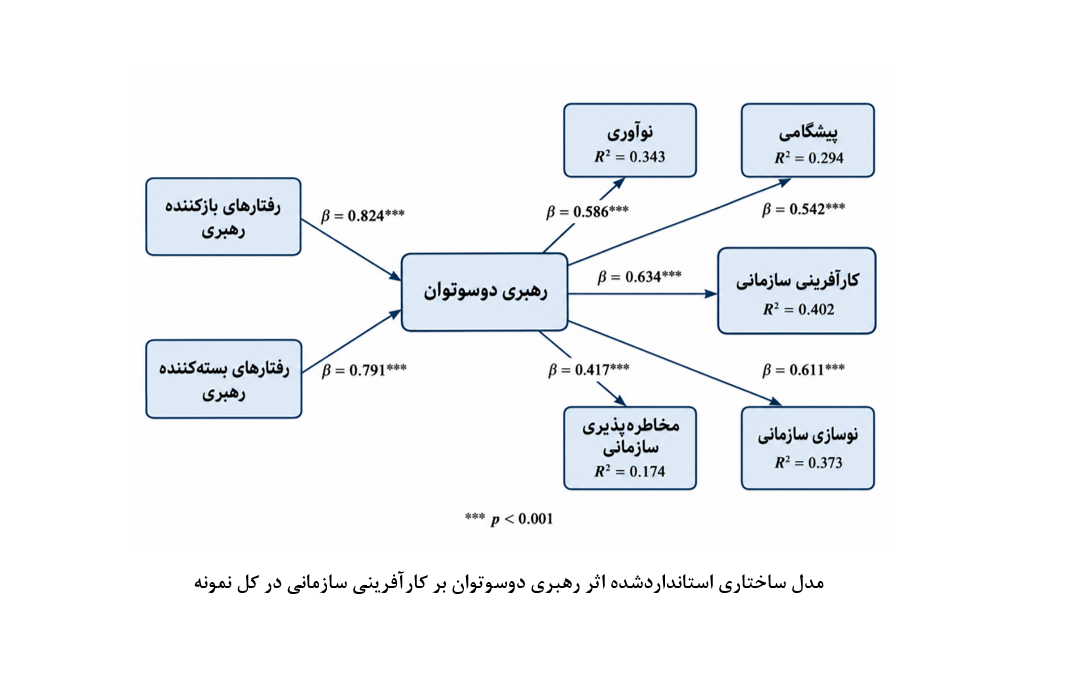
هدف پژوهش حاضر بررسی اثر رهبری دوسوتوان بر کارآفرینی سازمانی و تعیین نقش نوع دانشگاه بهعنوان شرط مرزی این رابطه در دانشگاههای دولتی و غیرانتفاعی شهر تهران بود. این پژوهش با رویکرد کمّی، طرح مقطعی و ماهیت کاربردی ـ تبیینی انجام شد. جامعه پژوهش شامل اعضای هیئت علمی دانشگاههای دولتی و غیرانتفاعی شهر تهران در سال تحصیلی 2025–2026 بود و نمونه نهایی از 384 نفر، شامل 192 عضو هیئت علمی دانشگاههای دولتی و 192 عضو هیئت علمی دانشگاههای غیرانتفاعی، تشکیل شد. دادهها با استفاده از پرسشنامه ساختاریافته رهبری دوسوتوان و کارآفرینی سازمانی گردآوری شدند. رهبری دوسوتوان بر اساس رفتارهای بازکننده و بستهکننده و کارآفرینی سازمانی بر اساس ابعاد نوآوری، پیشگامی، مخاطرهپذیری سازمانی و نوسازی سازمانی سنجیده شد. تحلیل دادهها با مدلسازی معادلات ساختاری حداقل مربعات جزئی، رویه MICOM و تحلیل چندگروهی PLS-MGA در نرمافزار SmartPLS 4 انجام گرفت. رهبری دوسوتوان اثر مثبت و معناداری بر کارآفرینی سازمانی داشت (β = 0.634، t = 15.463، p < 0.001) و 40.2 درصد از واریانس آن را تبیین کرد. این متغیر بر نوسازی سازمانی (β = 0.611)، نوآوری (β = 0.586)، پیشگامی (β = 0.542) و مخاطرهپذیری سازمانی (β = 0.417) نیز اثر مثبت و معنادار داشت (همه p < 0.001). تحلیل چندگروهی نشان داد اثر رهبری دوسوتوان بر کارآفرینی سازمانی در دانشگاههای غیرانتفاعی (β = 0.742) بهطور معناداری قویتر از دانشگاههای دولتی (β = 0.487) بود (p = 0.003). رفتارهای بازکننده در دانشگاههای غیرانتفاعی و رفتارهای بستهکننده در دانشگاههای دولتی اثر قویتری بر کارآفرینی سازمانی نشان دادند. رهبری دوسوتوان از عوامل مهم تقویت کارآفرینی سازمانی در دانشگاهها است، اما اثربخشی آن به بافت نهادی وابسته است؛ بهگونهای که دانشگاههای غیرانتفاعی از رفتارهای بازکننده و دانشگاههای دولتی از رفتارهای بستهکننده رهبری بهره بیشتری میبرند.
دانلودها
مراجع
1. Taleb MA, Tantawi P, Ragheb M, Amara DF. Small and Medium-Sized Enterprises’ Resilience to Socioeconomic Challenges in Emerging Economies: The Impact of Entrepreneurial Orientation on Organisational Ambidexterity. Socioeconomic Challenges. 2025;9(2):156-79. doi: 10.61093/sec.9(2).156-179.2025.
2. Yu X, Cao N, Ren H. The Impact of Entrepreneurial Orientation on the Sustainable Innovation Capabilities of New Ventures: From the Perspective of Ambidextrous Learning. Sustainability. 2023;15(11):9026. doi: 10.3390/su15119026.
3. Mendes T, Braga V, Silva C, Ratten V. Taking a Closer Look at the Regionally Clustered Firms: How Can Ambidexterity Explain the Link Between Management, Entrepreneurship, and Innovation in a Post-Industrialized World? The Journal of Technology Transfer. 2023;48(6):2007-53. doi: 10.1007/s10961-022-09991-5.
4. Zhang S, Suntrayuth S. The Synergy of Ambidextrous Leadership, Agility, and Entrepreneurial Orientation to Achieve Sustainable AI Product Innovation. Sustainability. 2024;16(10):4248. doi: 10.3390/su16104248.
5. Indriyani DS, Utami HN, Afrianty TW. The Role of Leadership Agility and Entrepreneurial Orientation on Innovation Ambidexterity and Its Impact on Competitive Advantage. Jurnal Aplikasi Manajemen. 2024;22(3):733-48. doi: 10.21776/ub.jam.2024.022.03.09.
6. Chen L, Ling CD, Zhang MJ, Wang N, Huang W. Team dual formation strategy, team ambidexterity trajectory, and entrepreneurial effectiveness. Personnel Psychology. 2026;79(3):327-51. doi: 10.1111/peps.70030.
7. Schindler J, Kallmuenzer A, Valeri M. Entrepreneurial culture and disruptive innovation in established firms-how to handle ambidexterity. Business Process Management Journal. 2024;30(2):366-87. doi: 10.1108/BPMJ-02-2023-0117.
8. Jha VK, Roshan R, Sinha S. Accelerating start-ups' leap to unicorns: The role of founders' ambidextrous orientation. International Journal of Entrepreneurial Behavior & Research. 2024;30(10):2551-77. doi: 10.1108/IJEBR-06-2023-0604.
9. Singh S, Singh M. How entrepreneurial orientation improves new-venture performance: The mediating role of innovation ambidexterity. Journal of Research in Marketing and Entrepreneurship. 2024;26(4):740-59. doi: 10.1108/JRME-03-2024-0058.
10. Arman M, Nematollahi H, Tangestani E, Mousavi SA. The Role of Digital Transformation and Entrepreneurial Leadership in Organizational Performance with the Mediating Role of Ambidextrous Learning: A Case Study of Small Businesses in Bushehr Province. Human Resource Excellence. 2023;4(1):87-113.
11. Mani Z, Khodadadi N, Faal M, Sadeghi N. The Role of Digital Transformation and Entrepreneurial Leadership in Organizational Performance with the Mediating Role of Ambidextrous Learning: A Case Study of Small Businesses in Bushehr Province. Small Business Management Research. 2023;8(4):88-112.
12. Chen A, Ling Y, Zhou J. Ambidextrous entrepreneurial learning, serendipity, and new venture innovation performance. International Review of Economics & Finance. 2025;103:104528. doi: 10.1016/j.iref.2025.104528.
13. Xiang G, Peng M, Su X. Ambidextrous learning, resource acquisition, and venture performance: The moderating effect of the entrepreneurial ecosystem network relationships. SAGE Open. 2024;14(3):1-18. doi: 10.1177/21582440241268823.
14. Ndou V, Passiante G. Knowledge Ambidexterity for Social Entrepreneurship Education: ToKnowPress; 2023.
15. Ghaderi Sheykhi Abadi M, Nasiri F, Afzali A, Ta'ajjobi M. The Role of School Organizational Ambidexterity in Organizational Entrepreneurship Mediated by Teachers' Productive Behaviors (Case Study: Technical and Vocational High Schools in Tehran Province). Journal of Management of Education for Organizations. 2023;12(2):175-200.
16. Murad M, Li C, Javed H, Hassan H, Islam MU. Unraveling the relationship between entrepreneurial networks and entrepreneurial ambidexterity: A mediation-moderation model. Heliyon. 2024;10(1):e23537. doi: 10.1016/j.heliyon.2024.e32613.
17. Tehseen S, Kayani UN, Haider SA, Aysan AF, Johara F, Hossain SM, et al. Unpacking the mechanisms of entrepreneurial bricolage for new venture growth: The mediating roles of new venture adaptiveness and innovative ambidexterity. Cogent Business & Management. 2024;11(1):2316357. doi: 10.1080/23311975.2024.2316357.
18. Indrianti Y, Sasmoko, Abdinagoro SB, Rahim RK. Building bridges to entrepreneurial resilience: Exploring the mediating role of business model innovation capacity in ambidextrous leadership and entrepreneurial mindfulness. Uncertain Supply Chain Management. 2024;12(4):2245-52. doi: 10.5267/j.uscm.2024.6.007.
19. Duong D, Vu Trong N, Ngo TVN. Generative artificial intelligence and entrepreneurial performance: The mediating and curvilinear role of innovation ambidexterity. Leadership & Organization Development Journal. 2026;47(4):717-42. doi: 10.1108/LODJ-07-2025-0609.
20. Shafieipour D, Mazidi Sharafabadi F. The Role of International Entrepreneurial Culture, Ambidextrous Innovation, and Dynamic Marketing Capabilities in Innovation Performance. Air Defense Management Quarterly. 2024;3(2).
دانلودها
گاهشمار انتشار
- ارسال
- بازنگری
- پذیرش
شماره
نوع مقاله
مجوز
حق نشر 2026 Saad Nahi Shakir Alzirgawee (Author); Alireza Fazlzadeh (Corresponding author); Mohammad Faryabi, Samad Rahimiaghdam (Author)

این پروژه تحت مجوز بین المللی Creative Commons Attribution-NonCommercial 4.0 می باشد.