Boundary Conditions of Ambidextrous Leadership Effectiveness: A Comparative Analysis of Corporate Entrepreneurship in Public and Non-Profit Universities
Keywords:
Ambidextrous Leadership, Corporate Entrepreneurship, Institutional Context, Higher Education, PLS, MGAAbstract
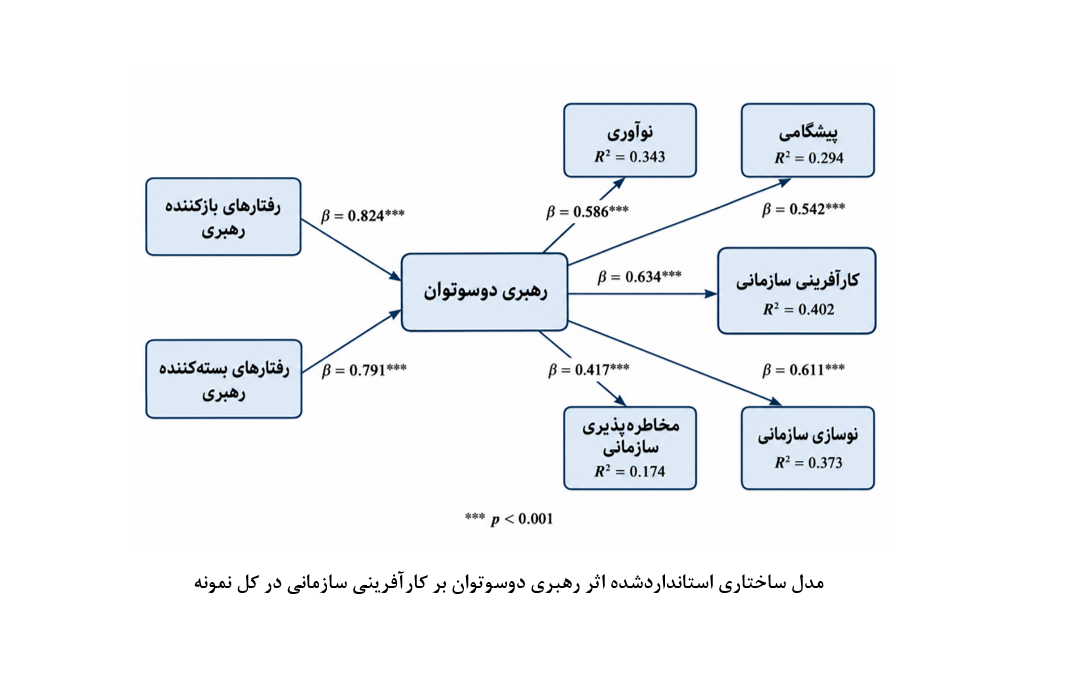
This study aimed to examine the effect of ambidextrous leadership on organizational entrepreneurship and to determine whether university type acts as a boundary condition of this relationship in public and non-profit universities in Tehran. This quantitative, cross-sectional, applied, and explanatory study was conducted among faculty members of public and non-profit universities in Tehran during the 2025–2026 academic year. The final sample consisted of 384 faculty members, including 192 participants from public universities and 192 from non-profit universities. Data were collected using a structured questionnaire assessing ambidextrous leadership and organizational entrepreneurship. Ambidextrous leadership was operationalized through opening and closing leadership behaviors, whereas organizational entrepreneurship was measured through innovation, proactiveness, organizational risk-taking, and organizational renewal. Data were analyzed using partial least squares structural equation modeling, the MICOM procedure, and PLS multigroup analysis in SmartPLS 4. Ambidextrous leadership had a positive and significant effect on organizational entrepreneurship (β = 0.634, t = 15.463, p < 0.001) and explained 40.2% of its variance. It also significantly predicted organizational renewal (β = 0.611), innovation (β = 0.586), proactiveness (β = 0.542), and organizational risk-taking (β = 0.417), with all effects significant at p < 0.001. Multigroup analysis showed that the effect of ambidextrous leadership on organizational entrepreneurship was significantly stronger in non-profit universities (β = 0.742) than in public universities (β = 0.487; p = 0.003). Opening leadership behaviors were more influential in non-profit universities, whereas closing leadership behaviors exerted a stronger effect in public universities. Ambidextrous leadership is an important driver of organizational entrepreneurship in universities, but its effectiveness depends on institutional context; non-profit universities benefit more from opening behaviors, whereas public universities benefit more from closing leadership behaviors.
Downloads
References
1. Taleb MA, Tantawi P, Ragheb M, Amara DF. Small and Medium-Sized Enterprises’ Resilience to Socioeconomic Challenges in Emerging Economies: The Impact of Entrepreneurial Orientation on Organisational Ambidexterity. Socioeconomic Challenges. 2025;9(2):156-79. doi: 10.61093/sec.9(2).156-179.2025.
2. Yu X, Cao N, Ren H. The Impact of Entrepreneurial Orientation on the Sustainable Innovation Capabilities of New Ventures: From the Perspective of Ambidextrous Learning. Sustainability. 2023;15(11):9026. doi: 10.3390/su15119026.
3. Mendes T, Braga V, Silva C, Ratten V. Taking a Closer Look at the Regionally Clustered Firms: How Can Ambidexterity Explain the Link Between Management, Entrepreneurship, and Innovation in a Post-Industrialized World? The Journal of Technology Transfer. 2023;48(6):2007-53. doi: 10.1007/s10961-022-09991-5.
4. Zhang S, Suntrayuth S. The Synergy of Ambidextrous Leadership, Agility, and Entrepreneurial Orientation to Achieve Sustainable AI Product Innovation. Sustainability. 2024;16(10):4248. doi: 10.3390/su16104248.
5. Indriyani DS, Utami HN, Afrianty TW. The Role of Leadership Agility and Entrepreneurial Orientation on Innovation Ambidexterity and Its Impact on Competitive Advantage. Jurnal Aplikasi Manajemen. 2024;22(3):733-48. doi: 10.21776/ub.jam.2024.022.03.09.
6. Chen L, Ling CD, Zhang MJ, Wang N, Huang W. Team dual formation strategy, team ambidexterity trajectory, and entrepreneurial effectiveness. Personnel Psychology. 2026;79(3):327-51. doi: 10.1111/peps.70030.
7. Schindler J, Kallmuenzer A, Valeri M. Entrepreneurial culture and disruptive innovation in established firms-how to handle ambidexterity. Business Process Management Journal. 2024;30(2):366-87. doi: 10.1108/BPMJ-02-2023-0117.
8. Jha VK, Roshan R, Sinha S. Accelerating start-ups' leap to unicorns: The role of founders' ambidextrous orientation. International Journal of Entrepreneurial Behavior & Research. 2024;30(10):2551-77. doi: 10.1108/IJEBR-06-2023-0604.
9. Singh S, Singh M. How entrepreneurial orientation improves new-venture performance: The mediating role of innovation ambidexterity. Journal of Research in Marketing and Entrepreneurship. 2024;26(4):740-59. doi: 10.1108/JRME-03-2024-0058.
10. Arman M, Nematollahi H, Tangestani E, Mousavi SA. The Role of Digital Transformation and Entrepreneurial Leadership in Organizational Performance with the Mediating Role of Ambidextrous Learning: A Case Study of Small Businesses in Bushehr Province. Human Resource Excellence. 2023;4(1):87-113.
11. Mani Z, Khodadadi N, Faal M, Sadeghi N. The Role of Digital Transformation and Entrepreneurial Leadership in Organizational Performance with the Mediating Role of Ambidextrous Learning: A Case Study of Small Businesses in Bushehr Province. Small Business Management Research. 2023;8(4):88-112.
12. Chen A, Ling Y, Zhou J. Ambidextrous entrepreneurial learning, serendipity, and new venture innovation performance. International Review of Economics & Finance. 2025;103:104528. doi: 10.1016/j.iref.2025.104528.
13. Xiang G, Peng M, Su X. Ambidextrous learning, resource acquisition, and venture performance: The moderating effect of the entrepreneurial ecosystem network relationships. SAGE Open. 2024;14(3):1-18. doi: 10.1177/21582440241268823.
14. Ndou V, Passiante G. Knowledge Ambidexterity for Social Entrepreneurship Education: ToKnowPress; 2023.
15. Ghaderi Sheykhi Abadi M, Nasiri F, Afzali A, Ta'ajjobi M. The Role of School Organizational Ambidexterity in Organizational Entrepreneurship Mediated by Teachers' Productive Behaviors (Case Study: Technical and Vocational High Schools in Tehran Province). Journal of Management of Education for Organizations. 2023;12(2):175-200.
16. Murad M, Li C, Javed H, Hassan H, Islam MU. Unraveling the relationship between entrepreneurial networks and entrepreneurial ambidexterity: A mediation-moderation model. Heliyon. 2024;10(1):e23537. doi: 10.1016/j.heliyon.2024.e32613.
17. Tehseen S, Kayani UN, Haider SA, Aysan AF, Johara F, Hossain SM, et al. Unpacking the mechanisms of entrepreneurial bricolage for new venture growth: The mediating roles of new venture adaptiveness and innovative ambidexterity. Cogent Business & Management. 2024;11(1):2316357. doi: 10.1080/23311975.2024.2316357.
18. Indrianti Y, Sasmoko, Abdinagoro SB, Rahim RK. Building bridges to entrepreneurial resilience: Exploring the mediating role of business model innovation capacity in ambidextrous leadership and entrepreneurial mindfulness. Uncertain Supply Chain Management. 2024;12(4):2245-52. doi: 10.5267/j.uscm.2024.6.007.
19. Duong D, Vu Trong N, Ngo TVN. Generative artificial intelligence and entrepreneurial performance: The mediating and curvilinear role of innovation ambidexterity. Leadership & Organization Development Journal. 2026;47(4):717-42. doi: 10.1108/LODJ-07-2025-0609.
20. Shafieipour D, Mazidi Sharafabadi F. The Role of International Entrepreneurial Culture, Ambidextrous Innovation, and Dynamic Marketing Capabilities in Innovation Performance. Air Defense Management Quarterly. 2024;3(2).
Downloads
Publication Timeline
- Submitted
- Revised
- Accepted
Issue
Section
License
Copyright (c) 2026 Saad Nahi Shakir Alzirgawee (Author); Alireza Fazlzadeh (Corresponding author); Mohammad Faryabi, Samad Rahimiaghdam (Author)

This work is licensed under a Creative Commons Attribution-NonCommercial 4.0 International License.