Identifying Key Dimensions and Indicators for Evaluating the Effectiveness of Blended Learning in Organizations
DOI:
https://doi.org/10.61838/jsied.353Keywords:
Blended Learning, Effectiveness, Learning Evaluation, Organizational Training, Systematic ReviewAbstract
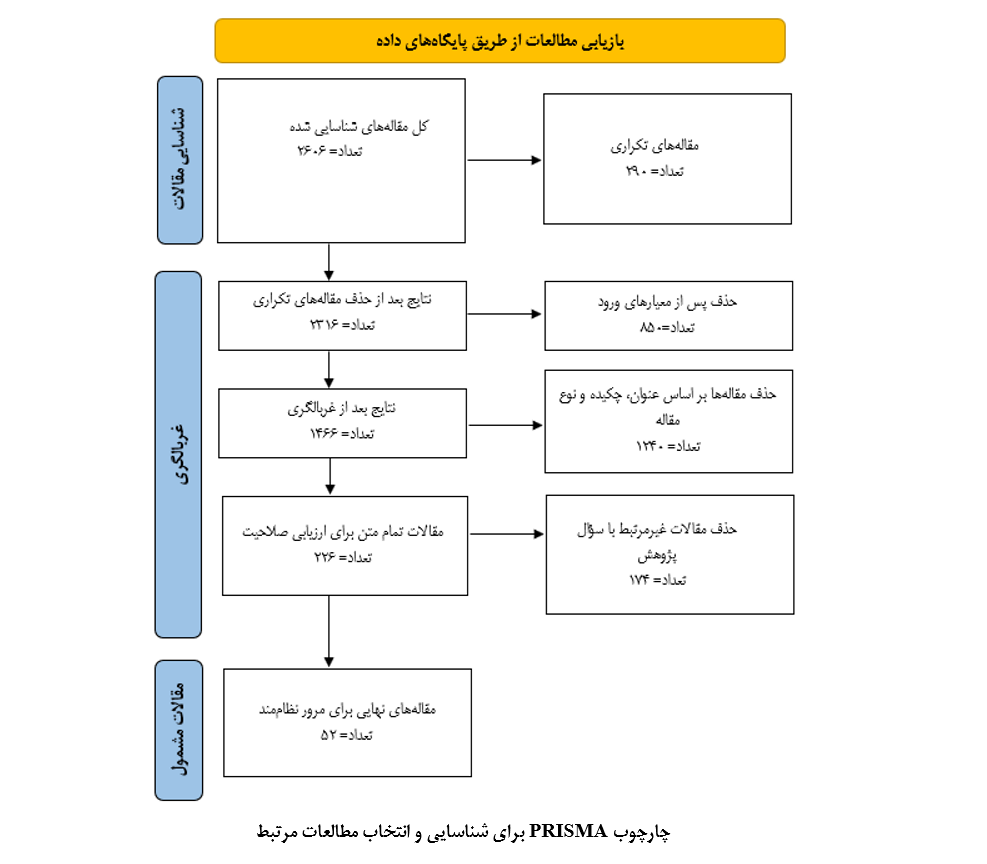
This study aimed to identify and conceptualize the key dimensions and indicators for evaluating the effectiveness of blended learning courses in organizational educational settings. This applied study adopted a qualitative approach using a mixed-method systematic review. Relevant scientific documents were retrieved from the Scopus and Web of Science databases based on the PRISMA framework, covering publications from 2000 to 2025. Out of 2,606 initially identified articles, 52 eligible studies were selected after applying inclusion and exclusion criteria. Data were analyzed through thematic synthesis, and analytical reliability was confirmed via independent coding by two researchers and calculation of Cohen’s Kappa coefficient, which exceeded 0.80. The findings revealed that the effectiveness of blended learning in organizations is multidimensional and can be explained through seven core dimensions: organization, learning environment, instructional design, content, learner, instructor, and evaluation. A total of 78 validated indicators were identified, indicating that the effectiveness of blended learning emerges from the systematic interaction of these dimensions rather than isolated factors. The study concludes that evaluating the effectiveness of blended learning in organizational contexts requires a comprehensive and systemic framework, and the identified dimensions and indicators provide a robust foundation for improving the quality and impact of organizational training programs.
References
Allen IE, Seaman J. Changing course: Ten years of tracking online education in the United States. Babson Survey Research Group, 2013.
Rospigliosi A. How the coronavirus pandemic may be the discontinuity which makes the difference in the digital transformation of teaching and learning. Interactive Learning Environments. 2020;28:383-4. doi: 10.1080/10494820.2020.1766753.
Means B, Toyama Y, Murphy R, Bakia M. The effectiveness of online and blended learning: A meta-analysis of the empirical literature. Teachers College Record. 2013;115(3). doi: 10.1177/016146811311500307.
Liu Q, Peng W, Zhang F, Hu R, Li Y, Yan W. The effectiveness of blended learning in health professions: Systematic review and meta-analysis. Journal of Medical Internet Research. 2016;18(1). doi: 10.2196/jmir.4807.
Vallée A, Sorbets E, Cariou A, Blacher J. Effectiveness of blended learning compared to traditional learning in medical education: A systematic review and meta-analysis (Preprint). Journal of Medical Internet Research. 2019;22(10). doi: 10.2196/16504.
Lockey A, Bland A, Stephenson J, Bray J, Astin F. Blended learning in health care education: An overview and overarching meta-analysis of systematic reviews. Journal of Continuing Education in the Health Professions. 2022;42(4):256-64. doi: 10.1097/ceh.0000000000000455.
Dziuban C, Graham C, Moskal P, Norberg A, Sicilia N. Blended learning: The new normal and emerging technologies. International Journal of Educational Technology in Higher Education. 2018;15. doi: 10.1186/s41239-017-0087-5.
Anthony B, Kamaludin A, Romli A, Mat Raffei AF, Eh Phon DNAL, Abdullah A, et al. Blended learning adoption and implementation in higher education: A theoretical and systematic review. Technology, Knowledge and Learning. 2020;27(2):531-78. doi: 10.1007/s10758-020-09477-z.
Gudoniene D, Staneviciene E, Huet I, Dickel J, Dieng D, Degroote J, et al. Hybrid teaching and learning in higher education: A systematic literature review. Sustainability. 2025;17:756. doi: 10.3390/su17020756.
Bates R, Coyne TH. Effective evaluation of training: Beyond the measurement of outcomes. 2005.
Cashmore M, Richardson T, Hilding-Rydevik T, Emmelin L. Evaluating the effectiveness of impact assessment instruments: Theorising the nature and implications of their political constitution. Environmental Impact Assessment Review. 2010;30(6):371-9. doi: 10.1016/j.eiar.2010.01.004.
Allen L, Hay M, Palermo C. Evaluation in health professions education – Is measuring outcomes enough? Medical Education. 2021;56(1). doi: 10.1111/medu.14654.
Ali S, Tufail M, Qazi D. Training evaluation models: Comparative analysis. Review of Journal of Social Sciences and Education Research. 2022;3(4):51-63. doi: 10.36902/rjsser-vol3-iss4-2022(51-63).
Urbancova H, Vrabcová P, Hudakova M, Ježková Petrů G. Effective training evaluation: The role of factors influencing the evaluation of effectiveness of employee training and development. Sustainability. 2021;13(5):2721. doi: 10.3390/su13052721.
Ho A, Arendt S, Zheng T, Hanisch K. Exploration of hotel managers' training evaluation practices and perceptions utilizing Kirkpatrick's and Phillips's models. Journal of Human Resources in Hospitality & Tourism. 2016;15(2):184-208. doi: 10.1080/15332845.2016.1084861.
Desimone LM. Improving impact studies of teachers’ professional development: Toward better conceptualizations and measures. Educational Researcher. 2009;38(3):181-99. doi: 10.3102/0013189X08331140.
Schinkel A, Wolbert L, Pedersen JB, de Ruyter DJ. Human flourishing, wonder, and education. Studies in Philosophy and Education. 2023;42(2):143-62. doi: 10.1007/s11217-022-09851-7.
Wang W, Ma W. Construction of a meaning effectiveness model: A new interpretation of meaning in life. New Ideas in Psychology. 2021;63:100876. doi: 10.1016/j.newideapsych.2021.100876.
Owston R, York DN. The nagging question when designing blended courses: Does the proportion of time devoted to online activities matter? The Internet and Higher Education. 2018;36:22-32. doi: 10.1016/j.iheduc.2017.09.001.
Cheung WS, Hew KF. Design and evaluation of two blended learning approaches: Lessons learned. Australasian Journal of Educational Technology. 2011;27(8):1319-37. doi: 10.14742/ajet.896.
Dumford A, Miller A. Online learning in higher education: Exploring advantages and disadvantages for engagement. Journal of Computing in Higher Education. 2018;30:9179. doi: 10.1007/s12528-018-9179-z.
Hung ML, Chou C. Students’ perceptions of instructors’ roles in blended and online learning environments: A comparative study. Computers & Education. 2014;81:315-25. doi: 10.1016/j.compedu.2014.10.022.
Akhtar R, Saidalvi A, Hassan H. A comparative study of blended learning versus traditional learning in ESL class. The International Journal of Humanities & Social Studies. 2019;7(2). doi: 10.24940/theijhss/2019/v7/i2/HS1902-063.
Cao S, Phongsatha S. An empirical study of the AI-driven platform in blended learning for Business English performance and student engagement. Language Testing in Asia. 2025;15(1). doi: 10.1186/s40468-025-00376-.
Gross S, Wunderlich K, Arpagaus A, Becker C, Gössi F, Bissmann B, et al. Effectiveness of blended learning to improve medical students’ communication skills: A randomized, controlled trial. BMC Medical Education. 2025;25(1). doi: 10.1186/s12909-025-06938-w.
Asghar MZ, Afzaal M, Iqbal J, Waqar Y, Seitamaa-Hakkarainen P. Evaluation of in-service vocational teacher training program: A blend of face-to-face, online and offline learning approaches. Sustainability. 2022;14(21):13906. doi: 10.3390/su142113906.
Ma G, Yang R, Minneyfield A, Gu X, Gan Y, Li L, et al. A practical analysis of blended training efficacy on organizational outcomes. Industrial and Commercial Training. 2022;54(4):637-46. doi: 10.1108/ICT-12-2021-0085.
Min W, Yu Z. A systematic review of critical success factors in blended learning. Education Sciences. 2023;13(5):469. doi: 10.3390/educsci13050469.
Kintu MJ, Zhu C, Kagambe E. Blended learning effectiveness: The relationship between student characteristics, design features and outcomes. International Journal of Educational Technology in Higher Education. 2017;14(1). doi: 10.1186/s41239-017-0043-4.
Hanh NTT. Organizational factors affecting lecturer performance in HEIs in the context of blended learning: An empirical study in Vietnam. Journal of Higher Education Policy and Leadership Studies. 2023;4(4):32-49. doi: 10.61186/johepal.4.4.32.
Mariam S, Khawaja KF, Qaisar MN, Ahmad F. Blended learning sustainability in business schools: Role of quality of online teaching and immersive learning experience. The International Journal of Management Education. 2023;21(2):100776. doi: 10.1016/j.ijme.2023.100776.
Hu K, Raman A. Systematic literature review on the holistic integration of e-learning in universities: Policy, human, financial and technical perspectives. Contemporary Educational Technology. 2024;16(2):ep497. doi: 10.30935/cedtech/14287.
Shamir-Inbal T, Blau I. Characteristics of pedagogical change in integrating digital collaborative learning and their sustainability in a school culture: e-CSAMR framework. Journal of Computer Assisted Learning. 2021;37(3):825-38. doi: 10.1111/jcal.12526.
Wang C, Chen X, Yu T, Liu Y, Jing Y. Education reform and change driven by digital technology: A bibliometric study from a global perspective. Humanities and Social Sciences Communications. 2024;11:256. doi: 10.1057/s41599-024-02717-y.
Al-Kahtani NK, Alkahtani HK, Subbarayalu AV, Raman V. Development and validation of a tool to explore the perspectives of the health sciences faculty towards blended learning. Smart Learning Environments. 2025;12(1). doi: 10.1186/s40561-025-00382-5.
Lazar IM, Panisoara G, Panisoara IO. Digital technology adoption scale in the blended learning context in higher education: Development, validation and testing of a specific tool. PLOS ONE. 2020;15(7):e0235957. doi: 10.1371/journal.pone.0235957.
Chen P, Yang X. Study on the evaluation method of blended learning effect based on multiple linear regression analysis. International Journal of Web-Based Learning and Teaching Technologies. 2023;18(1). doi: 10.4018/IJWLTT.327453.
Jia L. Clustering analysis of the evaluation data on students’ learning under a blended environment. International Journal of Emerging Technologies in Learning (iJET). 2022;17(23):128-44. doi: 10.3991/ijet.v17i23.35941.
Chen Z. Artificial intelligence-virtual trainer: Innovative didactics aimed at personalized training needs. Journal of the Knowledge Economy. 2022;14:2007-25. doi: 10.1007/s13132-022-00985-0.
Hu J. Teaching evaluation system by use of machine learning and artificial intelligence methods. International Journal of Emerging Technologies in Learning (iJET). 2021;16(5):87-101. doi: 10.3991/ijet.v16i05.20299.
Ren F, Zhao B, Wang J, Zhou JX, Xie TY. Enhancing blended learning evaluation through a blockchain and searchable encryption approach. Electronics (Switzerland). 2025;14(5). doi: 10.3390/electronics14051039.
Asali-Van Der Wal R. Assessment of student satisfaction with distance and blended learning. Integration of Education. 2023;27(2):262-72. doi: 10.15507/1991-9468.111.027.202302.262-272.
Ren W, Wang R, Mohamad SNA, Mao C, Harutyunyan H. Factors influencing students’ learning satisfaction and students’ learning outcomes in blended learning. International Journal of Education and Practice. 2024;12(1):95-108. doi: 10.18488/61.v12i1.3624.
Rienties B, Tempelaar D, Nguyen Q, Littlejohn A. Unpacking the intertemporal impact of self-regulation in a blended mathematics environment. Computers in Human Behavior. 2019;100:345-57. doi: 10.1016/j.chb.2019.07.007.
Nyathi M. Evaluating the effectiveness of blended learning in learning business courses in low-income economies. Asian Association of Open Universities Journal. 2024;19(1):55-69. doi: 10.1108/AAOUJ-07-2023-0089.
Tay H. Investigating engagement in a blended learning course. Cogent Education. 2016;3:1135772. doi: 10.1080/2331186X.2015.1135772.
Sandanayake T. Promoting open educational resources-based blended learning. International Journal of Educational Technology in Higher Education. 2019;16(1). doi: 10.1186/s41239-019-0133-6.
Çevik Y, Şen U, Avcı D. Evaluating the impact of an online course for technology mentors in reverse mentoring. Journal of Learning and Teaching in Digital Age. 2025;10:244-59. doi: 10.53850/joltida.1627427.
Vaughan N, Reali A, Stenbom S, van Vuuren MJ, MacDonald D. Blended learning from design to evaluation: International case studies of evidence-based practice. Online Learning Journal. 2017;21(3):103-14. doi: 10.24059/olj.v21i3.1252.
Kebritchi M, Lipschuetz A, Santiague L. Issues and challenges for teaching successful online courses in higher education: A literature review. Journal of Educational Technology Systems. 2017;46(1):4-29. doi: 10.1177/0047239516661713.
Umar N, Choi SL. The relationship between training and organizational commitment among academicians in Malaysia. Journal of Management Development. 2015;34(10):1227-45. doi: 10.1108/JMD-01-2015-0008.
Tan KF, Sabari MA, Osran SA, Noh N, Fuad AAA. Comparing blended e-learning and conventional classroom methods in teaching the basic statistics subject. Education in Medicine Journal. 2023;15(3):1-15. doi: 10.21315/eimj2023.15.3.1.
Doş B. Developing and evaluating a blended learning course. Anthropologist. 2014;17:121-8. doi: 10.1080/09720073.2014.11891421.
Eryilmaz M. The effectiveness of blended learning environments. Contemporary Issues in Education Research (CIER). 2015;8(4):251-6. doi: 10.19030/cier.v8i4.9433.
Sui J, Yang L. Effectiveness and evaluation of online and offline blended learning for an electronic design practical training course. International Journal of Distance Education Technologies. 2023;21(1). doi: 10.4018/IJDET.318652.
Mansoori S, Salari Koohfini Z, Ghasemali M. A comparison between the effectiveness of e-learning and blended learning in industrial training. Interdisciplinary Journal of Virtual Learning in Medical Sciences. 2020;11(1):46-53. doi: 10.30476/ijvlms.2020.84352.1006.
Kimiloglu H, Özturan M, Kutlu B. Perceptions about and attitude toward the usage of e-learning in corporate training. Computers in Human Behavior. 2017;72:339-49. doi: 10.1016/j.chb.2017.02.062.
Moreira I, Ventura S, Ramos I, Rodrigues P. Development and assessment of an e-learning course on breast imaging for radiographers: A stratified randomized controlled trial. Journal of Medical Internet Research. 2015;17(1):e3. doi: 10.2196/jmir.3344.
Fedorova A. Application of blended education models in teaching students of non-language universities a foreign language (English): Problems and prospects for implementing didactic goals. SSRN Electronic Journal. 2020. doi: 10.2139/ssrn.3750648.
Lazarinis F, Panagiotakopoulos T, Armakolas S, Vonitsanos G, Iatrellis O, Kameas A. A blended learning course to support innovative online teaching in higher education. European Journal of Education. 2024;60. doi: 10.1111/ejed.12820.
Alaidaros H, Omer S, Asma A. The evaluation of the blended learning implemented at Al-Ahgaff University, Yemen: A students’ perspective. Journal of Educational Technology & Interactive Learning. 2024;10(49):54-8. doi: 10.5935/jetia.v10i49.1165.
Yari M, Shams G, Abbasi Kasani H. The effectiveness of blended in-service training courses for school principals in Rezvanshahr City based on the BELZ blended evaluation framework. Development Strategies in Medical Education. 2024;11(4):377-92. doi: 10.1001.1.28210719.1401.2.1.13.7.
Lashkarian R, Khorshidi A, Barzegar N, Moghaddasi H, Moradi S. Identifying the dimensions, components, and indicators of e-learning for medical sciences universities in Tehran: A qualitative approach. Nursing Management Quarterly. 2022;11(3):76-88.
Moslehi L, Alidoust Ghahfarrokhi A. Identifying and prioritizing factors affecting the quality of e-learning among physical education students during the COVID-19 pandemic. Quarterly Journal of Research and Planning in Higher Education. 2022;28(4):201-17. doi: 10.22034/irphe.2022.705236.
Mohammadi L, Rastegoo A, Nokhostin Goldoust A, Mirzaei N, Mazbouhi S. Identifying components of e-learning and workplace learning. Journal of School of Public Health and Institute of Public Health Research. 2022;20(2):223-42.
Masoomifard M, Shayestehfar A, Alipour V, Nouri Z. An investigation into the effect of in-service training of problem-solving skills with two approaches: E-learning and blended learning on the development of creativity of educational managers in schools in Ray City. Sociology of Education. 2025;11(3):1-12.
Rostami B, Fathi M, Safavi SZ, Oroji M, Karimi R. Investigating the mediating role of spiritual intelligence on the quality of combined learning and creativity from students’ views in Zanjan University of Medical Sciences. Research in Medical Education. 2021;13(1):14-23.
Yulianti T, Sulistiyawati A. The blended learning for student’s character building. International Conference on Progressive Education (ICOPE 2019): Atlantis Press; 2020. p. 56-60.
Ibrahim MM, Nat M. Blended learning motivation model for instructors in higher education institutions. International Journal of Educational Technology in Higher Education. 2019;16(12). doi: 10.1186/s41239-019-0145-2.
Hui YK, Li C, Qian S, Kwok LF. Learning engagement via promoting situational interest in a blended learning environment. Journal of Computing in Higher Education. 2019;31(2):408-25. doi: 10.1007/s12528-019-09216-z.
Asad MM, Aftab K, Sherwani F, Churi P, Moreno-Guerrero AJ, Pourshahian B. Techno-pedagogical skills for 21st century digital classrooms: An extensive literature review. Education Research International. 2021;2021(1):8160084. doi: 10.1155/2021/8160084.
Wareing S. Measuring the success of active blended learning. In: Stokes J, McVey A, editors. Cases on active blended learning in higher education: IGI Global; 2021. p. 292-302.
Unal A, Unal Z. An examination of K–12 teachers’ assessment beliefs and practices in relation to years of teaching experience. Georgia Educational Researcher. 2019;16(1). doi: 10.20429/ger.2019.160102.
Page MJ, McKenzie JE, Bossuyt PM, Boutron I, Hoffmann TC, Mulrow CD, et al. The PRISMA 2020 statement: An updated guideline for reporting systematic reviews. BMJ. 2021;372:n71. doi: 10.1136/bmj.n71.
Panday A, Ray T, Jalandharachari AS, Gopinath G. Insights into blended learning research: A thorough bibliometric study. Discover Education. 2025;4:50. doi: 10.1007/s44217-025-00439-0.
Muhamad Hizam S, Nadirah Abu Hasan N, Shakani Abdullah A, Nadian Nisa Nik Nazli N, Muhamad Hizam Sheikh Khairuddin S. Theory of training effectiveness evaluation by Kirkpatrick. 1989.
Govil S, Usha KB. The importance of training in an organization. Advances in Management. 2014;7:44.
Borate NS, Gopalkrishna, Shiva Prasad HC, Borate SL. A case study approach for evaluation of employee training effectiveness and development program. The International Journal of Business & Management. 2014;2(5):201-10. doi: 10.13140/2.1.3407.4243.
Laumakis M, Graham C, Dziuban C. The Sloan-C pillars and boundary objects as a framework for evaluating blended learning. Journal of Asynchronous Learning Network. 2009;13(1):75-87. doi: 10.24059/olj.v13i1.1679.
Kaavand N, Talaei M. Blended learning: A review of dimensions and models. Teacher Literacy. 2022;2(1):120-40. doi: 20.1001.1.28210719.1401.2.1.13.7.
Widjaja G, Aslan A. Blended learning method in the view of learning and teaching strategy in geography study programs in higher education. Nazhruna: Jurnal Pendidikan Islam. 2022;5(1):22-36. doi: 10.31538/nzh.v5i1.1852.
Puspitarini D. Blended learning sebagai model pembelajaran abad 21. Ideguru: Jurnal Karya Ilmiah Guru. 2022;7(1):1-6. doi: 10.51169/ideguru.v7i1.307.
Shi H, Li L. Exploration and practice of blended learning in business virtual simulation comprehensive training. Proceedings of the 2024 7th International Conference on Educational Technology Management; 2024/112024. p. 461-6.
Müller C, Mildenberger T, Steingruber D. Learning effectiveness of a flexible learning study programme in a blended learning design: Why are some courses more effective than others? International Journal of Educational Technology in Higher Education. 2023;20(1). doi: 10.1186/s41239-022-00379-x.
Zhang X, Wen H, Li H, Huang Y, Lv C, Zhu H. Effectiveness of blended learning on improving medical student’s learning initiative and performance in the physiology study. Cogent Education. 2023;10(1):2192150. doi: 10.1080/2331186X.2023.2192150.
Almekhlafi AG, Zaneldin E, Ahmed WA, Kazim HY, Jadhav MD. The effectiveness of using blended learning in higher education: Students’ perception. Cogent Education. 2025;12(1). doi: 10.1080/2331186X.2025.2455228.
Pratiwi A, Azizah N, Baharudin B, Saputra MI, Mustofa M. Student learning outcomes: Innovative learning with an experimentation blended learning model. Jurnal Pendidikan Dan Pembelajaran Indonesia (JPPI). 2025;5(1):63-74. doi: 10.53299/jppi.v5i1.938.
Osadcha K, Osadchyi V, Kruhlyk V, Spirin O, Krasheninnik I, Horbatiuk R. Model of blended learning in higher educational institutions: Development, implementation and evaluation. Information Technologies and Learning Tools. 2022;91(5):158-69. doi: 10.33407/itlt.v91i5.5045.
Obukhova LA, Galustyan OV, Baklanov IO, Belyaev RV, Kolosova LA, Dubovitskaya TV. Formation of organizational competence of future engineers by means of blended learning. International Journal of Engineering Pedagogy. 2020;10(2):119-27. doi: 10.3991/ijep.v10i2.12047.
Zhao J, Lu J, Zou X, Zhu Z. Research on the application of blended teaching mode with “Deep Learning” orientation. Security and Communication Networks. 2022;2022. doi: 10.1155/2022/4128995.
Han X. Evaluating blended learning effectiveness: An empirical study from undergraduates’ perspectives using structural equation modeling. Frontiers in Psychology. 2023;14:1059282. doi: 10.3389/fpsyg.2023.1059282.
Martín Martínez L, Rodríguez Legendre F, Sainz López V. Evaluation of a blended learning model for pre-service teachers. Knowledge Management and E-Learning. 2020;12(2):147-64. doi: 10.34105/j.kmel.2020.12.008.
Sitthiworachart J, Joy M, Mason J. Blended learning activities in an e-business course. Education Sciences. 2021;11(12). doi: 10.3390/educsci11120763.
Cannaos C, Onni G, Casu A. Blended learning: What changes? Sustainability. 2024;16(20):8988. doi: 10.3390/su16208988.
Sunarti V, Jamaris J, Solfema S, Iswari M, Hidayati A, Handrianto C, et al. Evaluating the effectiveness of a blended learning system for developing technological andragogical content knowledge (TACK) in community educators. Encontros Bibli: Revista Eletrônica de Biblioteconomia e Ciência da Informação. 2024;29:1-19. doi: 10.5007/1518-2924.2024.e96419.
Kyei-Akuoko C, Mensah R, Kuusongno D, Yalley C, Amponsah K. Evaluation of blended learning: Challenges, academic performance shifts, and the pros and cons in a selected technical university. Cogent Arts & Humanities. 2024;12:2435713. doi: 10.1080/23311983.2024.2435713.
Sawaftah W, Aljeraiwi A. The effectiveness of blended learning based on Blackboard in immediate and delayed achievement and retention in a physics course among health colleges students at King Saud University (KSU). Journal of Educational and Psychological Studies (JEPS). 2016;10(3):476-97. doi: 10.24200/jeps.vol10iss3pp476-497.
Marzuki I, Syahrial Z, Rusmono. How to develop blended learning educational evaluation courses Islamic religious education study program. Universal Journal of Educational Research. 2020;8(3A):24-34. doi: 10.13189/ujer.2020.081404.
Ansar BI, Junaidi J, Maulin S, Herman H, Kamaruddin I, Rahman A, et al. Blended-learning training and evaluation: A qualitative study. Journal of Intercultural Communication. 2023;23(4):155-64. doi: 10.36923/jicc.v23i4.201.
Zhang R. Blended course evaluation in the context of English for specific purposes: Accountability and development. SAGE Open. 2021;11. doi: 10.1177/21582440211054502.
Reece M, Lockee B. Improving training outcomes through blended learning. Online Learning Journal. 2019;9(4):49-57. doi: 10.24059/OLJ.V9I4.1778.
Mirriahi N, Alonzo D, Fox B. A blended learning framework for curriculum design and professional development. Research in Learning Technology. 2015;23:28451. doi: 10.3402/rlt.v23.28451.
Mañas AG. Ejes, articulación y evaluación del uso de la semipresencialidad en la formación de traductores. Educacion XX1. 2013;16(1):161-90. doi: 10.5944/educXX1.16.1.722.
Hubackova S, Semradova I. Evaluation of blended learning. Procedia - Social and Behavioral Sciences. 2016;217:551-7. doi: 10.1016/j.sbspro.2016.02.044.
El-Khalili N, El-Ghalayini H. Comparison of effectiveness of different learning technologies. International Journal of Emerging Technologies in Learning (iJET). 2014;9(9):56. doi: 10.3991/ijet.v9i9.4158.
Liu Y. Designing and evaluating learning effectiveness of blended teaching and learning of college English based on BOPPPS modeling. Applied Mathematics and Nonlinear Sciences. 2024;9. doi: 10.2478/amns-2024-1624.
Miyaji I, Shimizu H, Yoshida K, Naruse Y. Support system developed for a beginner’s design of blended learning courses and its use. International Journal for Digital Society. 2013;4(4):876-85. doi: 10.20533/ijds.2040.2570.2013.0106.
Ballesteros J, De Saá-Pérez P. The influence of organisational context on training success in the restaurant industry. Service Industries Journal. 2012;32(8):1265-82. doi: 10.1080/02642069.2010.531270.
Dziuban C, Moskal P. A course is a course is a course: Factor invariance in student evaluation of online, blended and face-to-face learning environments. The Internet and Higher Education. 2011;14(4):236-41. doi: 10.1016/j.iheduc.2011.05.003.
Downloads
Publication Timeline
- Submitted
- Revised
- Accepted
Issue
Section
License
Copyright (c) 2025 Mahsa Taghipour (Corresponding author); Gholamreza Shams (Author)

This work is licensed under a Creative Commons Attribution-NonCommercial 4.0 International License.