Identification of Causal Factors Influencing Media Governance Based on Iranian–Islamic Value Principles
DOI:
https://doi.org/10.61838/jsied.403Keywords:
media governance, media management, Iranian–Islamic values, causal factorsAbstract
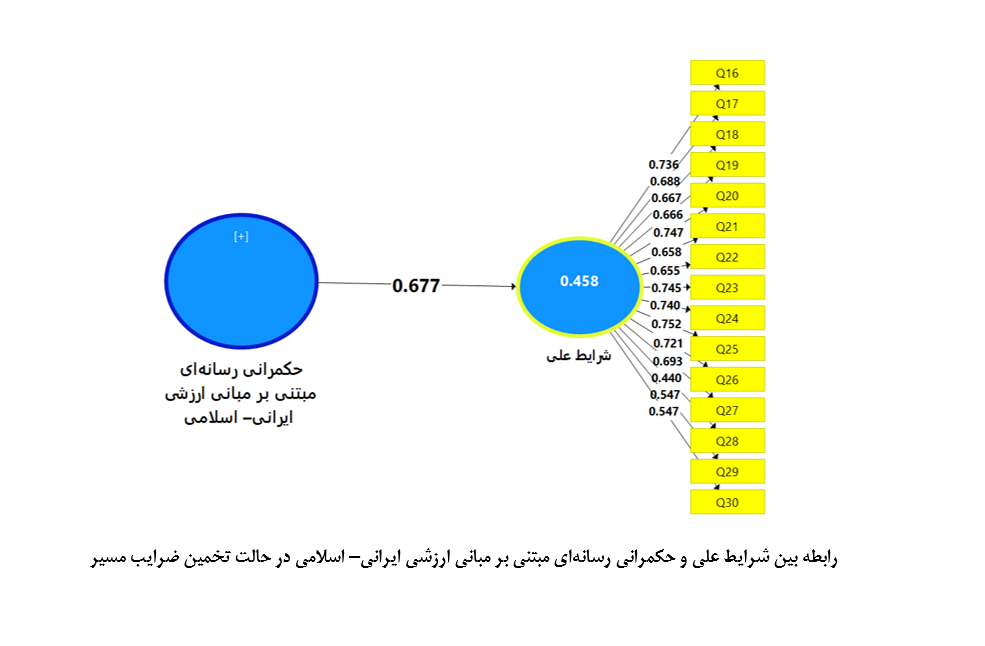
This study aims to design and explain a media governance model grounded in Iranian–Islamic values by identifying the key causal factors shaping media orientation. A sequential exploratory mixed-methods design was employed. The qualitative phase used grounded theory based on Strauss and Corbin’s approach, drawing on 13 semi-structured interviews with media governance experts and analyzed through open, axial, and selective coding. The quantitative phase applied a descriptive–survey method using a researcher-developed 90-item questionnaire administered to 357 media managers, professionals, and practitioners. Data were analyzed using Partial Least Squares Structural Equation Modeling (PLS-SEM). The results indicate that causal conditions have a significant effect on value-based media governance (path coefficient = 0.677; t = 21.219; p < 0.001). The absence of unified media policy, weak supervision, inefficient administrative structures, lack of financial independence, and the absence of a localized policy framework exhibited the strongest explanatory power. Five core categories— institutional support, media management and human resources, public media literacy, technology, and interaction—constituted the main causal conditions. Effective media governance in Iran requires institutional coherence, unified policymaking, strengthened professional oversight, financial independence of media organizations, capacity building of committed human resources, and the development of a localized governance framework grounded in communication justice, human dignity, and ethical responsibility.
Downloads
References
Puppis M. Media governance: A new concept for the analysis of media policy and regulation. Communication, Culture & Critique. 2010;3(2):134-49. doi: 10.1111/j.1753-9137.2010.01063.x.
Martin FR, Koskie T. Governing media and communications diversity in the digital age. Handbook of Media and Communication Governance: Edward Elgar Publishing; 2024. p. 397-413.
Zhang X, Lu F. Enhancing Public Health Policy Communication Through Government-Citizen Social Media Interactions: The Impact of Replying Agents, Inquiry Tone, and Institutional Trust. Policy & Internet. 2025;17(1). doi: 10.1002/poi3.70000.
Marchal N, Hoes E, Klüser KJ, Hamborg F, Alizadeh M, Kubli M, et al. How negative media coverage impacts platform governance: evidence from facebook, twitter, and youtube. Political Communication. 2025;42(2):215-33. doi: 10.1080/10584609.2024.2377992.
Pūrrashīdī Alībeiglū H, Alīpūr J. Desirable Islamic Governance and Cyberspace Governance. Governance Code Quarterly. 2025.
Pourrashidi H, Alipoor J, Samadi M, Soleimani N. Understanding Islamic Republic of Iran's Media Policy: A Concentration on Regulations and Laws. Southern Communication Journal. 2022;87(1):97-107. doi: 10.1080/1041794X.2021.2011955.
Rezaei S, Moḥammadī Khānghāhī M. Investigating the Challenges of Drawing a Policy Model for Media Governance in the Country; With a Grounded Theory Approach. News Sciences Quarterly. 2023;12(4):77-95.
Gāpleh M, Khojasteh Bāqerzādeh H, Rasūlī MR. The Governance Model for Regulating Iran's Over-the-Top (OTT) Audio-Visual Media. Scientific Quarterly of Culture-Communication Studies. 2025;26(69):43-79.
Nāmdārīān L, Khadmatgozār HR. Investigating the Governance System of Audio-Visual Media Services in Iran Based on the Institutional Mapping of Upland Documents. Strategic and Macro Policies Quarterly. 2024;12(48):963-1002.
Moṣaddeghī M, Sharīfī SM, Naṣrollāhī A. The Educational Model for Empowering and Promoting Talents in National Media News. Research in Islamic Education and Training Issues. 2023;31(58):11-40.
Cho H, Cannon J, Lopez R, Li W. Social media literacy: A conceptual framework. New media & society. 2024;26(2):941-60. doi: 10.1177/14614448211068530.
Chowdhury RH. Sentiment analysis and social media analytics in brand management: Techniques, trends, and implications. World Journal of Advanced Research and Reviews. 2024;23(2):287-96. doi: 10.30574/wjarr.2024.23.2.2369.
Aondover EM, Tosin YAN, Akin-Odukoya OO, Onyejelem TE, Ridwan M. Exploring the Application of Social Media in Governance in Nigeria. SIASAT. 2025;10(1):30-43.
Moḥammadī H, Naṣrollāhī A. Strategies of the Supreme Council of Cyberspace in Policy Making for New Communication Media. Socio-Cultural Strategy Quarterly. 2021;10(1):127-56.
Mehrbānī Far H. Analysis of the Relationship between Local Media and Popular Governance in the Upland Media Policies of the Islamic Republic of Iran System. Interdisciplinary Studies of the Civilizational Revolution of Islam Quarterly. 2024;2(7):135-61.
Seyed Moḥsenī SS, Dādgarān SM, Afkhamī H. Communication Challenges of Public Relations and Mass Media (Case Study: Ministries and National Newspapers). Resāneh (Media). 2022;33(3, Serial 128):297-317.
Downloads
Publication Timeline
- Submitted
- Revised
- Accepted
Issue
Section
License
Copyright (c) 2025 Seyyedeh Sara Mirghasemi (Author); Roohalah Ahmadzadeh Kermani (Corresponding author); Mohammad Soltani Far (Author)

This work is licensed under a Creative Commons Attribution-NonCommercial 4.0 International License.