Identifying Factors that Reduce Elementary School Teacher Turnover Using a Thematic Analysis Approach
DOI:
https://doi.org/10.61838/jsied.410Keywords:
turnover, teacher retention, thematic analysis, organizational factors, elementary school teachersAbstract
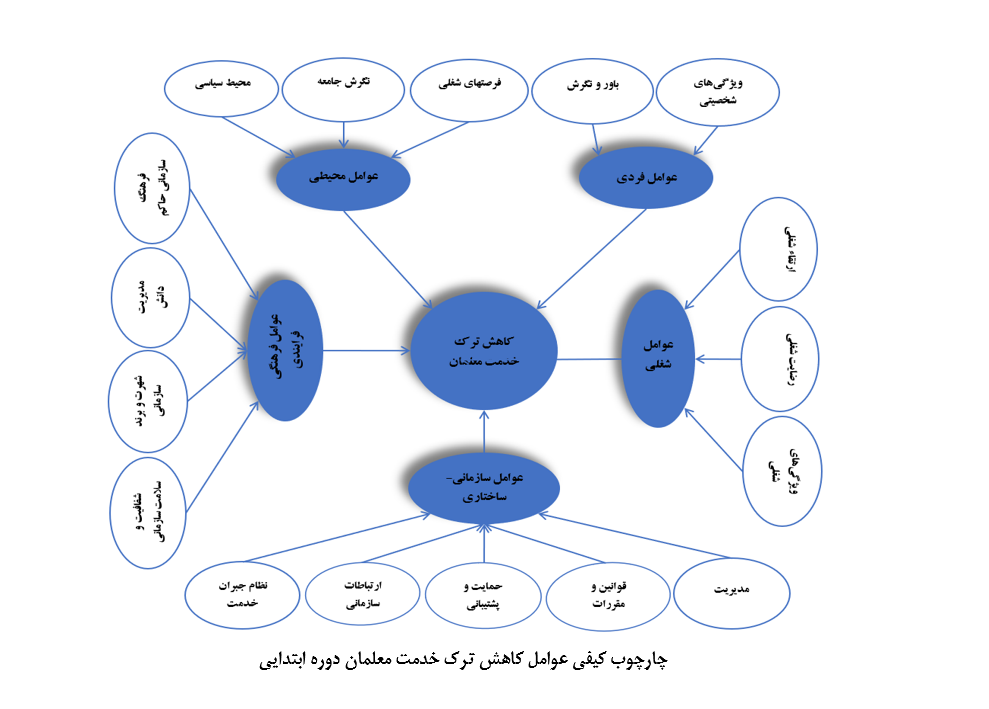
This study aimed to identify the factors that reduce elementary school teacher turnover and to develop a comprehensive qualitative framework based on thematic analysis. This applied qualitative study adopted an exploratory–inductive design. Data were collected through document analysis and semi-structured interviews with 32 academic experts and education professionals until theoretical saturation was achieved. Thematic analysis was conducted through systematic coding at basic, organizing, and global theme levels using MAXQDA software, and trustworthiness was ensured through credibility, dependability, confirmability, and transferability criteria. The findings revealed that teacher turnover reduction is explained through five overarching themes, eighteen organizing themes, and ninety-two basic themes, encompassing individual, job-related, organizational–structural, cultural–processual, and environmental dimensions that jointly influence teacher retention. The results highlight that reducing teacher turnover requires an integrated, multi-level human resource strategy within the education system rather than isolated or short-term interventions.
Downloads
References
Shafique M, Fatima M, Shafique A. Employee Turnover Models: A Review of Conventional and Contemporary Approaches and Future Research Direction. Leadership and Organizational Behavior Journal. 2025;4(1):42-60.
Wijayanthi IAT, Subagio M, Suhendra A, Hartini, Darmawan AA. Employee Retention Implementation Prevents Employee Turnover. SJAM. 2024;2(2):288-301. doi: 10.38035/sjam.v2i2.
Domurath A, Taggar S, Patzelt H. A contingency model of employees' turnover intent in young ventures. Small Bus Econ. 2023;60:901-27. doi: 10.1007/s11187-022-00629-2.
Arnold B, Rahimi M. Teachers' working conditions, wellbeing and retention: an exploratory analysis to identify the key factors associated with teachers' intention to leave. The Australian Educational Researcher. 2025. doi: 10.1007/s13384-024-00794-1.
Moran A, Orly L, Miriam S. Professional Commitment and Turnover Intentions of Elementary School Teachers During Educational Crisis. Front Educ. 2025;10. doi: 10.3389/feduc.2025.1548359.
Wang G. Teaching autonomy and teachers' turnover intentions under the labor process theory perspective: A moderated mediation model of work alienation and professional identity. Teaching and Teacher Education. 2025;159:104981. doi: 10.1016/j.tate.2025.104981.
Farahmandpour Z, Voelkel R. Teacher Turnover Factors and School-Level Influences: A Meta-Analysis of the Literature. Education Sciences. 2025;15(2):219. doi: 10.3390/educsci15020219.
Bustillo JCM. Optimization-based Techniques Prediction Model in Determining Employee Turnover. Procedia Computer Science. 2025;252:440-9. doi: 10.1016/j.procs.2025.01.003.
Park J, Yituo Feng Y, Jeong SP. Developing an advanced prediction model for new employee turnover intention utilizing machine learning techniques. Scientific Reports. 2024;14:1221. doi: 10.1038/s41598-023-50593-4.
Kanuto AE. Identifying Patterns and Predicting Employee Turnover Using Machine Learning Approaches. International Journal of Science and Business. 2024;36(1):20-35. doi: 10.58970/IJSB.2373.
Ebrahimi K. Investigation of the tendency and causes of employee turnover in organizations of Tehran province's counties. 2023.
Kavoosi SE, Fani AA, Danaeifard H, Nayeri S. Explaining the causes of employee turnover in Iranian knowledge-based companies and providing solutions: Investigating the role of compensation. Public Management Research. 2021;14(53):89-114.
Hashem Zehi R, Najaf Beygi R, Zabihi MR. Designing a knowledge employee turnover model in Khorasan Razavi Oil Products Distribution Company. Human Resource Management in the Oil Industry. 2021;12(47):23-39.
Miri B, Ghorbanizadeh V, Seyyed Naghavi M. Phenomenological analysis of employee turnover experience in a government organization. Management and Development Process. 2021;34(3):113-42. doi: 10.52547/jmdp.34.3.113.
Nikkhah Farkhani Z, Nemati Daghiyan S, Molamohammad Zamani M, Sheikhzadeh M. Explaining the work experience of teachers in deprived areas with the mediating role of job characteristics. Educational and School Studies. 2022;11(2):299-324.
Khanifar H, Naderi Beni N, Ebrahimi S, Fayazi M, Rahmati M. Identify the competency of schoolmasters for use in the assessment center. Journal of School Administration. 2019;7(1):105-25.
Aulia N, Haerani I. Teacher Retention and Turnover: Exploring the Factors that Influence Teacher Decision-Making. Journal of Education Review Provision. 2022;2(2):36-42. doi: 10.55885/jerp.v2i2.155.
Sudrajat J, Loke SH, Syafwandi, Bahri ES, Permana IA. A Proposed Conceptual Model of Teacher Turnover Intention in the Vocational High Schools in Indonesia. BRILLIANT INTERNATIONAL JOURNAL OF MANAGEMENT AND TOURISM(BIJMT). 2022;2(3):239-50. doi: 10.55606/bijmt.v2i3.817.
Bussin M, Brigman N. Evaluation of remuneration preferences of knowledge workers. SA Journal of Human Resource Management. 2019;17(1):1-10. doi: 10.4102/sajhrm.v17i0.1075.
Shareef RA, Atan T. The influence of ethical leadership on academic employees' organizational citizenship behavior and turnover intention: Mediating role of intrinsic motivation. Journal of Management Decision. 2019;57(3):583-605. doi: 10.1108/MD-08-2017-0721.
Aburumman O, Salleh A, Omar K, Abadi M. The impact of human resource management practices and career satisfaction on employee's turnover intention. Management Science Letters. 2020;10:641-52. doi: 10.5267/j.msl.2019.9.015.
Ready DA, Conger JA. Make your company a talent factory. Harvard Business Review. 2017:69-77.
Pirayesh R, Khan Mohammadi M, Badfar O. Factors affecting employees' intention to leave and its impact on the efficiency of Zarrin Roy Zanjan Company employees. Bimonthly Scientific-Specialized Journal of Applied Studies in Management and Development Sciences. 2020;5(1):7-18.
Basti S, Delkhah J, Danaeifard H, Fani AA. Designing a model of voluntary employee turnover. Executive Management Research Journal. 2022;14(27):375-410.
Sha'af A'mal M, Vedadi A, Tavakoli M, Gholamzadeh D. Presenting a model of elite turnover factors in the Iranian Offshore Oil Company. Quarterly Journal of Management and Education Outlook. 2024;6(1):189-210.
Oh J. Employee perceptions of HRM practices and their turnover intentions: evidence from South Korea. Journal of Evidence-based HRM. 2020;3:145-60. doi: 10.1108/EBHRM-04-2019-0037.
Lin W, Deng M. Turnover intention predictors among social workers in China. Asian Social Work and Policy Review. 2019;13(1):117-23. doi: 10.1111/aswp.12161.
Johannes Masenya JM, Ngoepe M, Jiyane V. Determinants of Turnover Intentions of Librarians at the City of Johannesburg Libraries in Gauteng Province, South Africa. South African Journal of Libraries and Information Science. 2020;86(1):73-83. doi: 10.7553/86-1-1890.
Downloads
Publication Timeline
- Submitted
- Revised
- Accepted
Issue
Section
License
Copyright (c) 2025 Hassan Dadashi (Author); Fakhreddin Ahmadi (Corresponding author); Hamid Shafizadeh (Author)

This work is licensed under a Creative Commons Attribution-NonCommercial 4.0 International License.