Identifying Crisis Management Challenges in Iran’s Education System: A Grounded Theory Approach
DOI:
https://doi.org/10.61838/jsied.438Keywords:
Crisis management, challenges, crisis, education, data-based theoryAbstract
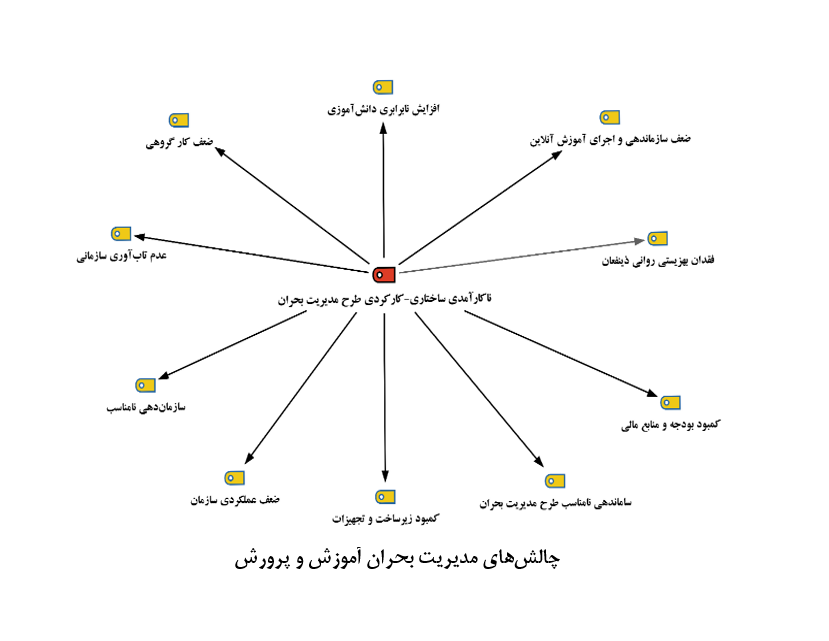
This study aims to identify and explain the challenges of crisis management in Iran’s education system using a grounded theory approach. The study is applied in purpose and exploratory-qualitative in methodology. Data were collected through semi-structured interviews with 23 experts and key practitioners in the fields of education and crisis management. Participants were selected using purposive sampling combined with the snowball technique, and data collection continued until theoretical saturation was achieved. Data analysis was conducted through open, axial, and selective coding based on the constant comparative method. Qualitative analysis yielded 120 initial concepts, which were organized into 10 axial categories and ultimately integrated into the core category of “structural–functional inefficiency of crisis management in the education system.” The main categories included lack of infrastructure and equipment, limited financial resources, inadequate crisis management planning, insufficient psychological well-being of stakeholders, weaknesses in online education, increased educational inequality, poor teamwork, low organizational resilience, improper organization, and weak organizational performance. The findings indicate that crisis management challenges in the education system are multidimensional and process-oriented, stemming from the interaction of structural, managerial, educational, and human factors rather than from resource shortages alone. Structural reform, strengthening managerial capacities, and simultaneous attention to technical and human dimensions are essential for improving the effectiveness of crisis management in education.
Downloads
References
Farmanesh M. Crisis is an inseparable reality of organizations. Management Monthly. 2016(1):20.
Riahi V, Azizpour F, Karimi K. Crisis management and presenting a desirable model with emphasis on vulnerability. Knowledge of Crisis Prevention and Management. 2016;6(4):368-81.
Hamzeh Esfahani M. Planning and Crisis Management. Tadbir Journal. 2018(1):52.
Mehdizadeh M, Haddadsaraei B, Tavakoli S, Ghanbari F. Structural challenges of crisis management in Mashhad Water and Wastewater Company. Knowledge of Crisis Prevention and Management. 2017;7(2):21-32.
Elbedour S, Alsubie F, Al'Uqdah SN, Bawalsah JA. School crisis management planning. Children & Schools. 2020;42(4):208-15. doi: 10.1093/cs/cdaa021.
Nickerson AB, Sulkowski ML. The COVID-19 pandemic as a long-term school crisis: Impact, risk, resilience, and crisis management. School psychology. 2021;36(5):271-6. doi: 10.1037/spq0000470.
Aisha Annet K. Crisis Management in Education: Lessons from Covid-19. Eurasian Experiment Journal of Arts and Management. 2024;6(3):20-4.
Schneider EJ. Reimagining Crisis Management With an Organizational Learning Framework. Journal of Contingencies and Crisis Management. 2024;32(4). doi: 10.1111/1468-5973.70001.
Gatuyu C. Challenges facing Education in Emergencies. 2021.
Hub EIE. Education in Emergencies and Crisis-Sensitive Planning. 2021.
Chatzipanagiotou P, Katsarou E. Crisis Management, School Leadership in Disruptive Times and the Recovery of Schools in the Post COVID-19 Era: A Systematic Literature Review. Education Sciences. 2023;13(2):118. doi: 10.3390/educsci13020118.
Lukwesa M. Crisis management in senior secondary schools in Kawambwa district of Luapula province: The University of Zambia; 2022.
Sayadi Y, Soleimani H. Primary school teachers' perceptions of successful school administrators' lived experiences in crisis situations. School Management. 2019;8(3):149-73.
Verinder B. Examining critical crisis management skills in the educational environment. International Journal of Educational Development. 2025;32(3):482-92.
Ben V. Examining critical crisis management skills in the educational environment. International Journal of Educational Development. 2025;32(3):482-92.
Farhang S. Presenting a Model for Enhancing Crisis Management with Emphasis on the Role of Social Media. Journal of Crisis Management. 2025;14(1):37-52.
Pasupuleti MK. Digital Leadership in the Age of AI: Crisis Management and Virtual Organizational Strategies. 2024:125-42. doi: 10.62311/nesx/17915.
Salehi N, Asma Y, Noor M, Kaykha A. Designing a community-oriented crisis management model using a meta-synthesis approach. Iranian Public Administration Studies. 2021;4(2):71-102. doi: 10.22344/jipas.2022.296577.1210.
Shirzad Kobria B. Investigating the dimensions and components of crisis management in order to provide a suitable solution for secondary schools in Tehran. Educational Management Research. 2013;4(16):85-118.
Kedačić-Buzina K, Klarin T, editors. Challenges of crisis management in educational institutions of the Republic of Croatia. Crisis Management Days; 2024.
Oufi N, De la Garza C, Nascimento A. Dynamics of COVID-19 crisis management in hospitals and its long-term effects: An analysis using organizational resilience. Applied Ergonomics. 2025;126:104486. doi: 10.1016/j.apergo.2025.104486.
Кара Н, Атаманчук ЗА, Kurytskyi V. Formation of Mechanisms for Anti-Crisis Management of Enterprises: International Economic Features. Journal of Lviv Polytechnic National University Series of Economics and Management Issues. 2024;8:197-208. doi: 10.23939/semi2024.02.197.
Downloads
Publication Timeline
- Submitted
- Revised
- Accepted
Issue
Section
License
Copyright (c) 2025 Mohammad Eskandarzadeh (Author); Peyman Yarmohammadzadeh (Corresponding author); Jahangir Yari Haj Atalou (Author)

This work is licensed under a Creative Commons Attribution-NonCommercial 4.0 International License.