A Sociological Explanation of the Role of Informal Student Network Structures in the Reproduction of Educational Inequality
Keywords:
Educational inequality, informal networks, social capital, sociology of education, studentsAbstract
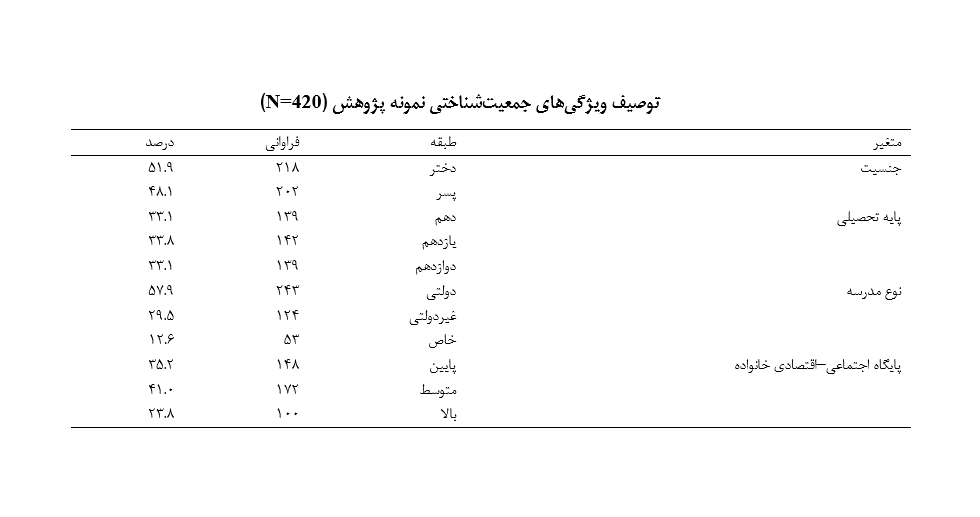
The objective of this study is to explain the role of informal student network structures in the reproduction of educational inequality among upper secondary school students in Tehran. This study adopted a mixed-methods design. The statistical population consisted of upper secondary school students in Tehran, from which 420 students were selected using multistage cluster sampling. Quantitative data were collected using a researcher-developed questionnaire measuring informal network structure, social capital, access to informal educational resources, perceived educational inequality, and academic performance. Additionally, 28 semi-structured interviews were conducted with students, teachers, and school counselors. Quantitative data were analyzed using descriptive statistics, Pearson correlation, and multiple regression analysis, while qualitative data were analyzed through thematic analysis. Results indicated that informal network structure, network social capital, access to informal educational resources, and family socio-economic status significantly predicted educational inequality and jointly explained 47% of its variance. Access to informal educational resources was the strongest predictor. Stronger network connections were associated with higher academic performance, whereas weaker network positions were linked to greater educational inequality. The findings demonstrate that informal student networks function as a powerful hidden mechanism in the reproduction of educational inequality, suggesting that educational policies must address these social processes to achieve sustainable equity.
Downloads
References
Downey DB. How Does Schooling Affect Inequality in Cognitive Skills? The View From Seasonal Comparison Research. Review of Educational Research. 2023;94(6):927-57. doi: 10.3102/00346543231210005.
Grätz M. Does Schooling Affect Socioeconomic Inequalities in Educational Attainment? Evidence From a Natural Experiment in Germany. Sociological Science. 2023;10:880-902. doi: 10.15195/v10.a31.
Terrin É, Triventi M. The Effect of School Tracking on Student Achievement and Inequality: A Meta-Analysis. Review of Educational Research. 2022;93(2):236-74. doi: 10.3102/00346543221100850.
Dougherty KJ. Choice, Information Inequity, and the Production, Legitimation, and Reduction of Educational Inequality. Teachers College Record. 2024;126(2):70-119. doi: 10.1177/01614681241240287.
Power S, Newton N, Taylor C. ‘Successful Futures’ for All in Wales? The Challenges of Curriculum Reform for Addressing Educational Inequalities. The Curriculum Journal. 2020;31(2):317-33. doi: 10.1002/curj.39.
Trinidad JE. An Organizational Sociology of Education: Using Structural, Network, and Ecological Perspectives to Study Schools. Sociological Inquiry. 2023;94(4):968-93. doi: 10.1111/soin.12583.
Hurst AL, Roscigno VJ, Jack AA, McDermott M, Warnock DM, Muñoz JA, et al. The Graduate School Pipeline and First-Generation/Working-Class Inequalities. Sociology of Education. 2023;97(2):148-73. doi: 10.1177/00380407231215051.
Holmqvist M. Consecration and Meritocracy in Elite Business Schools: The Case of a Swedish Student Union. British Journal of Sociology. 2023;74(4):531-46. doi: 10.1111/1468-4446.13026.
Haber J. Sorting Schools: A Computational Analysis of Charter School Identities and Stratification. Sociology of Education. 2020;94(1):43-64. doi: 10.1177/0038040720953218.
Donoghue C, Pascoe CJ. A Sociology of Bullying: Placing Youth Aggression in Social Context. Sociology Compass. 2023;17(4). doi: 10.1111/soc4.13071.
Clarke A, Smith C. Reproducing a White Elite: The Chief Officers’ ‘Club’ in the London Metropolitan Police Service. Work Employment and Society. 2023;38(4):911-29. doi: 10.1177/09500170231199415.
Broeck LVd, Blöndal KS, Andreu ME, Markussen E. A Search for the Determinants of Students’ Educational Expectations for Higher Education in Four European Cities: The Role of School SES Composition and Student Engagement. European Educational Research Journal. 2022;22(3):433-55. doi: 10.1177/14749041211062434.
Ye R, Chudnovskaya M, Nylander E. Right Competence at the Right Time—but for Whom? Social Recruitment of Participants in an Expanding Higher Vocational Education Segment in Sweden (2005–2019). Adult Education Quarterly. 2022;72(4):380-400. doi: 10.1177/07417136221080423.
Haskins AR, Jacobsen WC, Mittleman J. Optimism and Obstacles: Racialized Constraints in College Attitudes and Expectations Among Teens of the Prison Boom. Sociology of Education. 2023;96(3):211-33. doi: 10.1177/00380407231167412.
Nika D, Grüttner M, Buchholz S. Social Origin and the Intention to Enrol in Higher Education: Personality Traits as a Mechanism of Reproduction or Mobility? Frontiers in Sociology. 2025;10. doi: 10.3389/fsoc.2025.1652429.
Heckhausen J. Invited Commentary: Societal Constraints and Individual Agency: Navigating Educational Transitions for Upward Mobility. Journal of Youth and Adolescence. 2020;50(3):437-45. doi: 10.1007/s10964-020-01311-0.
Giavrimis P. Sociological Approaches to ICT Integration in Primary School Through Students’ Views. Sn Computer Science. 2020;1(5). doi: 10.1007/s42979-020-00262-4.
Harahap R, Sutikno S, Matondang SA. Digital Technology for Non-Formal Learning During the Covid 19 Pandemic. Al-Ishlah Jurnal Pendidikan. 2022;14(3):3375-82. doi: 10.35445/alishlah.v14i3.2157.
Wright ER, Wong D, Ahmad W, Mallick RJ. Doing Sociology Across Borders: Student Experiences and Learning With Virtual Exchange in Large Introductory Sociology Classes. Teaching Sociology. 2024;52(4):323-35. doi: 10.1177/0092055x241230549.
Cadena RS. Toward a DuBoisian Theorization of School Curricula. Sociology Compass. 2023;17(12). doi: 10.1111/soc4.13135.
Cant S, Chatterjee A. Powerful or Disempowering Knowledge? The Teaching of Sociology in English Schools and Colleges. Sociology. 2022;57(3):606-24. doi: 10.1177/00380385221107299.
Kolluri S, Tichavakunda AA. The Counter-Deficit Lens in Educational Research: Interrogating Conceptions of Structural Oppression. Review of Educational Research. 2022;93(5):641-78. doi: 10.3102/00346543221125225.
Byron RA. Organizational Directives and the Persistence of Racial Discrimination in U.S. Public Accommodations. Sociology of Race and Ethnicity. 2022;9(3):326-41. doi: 10.1177/23326492221138224.
Sola J, Catalán CD, Rodríguez IS, Romanos E, Rendueles C. The Inequality Mirror: Using a Student Survey to Teach Social Stratification. Teaching Sociology. 2022;50(3):241-55. doi: 10.1177/0092055x211071131.
Culatta E, Powell-Williams M, Davies K. Preparing for Medical School: How Sociology Helps Premedical Students Prepare for the McAt and Beyond. Teaching Sociology. 2023;52(1):27-38. doi: 10.1177/0092055x231169754.
Fürst H, Millenberg F, Nylander E. Enforced Freedoms: Testing Art Students’ Artistic Engagements in a Folk High School. European Educational Research Journal. 2024. doi: 10.1177/14749041241276568.
Steyer L. De Facto Suspensions: Informal Exclusionary Discipline Practices in Public Preschool and Early Elementary Settings. Aera Open. 2025;11. doi: 10.1177/23328584251375062.

Downloads
Published
Submitted
Revised
Accepted
Issue
Section
License
Copyright (c) 2025 Saed Mosa Raesi (Corresponding author)

This work is licensed under a Creative Commons Attribution-NonCommercial 4.0 International License.