Examining the Relationship Between Structural Social Capital and Economic Underdevelopment: A Qualitative Approach (Case Study: Ilam Province)
Keywords:
Social Capital, Economic Underdevelopment, Ilam Province, Grounded Theory, Civic Participation, Social NetworksAbstract
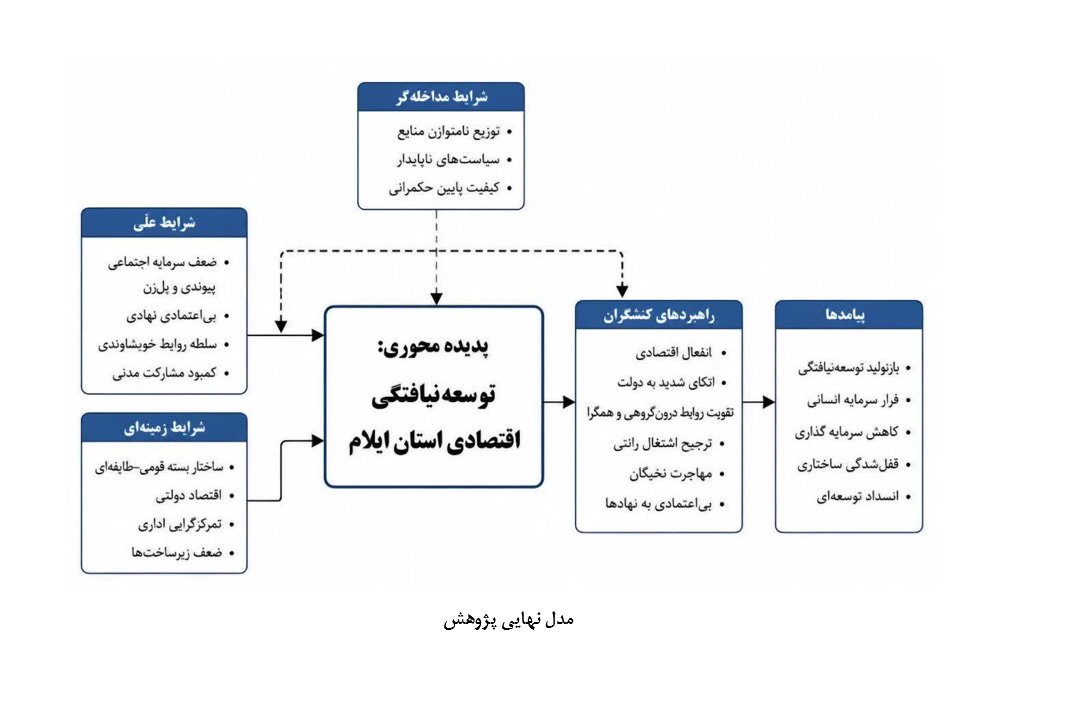
This study aimed to explain how structural social capital influences the economic underdevelopment of Ilam Province and to identify the mechanisms through which this condition is reproduced within the province’s institutional and social context. This research was conducted using a qualitative approach based on the Grounded Theory methodology. The study population included local stakeholders, experts, policymakers, economic actors, and members of social institutions in Ilam Province who were selected through purposive and snowball sampling methods. Data were collected through 33 in-depth semi-structured interviews and 7 focus group discussions. Data analysis was performed simultaneously with data collection using open, axial, and selective coding procedures. To ensure the credibility of findings, triangulation, member checking, thick description, and constant comparison techniques were employed. The reliability of coding was assessed through inter-coder agreement, yielding an agreement coefficient of 82%, which confirmed the trustworthiness of the analytical process. The findings indicated that weak structural social capital—manifested in limited formal participation networks, institutional distrust, dominance of kinship relations, and weak bridging social capital—plays a central role in reproducing economic underdevelopment in Ilam Province. The paradigmatic analysis revealed that contextual conditions such as a state-dependent economy, administrative centralization, weak infrastructure, and closed ethnic structures, combined with intervening factors including unstable development policies and weak local governance, have led to strategies such as excessive dependence on the government, rent-seeking behaviors, human capital migration, and declining social participation. These processes ultimately contribute to structural lock-in, reduced investment, and the persistence of economic underdevelopment. The findings demonstrate that the economic underdevelopment of Ilam Province is not merely the result of limited economic resources, but is deeply rooted in weak institutional structures and insufficient structural social capital. Strengthening civil institutions, enhancing social participation, improving local governance, and expanding formal cooperation networks can provide the foundation for breaking the cycle of reproduced underdevelopment in the province.
Downloads
References
1. Azkia M, Ahmadrash R. Theories of Development. Tehran: Ehsan Publishing; 2020.
2. Azkia M, Ghaffari G. Sociology of Development: Theoretical and Applied Issues. Tehran: Elm Publishing; 2009.
3. Putnam RD. Bowling Alone: The Collapse and Revival of Social Capital in America. Tehran: Rozaneh Publishing; 2005.
4. Field J. Social Capital. Tehran: Shirazeh; 2005.
5. Mousavi SD. Social Capital and Development. Tehran: SAMT Publishing; 2006.
6. Shokri M. Social Capital and Its Consequences. Tehran: University of Tehran Press; 2020.
7. Haldane A, Halpern D. Social Capital 2025 The Hidden Wealth Of Nations. Demos, 2025.
8. Lin N, Fu Y. Structural Social Capital and Network Theory: Advances and Extensions: Oxford University Press; 2021.
9. Chuang Y, Chiu Y. Local Governance, Institutional Trust and Structural Social Capital. Governance. 2022;35(4):1012-31.
10. Bjørnskov C, Sønderskov KM. Social Trust and Economic Performance. Journal of Comparative Economics. 2021;49(2):112-28.
11. Sabit NS, Khaksar S. The Performance of Local Government, Social Capital, and Rural Participation in Sustainable Rural Development. Journal of Social Sciences. 2025.
12. Zarei R. Examining the Relationship Between Social Capital and Sustainable Rural Tourism Development in Tourist Destinations. Social Studies in Tourism. 2025;13(29):1-26.
13. Wang Y, Chen H. A system dynamics model for analyzing the impact of social capital on organizational resilience in crises. Journal of Organizational Behavior. 2025.
14. Paldam M, Svendsen GT. The Dark Side of Social Capital Revisited. Journal of Institutional Economics. 2023;19(1):54-71.
15. Grieger L. Ethnic Networks and Local Development. European Regional Studies. 2018;26(2):118-35.
16. Warde A, Tampubolon G. Social Capital, Networks and Leisure Consumption. Sociology. 2002;36(1):165-83.
17. Undp. Social Cohesion and Regional Disparities in Iran. Tehran Office, 2022.
18. Oecd. Regional Development Outlook: Governance and Territorial Inequalities. OECD Publishing, 2020.
19. Alkire S, Santos ME. Multidimensional Poverty and Structural Inequality. Oxford Poverty and Human Development Initiative, 2025.
20. Amanpour S, Parvizian A, Alizadeh M. Assessing the Status of Development Indicators in Ilam Province. Farhang-e Ilam. 2015;16(48-49).
21. Huysentruyt M, Gutiérrez M MdlÁ, Algan Y. Bridging social capital and trust: a research agenda. sustainability & Organizational Institute, 2025.
22. Charmaz K. Constructing Grounded Theory. 3rd ed: Sage; 2021.
23. Azkia M, Ahmadrash R, Partazian K. Qualitative Research Method. Tehran: Keyhan; 2017.
Downloads
Publication Timeline
- Submitted
- Revised
- Accepted
Issue
Section
License
Copyright (c) 2025 Amin Doust Mohammadi (Author); Mostafa Azkia (Corresponding author); Mansour Vosoughi (Author)

This work is licensed under a Creative Commons Attribution-NonCommercial 4.0 International License.