Design and Validation of a Curriculum Model Based on the Theory–Practice Connection in Virtual Education with an Emphasis on Higher Education
Keywords:
Curriculum model, Theory, practice connection, Virtual education, Higher educationAbstract
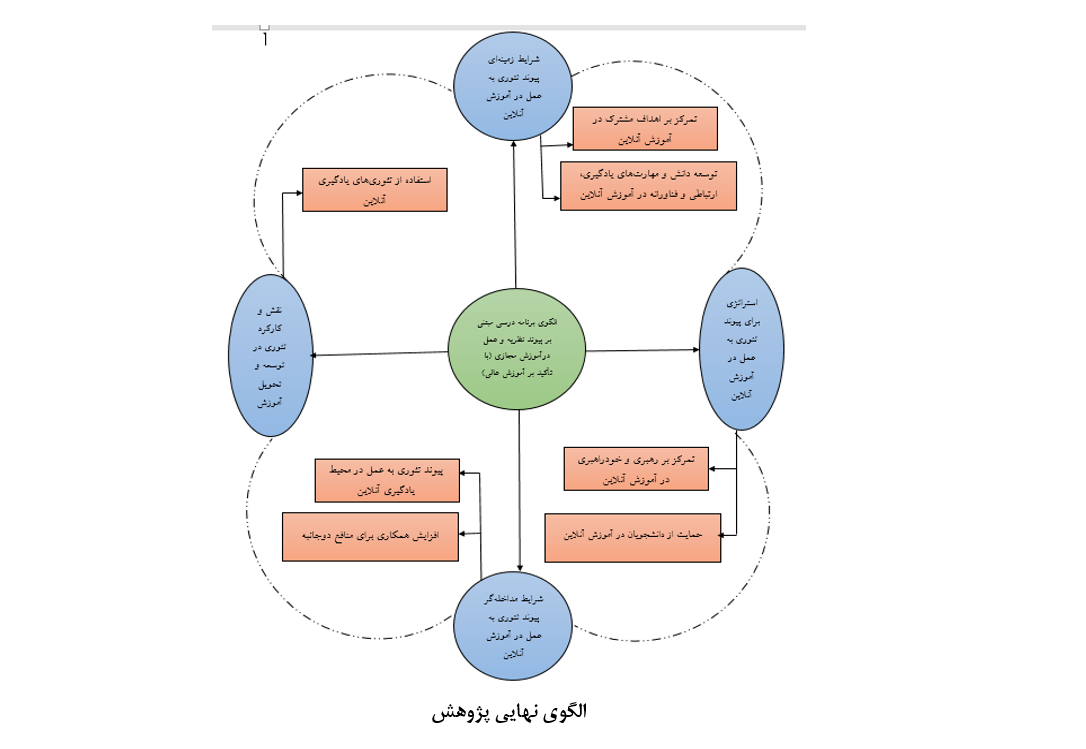
This study aimed to design and validate a comprehensive curriculum model for establishing a coherent connection between theoretical knowledge and practical application in virtual higher education. This applied study employed a sequential exploratory mixed-methods design. In the qualitative phase, 15 faculty members and experts in curriculum studies and educational sciences from universities in Khuzestan Province were recruited in 2025 through purposive snowball sampling until theoretical saturation was achieved. Data were collected through semi-structured interviews and analyzed using Attride-Stirling’s thematic network analysis. In the quantitative phase, the population comprised 800 postgraduate students and graduates of selected universities in Khuzestan Province, from whom 260 participants were selected through multistage cluster sampling. A 58-item researcher-developed questionnaire derived from the qualitative findings was administered. Content validity was evaluated using the content validity ratio and content validity index, while construct validity was assessed through exploratory and confirmatory factor analyses. Cronbach’s alpha and composite reliability were used to assess reliability. Data were analyzed using SPSS and SmartPLS through exploratory factor analysis, confirmatory factor analysis, and structural equation modeling. The Kaiser–Meyer–Olkin index was 0.825, and Bartlett’s test of sphericity was statistically significant (χ²=6164.525, df=1653, p<0.001), confirming the suitability of the data for factor analysis. Exploratory factor analysis supported a seven-factor structure that explained 44.447% of the total variance. Composite reliability coefficients ranged from 0.722 to 0.840, while average variance extracted values ranged from 0.520 to 0.791, confirming convergent validity. The coefficients of determination indicated acceptable explanatory power for the endogenous constructs, and all Q² values were positive, demonstrating adequate predictive relevance. The structural relationships among the model components were statistically significant. Moreover, the overall goodness-of-fit index was 0.439, indicating satisfactory fit of the final structural model. The validated model provides an empirically supported framework for designing, implementing, and evaluating virtual higher education curricula. Its application may strengthen practice-oriented learning, interaction, self-directed learning, learner support, and the purposeful use of learning theories, thereby reducing the gap between theoretical instruction and professional practice.
Downloads
References
1. Makda F. Digital Education: Mapping the Landscape of Virtual Teaching in Higher Education: A Bibliometric Review. Education and Information Technologies. 2025;30:2547-75. doi: 10.1007/s10639-024-12899-2.
2. Rapanta C, Botturi L, Goodyear P, Guàrdia L, Koole M. Online University Teaching During and After the COVID-19 Crisis: Refocusing Teacher Presence and Learning Activity. Postdigital Science and Education. 2020;2(3):923-45. doi: 10.1007/s42438-020-00155-y.
3. Martin F, Sun T, Westine CD. A Systematic Review of Research on Online Teaching and Learning from 2009 to 2018. Computers & Education. 2020;159:104009. doi: 10.1016/j.compedu.2020.104009.
4. Kolb DA. Experiential Learning: Experience as the Source of Learning and Development. Englewood Cliffs, NJ: Prentice-Hall; 1984.
5. Schön DA. The Reflective Practitioner: How Professionals Think in Action. New York, NY: Basic Books; 1983.
6. Friesen N. Continuing the Dialogue: Curriculum, Didaktik and Theories of Knowledge. Journal of Curriculum Studies. 2018;50(6):724-32. doi: 10.1080/00220272.2018.1537377.
7. Mian A, Khan S. Medical Education During Pandemics: A UK Perspective. BMC Medicine. 2020;18:100. doi: 10.1186/s12916-020-01577-y.
8. van Dorresteijn C, Fajardo-Tovar D, Pareja Roblin N, Cornelissen F, Meij M, Voogt J, et al. What Factors Contribute to Effective Online Higher Education? A Meta-Review. Technology, Knowledge and Learning. 2025;30(1):171-202. doi: 10.1007/s10758-024-09750-5.
9. Lewis E. Best Practices for Improving the Quality of the Online Course Design and Learners Experience. The Journal of Continuing Higher Education. 2021;69(1):61-70. doi: 10.1080/07377363.2020.1776558.
10. Viana J, Peralta H. Online Learning: From the Curriculum for All to the Curriculum for Each Individual. Journal of New Approaches in Educational Research. 2021;10(1):122-36. doi: 10.7821/naer.2021.1.579.
11. Bayram A, Bayram SB, Özsaban A. Using the Online Education Planned Based on Anderson's Theory to Facilitate the Practice Learning Experiences of Nursing Students: A Phenomenological Study. Education and Information Technologies. 2024;29:21547-65. doi: 10.1007/s10639-024-12692-1.
12. Shahini G. The Role of Pedagogical Practice Duration in Developing Pre-Service Teacher Competencies. Journal of Curriculum Studies Research. 2025;7(2):73-90. doi: 10.46303/jcsr.2025.12.
13. Abdollahi M, Kargar M, Mohammadi SM, Behrouzi M. Designing a Curriculum Model Based on Critical Thinking Education in Elementary School. Education, Training and Sustainable Development. 2026;4(4):1-18.
14. Omrani L, Adib Y, Yari J. Construction and Validation of a Competency-Based Curriculum Model for Training Biology Teachers. Journal of Research and Innovation in Education and Development. 2024;4(1):43-62. doi: 10.61838/jsied.4.1.3.
15. Mahmoudi Z, Shahabadi MR, Shahmohammadi N. Designing a Curriculum Model Based on Blended Learning. Journal of Cognition, Behavior and Learning. 2024;1(2):20-52. doi: 10.61838/jcbl.1.2.2.
16. Dalqandi M, Karimi M, Nodehi H, Cherabin M. Designing an Effective Virtual Education Model at Farhangian University. Sociology of Education. 2024;10(1):280-94. doi: 10.22034/ijes.2024.2012176.1469.
Downloads
Publication Timeline
- Submitted
- Revised
- Accepted
Issue
Section
License
Copyright (c) 2025 Azam Ahmadpour (Author); Afsaneh Saber Karagan (Corresponding author); Mojgan Mohammadi Naeini (Author)

This work is licensed under a Creative Commons Attribution-NonCommercial 4.0 International License.