Institutional–Structural Contexts and Value–Cultural Consequences of Modernism in the Formation of Social Indifference: A Qualitative Study in Three Districts of Tehran
Keywords:
Social indifference, Modernism, Thematic analysis, Institutional inefficiency, Social capital, ConsumerismAbstract
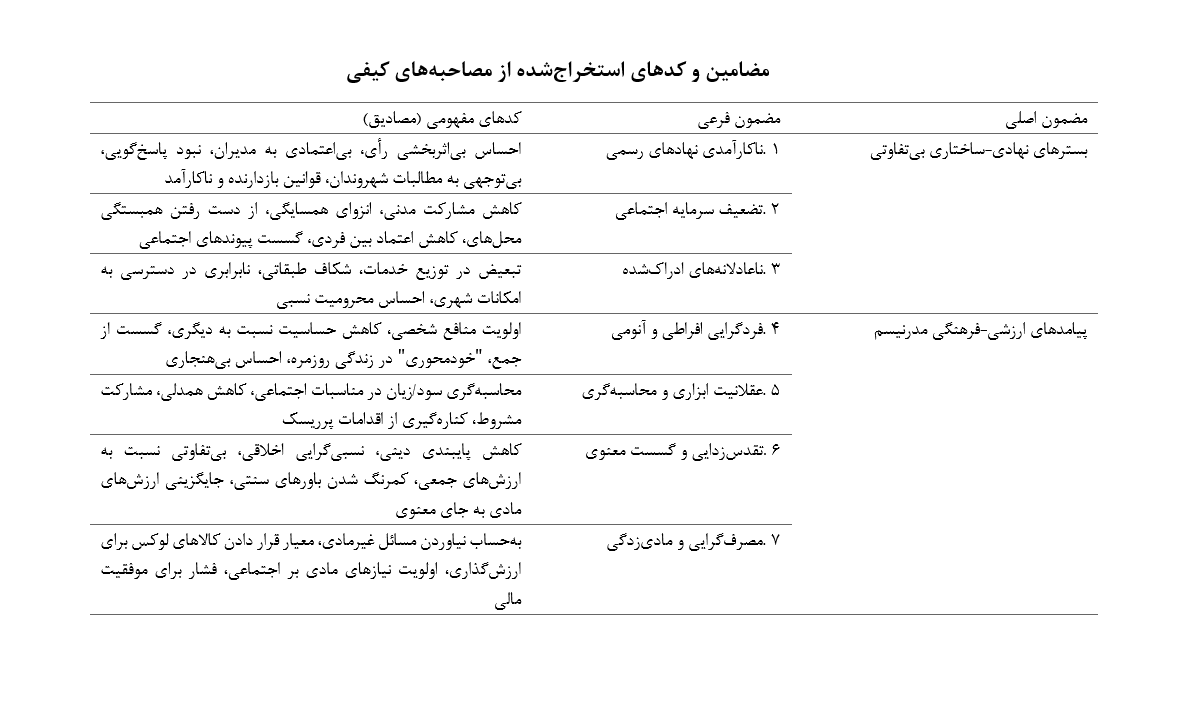
This study aimed to explore the institutional–structural contexts and value–cultural consequences of modernism contributing to social indifference and to explain variations in its patterns across Districts 3, 6, and 16 of Tehran. This qualitative study employed thematic analysis based on Braun and Clarke’s six-phase framework. Data were collected through 15 in-depth semi-structured interviews with experts, university academics, researchers, and individuals knowledgeable about social issues residing in Districts 3, 6, and 16 of Tehran. Participants were purposively selected until theoretical saturation was achieved. Following transcription, the interviews were analyzed through open, axial, and selective coding. Trustworthiness was enhanced through member checking and inter-coder agreement. The inter-coder Cohen’s kappa coefficient of 0.85 indicated a high level of coding agreement. The thematic analysis demonstrated that social indifference emerged through the interaction of two major mechanisms: institutional–structural conditions and the value–cultural consequences of modernism. Institutionally, inefficiency of formal institutions, erosion of social capital, and perceived injustice reduced interpersonal and institutional trust, perceived efficacy, and motivation for collective participation. Culturally, excessive individualism and anomie, instrumental rationality and calculative orientations, desacralization and spiritual disengagement, and consumerism and materialism shifted priorities toward personal interests and weakened sensitivity to collective concerns. Cross-district comparison revealed distinct configurations: institutional inefficiency and desacralization were more prominent in District 3; consumerism, excessive individualism, and weakened social capital characterized District 6; whereas perceived injustice, relative deprivation, and institutional inefficiency were particularly salient in District 16. Social indifference in Tehran is a multidimensional phenomenon generated by the interaction between institutional weaknesses and modern value transformations. Effective responses therefore require context-sensitive and district-specific interventions that strengthen institutional accountability and effectiveness, reduce inequalities in urban service distribution, rebuild social capital, and reinforce norms of civic responsibility, solidarity, and collective participation.
Downloads
References
1. Mohseni Tabrizi A, Sedaghatifard M. A Study of Social Indifference in Iran: The Case of Tehran Citizens. Applied Sociology. 2011;22(3):2.
2. Anbari M, Gholamian S. A Sociological Explanation of Factors Related to Social Indifference. Journal of Social Problems of Iran. 2016;7(2):133-59.
3. Ghazizadeh H, Kianpour M. Examining the Level of Social Indifference Among University Students: A Case Study of the University of Isfahan. Strategic Research on Social Security and Order. 2015;4(1):59-78.
4. Mousavi Chelak SH. Social Indifference: Causes of Formation, Harms, and Ways Out. 2017.
5. Khaje Noori BKN, Mosavat SE, Riyahi Z. "Modernism of underdevelopment and alienation of the middle class in post-revolutionary Iran". Sociological Cultural Studies. 2015;5(4):19-36.
6. Khajeh Noori B, Mosavat A, Riahi Z. Modernism, Underdevelopment, and Alienation of the Middle Class in Iran After the Revolution. Cultural Sociology Research. 2020;5(4).
7. Karimian M, Zare'i G. Factors effective on youth modernism in urban culture. Urban Management Journal. 2017;16(46).
8. Featherstone M. Consumer Culture and Postmodernism. 2nd ed: Sage Publications; 2007.
9. Jimson F. Postmodernism, or the logic of late capitalist culture: The relationship between late capitalism and postmodern culture. Journal of Contemporary Cultural Analysis. 2025;9(1):7-55.
10. Mazrouei K, Kamal Gharibi Mofrad M. Postmodernism and the globalization of culture with an emphasis on Jean-François Lyotard’s critical perspective. Political Studies. 2014;26.
11. Afrin S. A Postmodern Cultural Study of Media Manipulation and Capital Market Expansion. Postmodernism Problems. 2021;11(3):270-89. doi: 10.46324/pmp2103270.
12. Yang J, McDonnell M. Social Structures and Family Systems: An Analysis of Cultural Influences. Journal of Psychosociological Research in Family and Culture. 2024;2(1):31-41. doi: 10.61838/kman.jprfc.2.1.6.
13. Soleiman Nejad S, Amraei K, Mousavi SA, Aghaali M, editors. Educating the global citizen: Teaching social values and responsibilities in schools. The First International Conference of Talent-Scouting and Culture-Building Teachers in the Development of Technical and Vocational Education and Skill Training on the Path to Sustainable Development; 2024.
14. Azmira R. Teacher Strategies in Civic Education for Internalizing Tolerance Values as Social Conflict Prevention in Multicultural Schools. Journal of Innovation and Research in Primary Education. 2026;5(1):454-66. doi: 10.56916/jirpe.v5i1.2891.
15. Rasyid M, Hidayat MI, Nurannisa I, Tang M, Syahrul M. Integration of Multicultural Values in the Development of Islamic Religious Education Curriculum. Edusoshum: Journal of Islamic Education and Social Humanities. 2026;6(1):116-25. doi: 10.52366/edusoshum.v6i1.225.
16. Tabatabaei S, Ахмедовна ББ, Trofimova G, Barabash V. Social Media, Cultural Values, and Digital Citizenship: A Study of Iranian Digital Natives. Changing Societies & Personalities. 2025;9(1):29. doi: 10.15826/csp.2025.9.1.316.
17. Taghavi H. Examining the spread of the theoretical foundations of social indifference in the Seljuk period. Journal of the History of Culture and Civilization. 2013.
Downloads
Publication Timeline
- Submitted
- Revised
- Accepted
Issue
Section
License
Copyright (c) 2025 Raha Heydari, Tahmineh Shaverdi, Mohamad Mehdi labibi (Author)

This work is licensed under a Creative Commons Attribution-NonCommercial 4.0 International License.