The Role of Crisis Management Training in Reducing Air Traffic Control Problems
Keywords:
Crisis Management, Training, Air TrafficAbstract
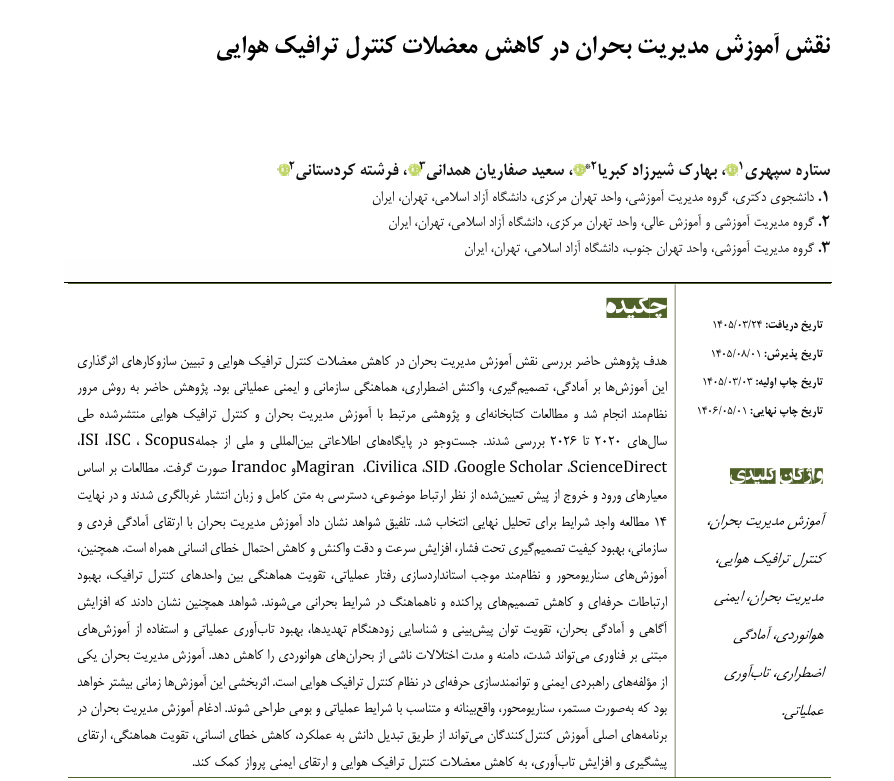
This study aimed to examine the role of crisis management training in reducing air traffic control problems and to clarify its effects on preparedness, decision-making, emergency response, organizational coordination, and operational safety. This systematic review examined library-based and empirical studies concerning crisis management training and air traffic control published between 2020 and 2026. Relevant studies were searched in international and national databases, including Scopus, ISC, ISI, ScienceDirect, Google Scholar, SID, Civilica, Magiran, and Irandoc. Studies were screened according to predefined inclusion and exclusion criteria, including topical relevance, availability of the full text, publication language, and consistency with the research objective. Following the screening and eligibility assessment process, 14 studies meeting the required criteria were included in the final synthesis. The synthesis of evidence indicated that crisis management training was associated with enhanced individual and organizational preparedness, improved decision-making under pressure, faster and more accurate emergency responses, and a reduced likelihood of human error. Systematic and scenario-based training also contributed to the standardization of operational behavior, stronger coordination among air traffic control units, improved professional communication, and fewer fragmented or inconsistent decisions during emergencies. The reviewed evidence further suggested that greater crisis awareness and preparedness, enhanced capability for anticipating and detecting threats at an early stage, improved operational resilience, and technology-supported training could reduce the severity, scope, and duration of aviation-related disruptions. Crisis management training should be considered a strategic component of safety management and professional competency development in air traffic control systems rather than a supplementary educational activity. Its effectiveness is likely to increase when training programs are continuous, scenario-based, realistic, and adapted to local and operational requirements. Integrating crisis management training into the core education of air traffic controllers may reduce operational problems by transforming knowledge into effective action, minimizing human error, strengthening interunit coordination, improving preventive capacity, and increasing operational resilience, thereby contributing to safer and more reliable air traffic management.
Downloads
References
1. Raziq O, Khaili ME, Nhaila H, Khiat A. Improving air traffic control by combining centralized and decentralized solutions. Edelweiss Applied Science and Technology. 2025;9(8):1122-38. doi: 10.55214/2576-8484.v9i8.9564.
2. Chen X, Li S, Li M. A hybrid centralized-decentralized traffic control framework for unmanned aerial vehicles in urban low-altitude airspace. Communications in Transportation Research. 2025;5(5). doi: 10.1016/j.commtr.2025.100195.
3. Cook D, Mayer R, Doy G. Crises and the resilience of the aviation industry: A literature review of crises and airline responses. Transportation Research Procedia. 2024;75(3):33-42. doi: 10.1016/j.trpro.2023.12.005.
4. Hsiu-Ying Kao G, Wang SW, Farquhar JD. Modeling airline crisis management capability: Brand attitude, brand credibility and intention. Journal of Air Transport Management. 2020;89(10):1-9. doi: 10.1016/j.jairtraman.2020.101894.
5. Gyles D, Bearman C. Co-constructing safety: How air traffic controllers change goals from efficiency to safety. Cognition, Technology & Work. 2025;27:449-65. doi: 10.1007/s10111-025-00805-w.
6. Chen Y, Zhao Y, Wu Y. Recent progress in air traffic flow management: A review. Journal of Air Transport Management. 2024;116(4). doi: 10.1016/j.jairtraman.2024.102573.
7. Zhao T, Macias JE, Zhang M, Fu S, Feng Y, Elhajj M, et al. Enhancing air traffic operational efficiency by reducing network scale. Aerospace Traffic and Safety. 2024;1(1):10-9. doi: 10.1016/j.aets.2024.06.001.
8. Meyer V, Jr., Cunha MPE, Mamédio DF, Nogueira DP. Crisis management in high-reliability organizations: Lessons from Brazilian air disasters. Disaster Prevention and Management: An International Journal. 2021;30(2):209-24. doi: 10.1108/DPM-08-2019-0245.
9. Abdallah F, Elhoss W, Chahine J. The importance of crisis management in the aviation industry: A case study on Kuwait. Edelweiss Applied Science and Technology. 2025;9(4):2459-70. doi: 10.55214/25768484.v9i4.6584.
10. Taylor F. Crisis management for airports and airlines. 2026.
11. Kar SK, Mathew DJ, S MM, John AM. Air Traffic Management as a Service for Urban Air Mobility in Indian Cities: A Study for Scalable and Adaptive Design Framework for Optimizing Airspace Over Rail, Metro, and Roads. In: Mahamuni R, Onkar P, editors. ServDes 2025: Empowering Diversity, Nurturing Lasting Impact; Hyderabad, India2025.
12. Gupta V, Bethapudi A. AI in crisis management: Reskilling and upskilling for the aviation industry. In: El Khoury R, editor. Empowering Business Through Technology: Innovations Shaping Our Future. Cham: Springer; 2026.
13. Hosseinian S, Ahmadi Dizaj I, Hosseini T, Hendiani A. Prioritizing the dimensions and components of a traffic crisis management model for natural disasters. Safe City. 2023;6(3):57-81.
14. Adibi Saadinejad F, Seif M. The necessity of smart urban development in crisis management and appropriate solutions for Tehran traffic. New Research Approaches in Management and Accounting. 2023;7(27):1477-96.
15. Moradi M, Ahmadvand AM, Samadi Foroushani M. System dynamics analysis of aviation accident crisis management to develop accident prevention policies based on improved flight safety. Disaster Prevention and Management Knowledge. 2024;14(3):274-91.
16. Mousavi K, Valizadeh R, Ahmadzad H. Analyzing the components influencing crisis management at the local scale: A case study of metropolitan Tabriz. Urban Structure and Function Studies. 2024;11(38):244-66.
17. Rabbani E, Moghli A, Shahin A, Abbasi N. Diagnosing organizational crisis management using a hazard and operability analysis approach: A case study of Iran's oil industry. Iranian Journal of Management Studies. 2025;16(1):43-60.
18. Shirini M, Ahmadzadeh H, Panahi A. Explaining the role and position of integrated urban management in crisis management through a passive defense approach in metropolitan Karaj. Urban Economics and Planning. 2026;7(1):86-103.
19. Saremi S, Esmaeili R, Taghipour F. Designing a media model for managing aviation accident crises. Transportation Engineering. 2023;15(2):3573-600.
Downloads
Publication Timeline
- Submitted
- Revised
- Accepted
Issue
Section
License
Copyright (c) 2025 Setareh Sepehri (Author); Baharak Shirzad Kebria (Corresponding author); Saeid Saffariyan Hamedani, Fereshteh Kordestani (Author)

This work is licensed under a Creative Commons Attribution-NonCommercial 4.0 International License.