Components of the Artificial Intelligence Curriculum in Primary Education of the Islamic Republic of Iran
DOI:
https://doi.org/10.61838/jsied.429Keywords:
Curriculum design, Artificial intelligence education, Primary education, Grounded theory, Educational futuresAbstract
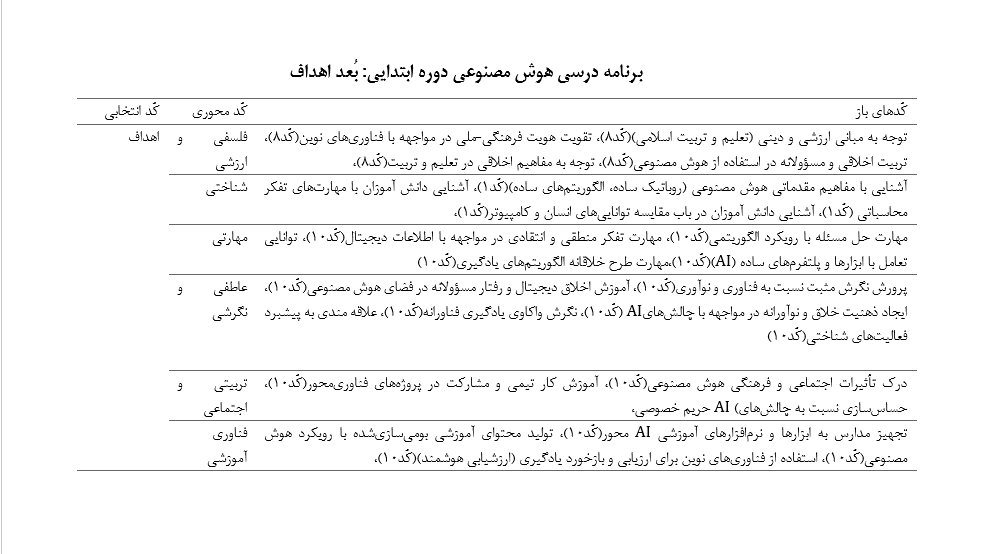
This study aims to identify and conceptualize the components of an artificial intelligence curriculum for primary education in the Islamic Republic of Iran. This applied qualitative study employed the classical grounded theory approach. Participants included 25 national experts in virtual education and information and communication technology curriculum selected through purposive sampling until theoretical saturation during the 2023–2024 academic year. Data were collected through in-depth semi-structured interviews and analyzed using open, axial, and selective coding procedures. Credibility and trustworthiness were ensured through participant validation and transferability techniques. Data analysis produced a comprehensive ten-dimensional curriculum model consisting of objectives, content, learning activities, tools, resources, scheduling, learning environment, evaluation, grouping, and underlying logic. Together, these dimensions form a coherent, future-oriented, and systematic framework for the design of an artificial intelligence curriculum in primary education and demonstrate an integrated developmental approach that extends beyond technical skills to cognitive, ethical, social, and cultural growth. The proposed model offers a scientifically grounded and contextually appropriate framework for designing, implementing, and evaluating artificial intelligence curricula in primary education and provides strategic guidance for preparing future generations to engage responsibly and effectively with intelligent technologies.
Downloads
References
Ilkka T. The impact of artificial intelligence on learning, teaching, and education. European Union, 2018.
Fahimirad M, Kotamjani SS. A review on application of artificial intelligence in teaching and learning in educational contexts. International Journal of Learning and Development. 2018;8(4):106-18. doi: 10.5296/ijld.v8i4.14057.
Luo D. Guide teaching system based on artificial intelligence. International Journal of Emerging Technologies in Learning (iJET). 2018;13(8). doi: 10.3991/ijet.v13i08.9058.
Popenici SA, Kerr S. Exploring the impact of artificial intelligence on teaching and learning in higher education. Research and practice in technology enhanced learning. 2017;12(1):22. doi: 10.1186/s41039-017-0062-8.
Cardona MA, Rodríguez RJ, Ishmael K. Artificial intelligence and the future of teaching and learning: Insights and recommendations. U.S. Department of Education, Office of Educational Technology, 2023.
Guo S, Zheng Y, Zhai X. Artificial intelligence in education research during 2013-2023: A review based on bibliometric analysis. Education and Information Technologies. 2024:1-23. doi: 10.1007/s10639-023-12230-5.
Iravani MH, Mir A, Saadatmand Menshadi D. Systematic Review of the Impact of Artificial Intelligence on Global Educational Systems. Journal of Modern Advances in Psychology, Educational Sciences, and Education. 2024;6(69):74-87.
Namdar R, Alizadeh Risani K, Khani Z, Aghajani Kovis M, Najdi M. The Role of New Technologies and Artificial Intelligence in Improving the Quality of Education and Teacher Teaching. Journal of Sexual and Psychological Disorders. 2023;1(4):1-12.
Rezaei F, Faghih Abdollahi A, editors. Investigating the Application of Artificial Intelligence in the Education System. The 8th National Conference on Modern Approaches in Education and Research; 2023.
Ramazanzadeh Z, Abbaspour S, Nikfarjam S, Nouri L, editors. The Impact of Artificial Intelligence on Education. The 10th National Conference on Interdisciplinary Research in Management and Humanities; 2023.
Rospigliosi PA. Artificial intelligence in teaching and learning: what questions should we ask of ChatGPT? Interactive Learning Environments. 2023;31(1):1-3. doi: 10.1080/10494820.2023.2180191.
Díaz B, Nussbaum M. Artificial intelligence for teaching and learning in schools: The need for pedagogical intelligence. Computers & Education. 2024:105071. doi: 10.1016/j.compedu.2024.105071.
Safari MJ, editor The Importance of Artificial Intelligence for Student Learning. The 1st National Conference on Humanities with a New Approach; 2024.
Tavakol M, Zeinalpour Aghdam Shandi F, Tavakol M, editors. The Importance of Artificial Intelligence in Improving Student Learning in Schools. The 1st National Conference on Humanities with a New Approach; 2024.
Taheri F, Taheri M, editors. The Impact of Artificial Intelligence on the Development of Specialized Skills in Students. The 1st National Conference on New Perspectives in Educational Issues; 2024.
Rajabi M, editor The Role of Artificial Intelligence in Changing Teaching and Learning Methods. The 1st National Conference on New Perspectives in Educational Issues; 2024.
Rostamzadeh F, Mohammadvand Z, Zarei R. Investigating the Role of Artificial Intelligence and Flexible Curriculum in the Fundamental Transformation Document of Education Using Research Synthesis Method. Journal of Strategic Research in Education. 2024(19):483-503.
Yazdanpanah Z, Alizadeh F, Yazdanpanah S, Mohammadi Y, editors. Designing and Compiling an Artificial Intelligence-Based Curriculum. The 1st International and 14th National Conference on Education; 2022.
Vahedi SS, Nozari N, editors. Investigating Developments, Opportunities, and Challenges of Using Artificial Intelligence in Education. Psychology and Behavioral Sciences: Proceedings of the 5th International and 8th National Conference; 2024.
Fitria TN, editor Artificial intelligence (AI) in education: Using AI tools for teaching and learning process. Prosiding Seminar Nasional & Call for Paper STIE AAS; 2021.
Sun Z, Anbarasan M, Praveen Kumar DJCI. Design of online intelligent English teaching platform based on artificial intelligence techniques. Computational Intelligence. 2021;37(3):1166-80. doi: 10.1111/coin.12351.
Zhang F. [Retracted] Design and Application of Artificial Intelligence Technology‐Driven Education and Teaching System in Universities. Computational and Mathematical Methods in Medicine. 2022;2022(1):8503239. doi: 10.1155/2022/8503239.
Rüütmann T, Läänemets U. Generating Curricula: A Human-Centred Perspective in the Era of Artificial Intelligence. 2025:180-96. doi: 10.33225/balticste/2025.180.
James DC, Maldonado‐Molina MM. Artificial Intelligence in the Curriculum: Development and Implementation of a Professional Training Program to Promote Literacy Among Health Education College Majors. Pedagogy in Health Promotion. 2025. doi: 10.1177/23733799251335628.
Mahmoud QH, Kishawy HA, Davis K, Piliounis A, James EJ, Bassyouni Z, et al. Thriving in the Age of AI: A Model Curriculum for Developing Competencies in Artificial Intelligence for K-12. Proceedings of the Canadian Engineering Education Association (Ceea). 2025. doi: 10.24908/pceea.2025.19712.
Zheng S. Artificial Intelligence – Driven Design of Aesthetic Education Curricula in Higher Education. Educ Insights. 2025;2(6):247-56. doi: 10.70088/ta9v8365.
Huapaya ESR, Chucos GL, Sosa EP, Meza MI. Disruptive Technologies in the University Curriculum: Use of Artificial Intelligence. International Journal of Evaluation and Research in Education (Ijere). 2025;14(1):671. doi: 10.11591/ijere.v14i1.30450.
Go C. The Application of Artificial Intelligence in Sports Applications for Extracurricular Physical Activity. Uchenye Zapiski Universiteta Imeni P F Lesgafta. 2025;0(1):36-40. doi: 10.5930/1994-4683-2025-36-40.
Downloads
Publication Timeline
- Submitted
- Revised
- Accepted
Issue
Section
License
Copyright (c) 2025 Elnaz Mazaheri Foroushani, Zohreh Saadatmand, Mostafa Ghaderi (Author)

This work is licensed under a Creative Commons Attribution-NonCommercial 4.0 International License.