Transformation of Educational Concepts in the Context of Emerging Technologies (Artificial Intelligence) and Pathology of Educational Pedagogy in Traditional Education Systems
DOI:
https://doi.org/10.61838/jsied.469Keywords:
Evolution of educational concepts, traditional education system, artificial intelligence, Pathology, educational pedagogyAbstract
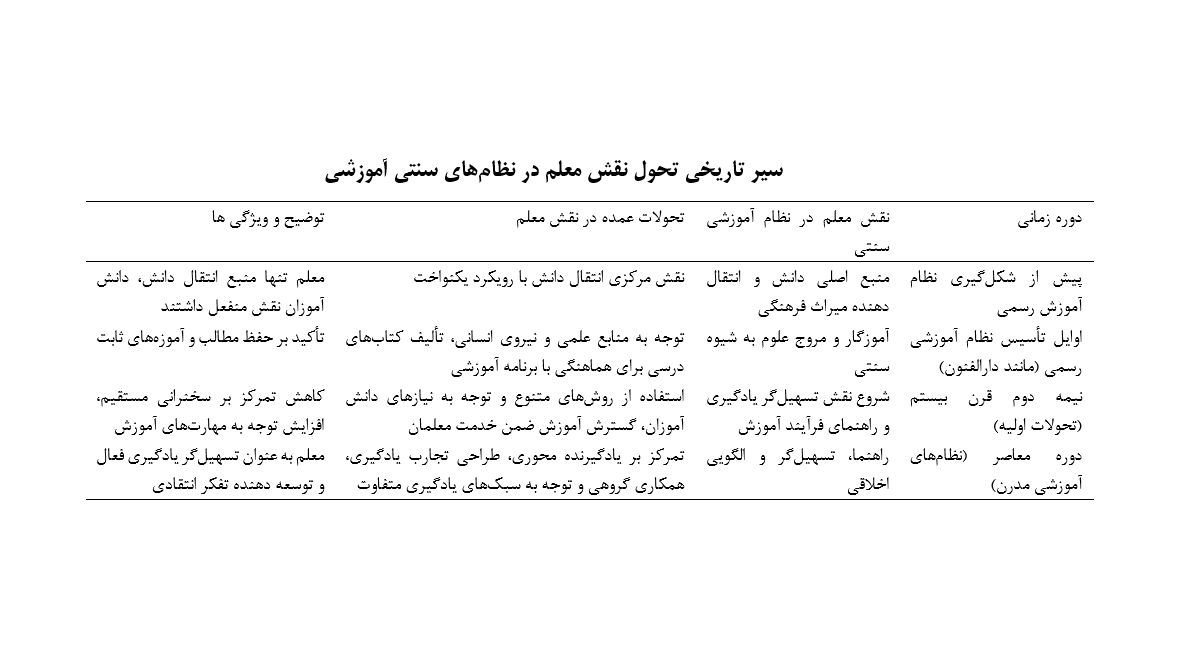
The present study aimed to examine the transformation of fundamental educational concepts under emerging technologies, particularly artificial intelligence, and critically analyze the limitations of traditional pedagogy to propose a contemporary educational framework. This qualitative study was conducted within an interpretive–critical paradigm using conceptual analysis, critical analysis, and deductive reasoning. The research corpus consisted of theoretical, philosophical, and empirical national and international sources related to traditional education, technology-enhanced pedagogy, and artificial intelligence in education, selected through purposive sampling. Data were collected through documentary and library research and analyzed using qualitative content analysis, conceptual coding, and comparative analysis between traditional educational structures and AI-supported learning environments to reinterpret key pedagogical concepts. The findings indicate that traditional educational concepts—including teacher role, teaching methods, learning processes, and assessment practices—are rooted in authority-centered and transmission-based models that inadequately respond to contemporary learning demands. Artificial intelligence enables personalized learning environments, intelligent assessment, and multidimensional interaction, thereby transforming teachers’ roles from knowledge transmitters to learning facilitators. Results further demonstrate a paradigm shift toward learner-centered, adaptive, and active learning models, while highlighting the inability of traditional systems to foster creativity, critical thinking, and self-regulated learning competencies required in digital societies. The study concludes that developing an intelligent pedagogical framework requires a balanced integration of valuable traditional educational principles with the analytical and technological capacities of artificial intelligence, ensuring human-centered, flexible, and sustainable learning systems for future education.
Downloads
References
Najafi R. Foundations of education and critique of educational systems. Tehran: SAMT; 2017.
Mazaheri M. Critique of school education in Iran. Tehran: Naqd-e Amouzeshi Publication; 2020.
Selwyn N. Education and technology. 3rd ed: Bloomsbury; 2022.
Williamson B. The social life of AI in education: MIT Press; 2023.
Oecd. Digital education outlook 2023: OECD Publishing; 2023.
Rezaei A. Interactive education and evaluation with digital technologies. Tehran: Education Research Institute; 2023.
Jafari N. E-learning and modern teaching methods. Tehran: Negah Publication; 2021.
Abedi R. Challenges of the traditional structure of education and the teacher's role in the transformation of the educational system. Modern Education Monthly. 2021;78:15-29.
Karimi M. Educational evaluation and the development of critical thinking. Tehran: University of Tehran; 2018.
Zhao Y. An education crisis is a terrible thing to waste: How radical changes can spark student excitement and success: Teachers College Press; 2020.
Fathi M. The role of information technology in the transformation of the educational system. Tehran: University Publication; 2019.
Wang Y, Zhang D. Smart learning environments and the role of educators. Journal of Educational Technology & Society. 2018;21(2):25-38.
Chassignol M, Khoroshavin A, Klimova A. AI in personalized learning: Current trends. Computers & Education. 2021;163:104110.
Hwang GJ, Xie H, Wah BW, Gašević D. Vision, challenges, roles and research issues of Artificial Intelligence in Education. Computers and Education: Artificial Intelligence. 2020;1:100001.
Heydari M. Application of artificial intelligence in educational evaluation. Isfahan: Research Institute of Educational Sciences; 2022.
Salari H. The teacher's role in technology-based education. Tehran: Elmi Publications; 2020.
Yue M, Jong MS, Ng DTK. Understanding K–12 Teachers’ Technological Pedagogical Content Knowledge Readiness and Attitudes Toward Artificial Intelligence Education. Education and Information Technologies. 2024;29(15):19505-36. doi: 10.1007/s10639-024-12621-2.
Yousefian F, Kazemi L. Negative effects of technology on the education process. Journal of Educational Psychology. 2022;5:65.
Mirzaei A. Educational challenges of modern technologies. Tehran: Education Research Institute; 2020.
Holmes W, Porayska-Pomsta K, Holstein K, Sutherland E, Baker T, Shum SB, et al. Ethical AI in classrooms. International Journal of Artificial Intelligence in Education. 2022;32(3):504-26.
Mohammadi M, Razavi S. Artificial intelligence and digital transformation in Iranian education. Tehran: Cultural Studies Research Institute Publications; 2023.
Alizadeh H. Challenges of artificial intelligence in the Iranian educational system. Quarterly Journal of Educational Studies. 2022;12(3):45-67.
Jafari N. Critique and rethinking of traditional evaluation methods in education. Tehran: Roshd Publications; 2019.
Nikfar H. Digital pedagogy and its impact on educational processes. Quarterly Journal of New Technologies in Education. 2020;15(3):40-5.
Kashefi H, Ghasemi F. Interactive learning and its challenges in digital pedagogy. Quarterly Journal of Educational Research. 2019;21(4):60-5.
Taheri F. The role of agency in effective learning. Journal of Educational Studies. 2019;12(3):105-25.
Kumari K, Al-Hawary SIS, Natarajan R, Vasudevan A. The Algorithmic Adjuvant: Synthesizing Human Pedagogy and Artificial Intelligence in the Modern ESL Classroom With Insights From Uzbekistan. Ais. 2025;6(3):246-52. doi: 10.62754/ais.v6i3.217.
Kotsis KΤ. Artificial Intelligence for Physics Education in STEM Classrooms: A Narrative Review Within a Pedagogy Technology Policy Framework. Sch Jo Phs Ed. 2025;6(3):204-11. doi: 10.37251/sjpe.v6i3.2148.
Gurion ARC, Mateo DEV, Ganiban RA, Villarama J. Artificial Intelligence Integration in Pedagogy and Its Influence on Learning Styles. Blockch Crypt Futur Res. 2025;1(2). doi: 10.70211/bafr.v1i2.216.
Torkashvand S, Keshavarz S, Salehi A, Mirzamohammadi MH. Providing a theoretical model of educational justice in the formal and public education system based on Farabi's epistemological foundations of justice. Applied Issues of Islamic Education. 2020;3(4):7-34.
Sharifi E. Modern outputs of smart educational systems. Mashhad: Toos University Publication; 2021.
Rahmani A, Hosseini F. Challenges of digital pedagogy and strategies to face them. Quarterly Journal of Research in Education. 2020;19(2):45-52.
Moradi H. Educational challenges arising from modern technologies. Education and Technology Journal. 2021;7:23.
Ofem UJ, Orim FS, Edam-Agbor IB, Amanso EOI, Eni E, Ukatu JO, et al. Teachers’ Preparedness for the Utilization of Artificial Intelligence in Classroom Assessment: The Contributory Effects of Attitude Toward Technology, Technological Readiness, and Pedagogical Beliefs With Perceived Ease of Use and Perceived Usefulness as Mediators. Frontiers in Education. 2025;10. doi: 10.3389/feduc.2025.1568306.
Moore KS, Zhang B, Lee I. An Exploratory Analysis of in-Service Middle School Teachers’ Teaching Practices When Introducing Artificial Intelligence Concepts and the Emergence of Culturally Responsive Pedagogy. 2025. doi: 10.31219/osf.io/7fwsu_v1.
Tafuri F, Romano G, Latino F. Artificial Intelligence in the Improvement of the Athlete's Anatomical-Physiological Parameters: Transdisciplinary Pedagogical Models. Journal of Inclusive Methodology and Technology in Learning and Teaching. 2025;5(1).
Keshavarz S, Abdollahi S, Safarpour B, editors. Pathology of religious education2024.
Freire P. Pedagogy of the oppressed: Herder and Herder; 1970.
Khani H. Motivation in education. Tehran: University Publication; 2016.
Mousavi F. Chatbots and smart assistants in educational environments. Journal of Educational Sciences and Technology. 2021;18(2):50-60.
Mousavi S. Principles and modern methods of teaching. Tehran: University Publication; 2016.
Mishra P, Koehler MJ. Technological pedagogical content knowledge: A framework for teacher knowledge. Teachers College Record. 2006;108(6):1017-54.
Black P, Wiliam D. Assessment and classroom learning. Assessment in Education: Principles, Policy & Practice. 1998;5(1):7-74.
Luckin R, Holmes W, Griffiths M, Forcier LB. Intelligence unleashed: An argument for AI in education: Pearson Education; 2016.
Holmes W, Bialik M, Fadel C. Artificial intelligence in education: Promises and implications for teaching and learning: Center for Curriculum Redesign; 2019.
Bransford JD, Brown AL, Cocking RR. How people learn: Brain, mind, experience, and school: National Academy Press; 2000.
Mahmoudi A, Nasiri R, Karimi S. Comparative education in the context of artificial intelligence: Opportunities and challenges. Quarterly Journal of Research in Curriculum Planning. 2021;18(3):50-65.
Downloads
Publication Timeline
- Submitted
- Revised
- Accepted
Issue
Section
License
Copyright (c) 2025 keyvan Sheykhi (Author); Seyed Mahdi Sajjadi (Corresponding author); Esmaeil Azimi (Author)

This work is licensed under a Creative Commons Attribution-NonCommercial 4.0 International License.