Validation of an Indigenous Good Governance Model with a Social Justice Approach in the Plan and Budget Organization of the Country
Keywords:
excellence-oriented governance, Iran’s administrative system, social justice, Plan and Budget Organization of iranAbstract
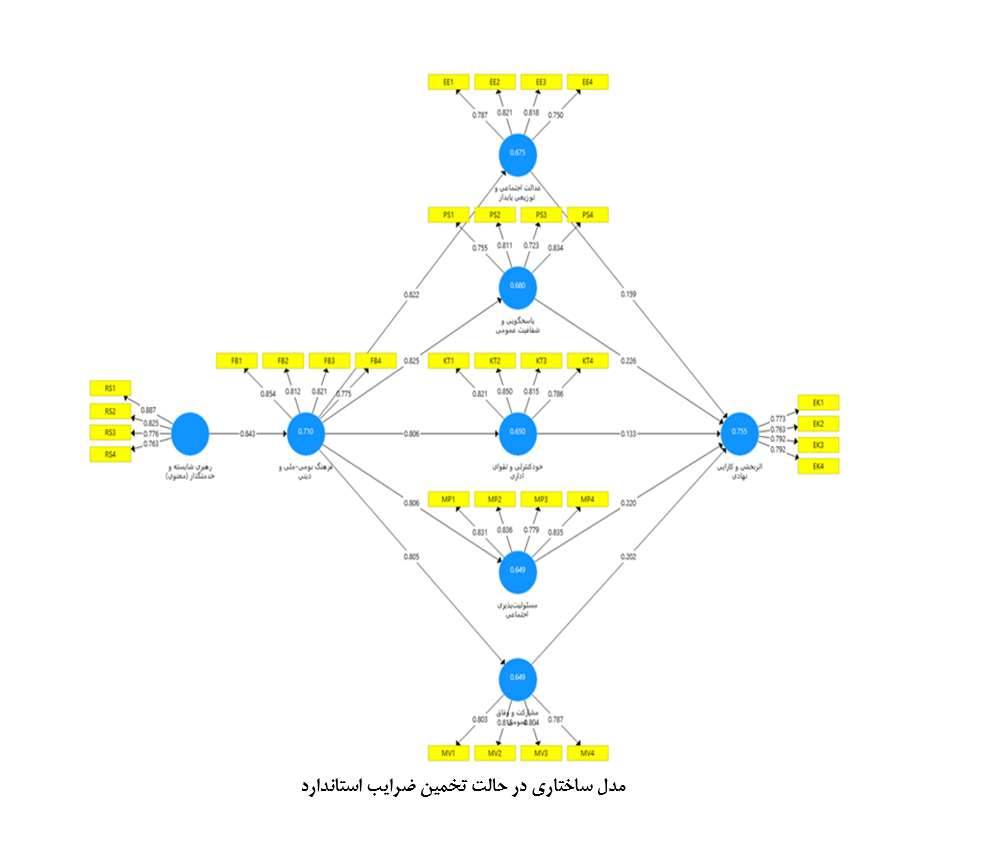
The present study aimed to validate an indigenous good governance model with a social justice approach in the Plan and Budget Organization of the Country using Structural Equation Modeling (SEM). This study was applied in terms of objective and exploratory–explanatory in terms of nature and was conducted using a correlational design with a path analysis approach. The statistical population consisted of managers, senior experts, and decision-makers working in the Plan and Budget Organization of the Country who were selected through stratified random sampling. Data were collected using a researcher-developed questionnaire designed based on the dimensions of good governance and social justice. Content validity was confirmed by expert evaluation, while construct validity was examined through Confirmatory Factor Analysis (CFA). Reliability was assessed using Cronbach’s alpha coefficient and Composite Reliability (CR). Data analysis was conducted using Structural Equation Modeling (SEM) and Partial Least Squares (PLS) techniques to evaluate the measurement and structural models and to test the causal relationships among the research variables. The findings indicated that all constructs demonstrated acceptable reliability and validity, as Cronbach’s alpha and Composite Reliability values exceeded 0.70 and the Average Variance Extracted (AVE) values were greater than 0.50. The overall Goodness of Fit (GOF) index of 0.663 confirmed the strong fit of the proposed model. Structural path analysis showed that competent and servant leadership had a significant positive effect on indigenous–national and religious culture (β = 0.843, p < 0.001), while indigenous culture significantly influenced sustainable social and distributive justice (β = 0.822, p < 0.001). Furthermore, social justice significantly affected institutional effectiveness and efficiency (β = 0.159, p < 0.001). The findings also confirmed the significant roles of accountability and transparency, administrative self-control, social responsibility, and public participation in strengthening governance effectiveness and justice-oriented institutional performance. The results demonstrated that good governance in Iran’s administrative system is a multidimensional and value-oriented phenomenon closely associated with social justice and institutional legitimacy. The proposed indigenous governance model showed strong explanatory capability and confirmed that governance effectiveness cannot be achieved solely through bureaucratic efficiency without transparency, accountability, ethical leadership, public participation, and justice-oriented policymaking. The study provides an indigenous and empirically validated framework that may support governance reform, institutional modernization, and policy improvement within the Plan and Budget Organization of the Country and other Iranian public sector institutions.
Downloads
References
1. Oecd. Principles on Good Governance and Public Integrity. OECD Publishing, 2021.
2. Kaufmann D, Kraay A, Mastruzzi M. The Worldwide Governance Indicators: Methodology and Analytical Issues. World Bank, 2022.
3. Rawls J. A Theory of Justice. Revised edition ed: Harvard University Press; 1999.
4. Rothstein B. Just Institutions Matter: The Moral and Political Logic of the Universal Welfare State: Cambridge University Press; 2018.
5. Grindle MS. Good Governance, R.I.P.: A Critique and an Alternative. Governance. 2017;30(1):17-22. doi: 10.1111/gove.12223.
6. Andrews M, Pritchett L, Woolcock M. Building State Capability: Evidence, Analysis, Action: Oxford University Press; 2020.
7. Booth D. Politically Smart, Locally Led Development. Overseas Development Institute, 2020.
8. Salehi M, Karimi H. Bureaucratic Inefficiency and Governance Deficits in Iran's Administrative System. International Journal of Public Administration. 2020;43(10):865-78. doi: 10.1080/01900692.2019.1658772.
9. Hosseinpour S, Vaezi R, Pourezzat AA. Administrative Reform and Governance Challenges in Iran's Public Sector. Journal of Public Administration Research. 2023;15(2):45-68.
10. Rothstein B, Teorell J. Getting to Sweden, Part II: Breaking with Corruption in the Nineteenth Century. Scandinavian Political Studies. 2019;42(3-4):238-54. doi: 10.1111/1467-9477.12143.
11. Khatmi S, Zamani SG, Salehi H. Good Governance in International Instruments: A Legal Approach to State Transparency and Accountability. Legal Studies in Digital Age. 2026:1-10.
12. Sukma N, Yamnill S. A New Public Management Model for Open Data Collaboration in Sustainable Digital Insurance Ecosystems. Frontiers in Political Science. 2025;7:1598403. doi: 10.3389/fpos.2025.1598403.
13. Toleikiene R, Butkus M, Bartuseviciene I, Jukneviciene V. Assessing Digital Governance Maturity in the Context of Municipal Resilience: The Triadic Model, Its Dimensions and Interrelations. Administrative Sciences. 2025;15(11):435. doi: 10.3390/admsci15110435.
14. Osborne SP. From Public Service-Dominant Logic to Public Service Logic: Are Public Service Organizations Capable of Co-Production and Value Co-Creation? Public Management Review. 2018;20(2):225-31. doi: 10.1080/14719037.2017.1350461.
15. Al-Mamary YH, Alshallaqi M, Abubakar AA. A Comprehensive Conceptual Model of Digital Transformation in Public Services: Exploring Key Factors and Their Impact on Government Success. Future Business Journal. 2025;11:193. doi: 10.1186/s43093-025-00621-8.
16. Forati H. Presenting a Model of Good Governance in Iran with a Focus on Employed Women and Gender Justice. Public Organizations Management. 2025;13(4):165-80. doi: 10.30473/ipom.2025.72814.5070.
17. Hien NTT, Hai PH, Bui TTT, Tuan DA. Structural Equation Modeling of Factors Affecting Accountability-Based Accounting in Public Sector Entities. Emerging Science Journal. 2025;9(4):2162-78. doi: 10.28991/ESJ-2025-09-04-023.
18. Ajaj R, Buniya MK, Wuni IY, Yousif OS. A Structural Equation Model of the Critical Success Factors for Sustainable Smart Cities: A Case Study of Abu Dhabi. Journal of Urban Management. 2025;14(3):843-55. doi: 10.1016/j.jum.2025.02.008.
Downloads
Publication Timeline
- Submitted
- Revised
- Accepted
Issue
Section
License
Copyright (c) 2025 Korush Nikanjam (Author); Mohammadreza Azadehdel (Corresponding author); Maryam Oshaksaraie (Author)

This work is licensed under a Creative Commons Attribution-NonCommercial 4.0 International License.