Redefining Sustainable Development in the Islamic Republic of Iran from the Perspective of the Thoughts and Discourses of the Supreme Leader
Keywords:
Islamic-Iranian Model of Development, Resistance Economy, Statement on the Second Step of the Revolution, Enduring (Sustainable) Development, National Cultural Capacity-BuildingAbstract
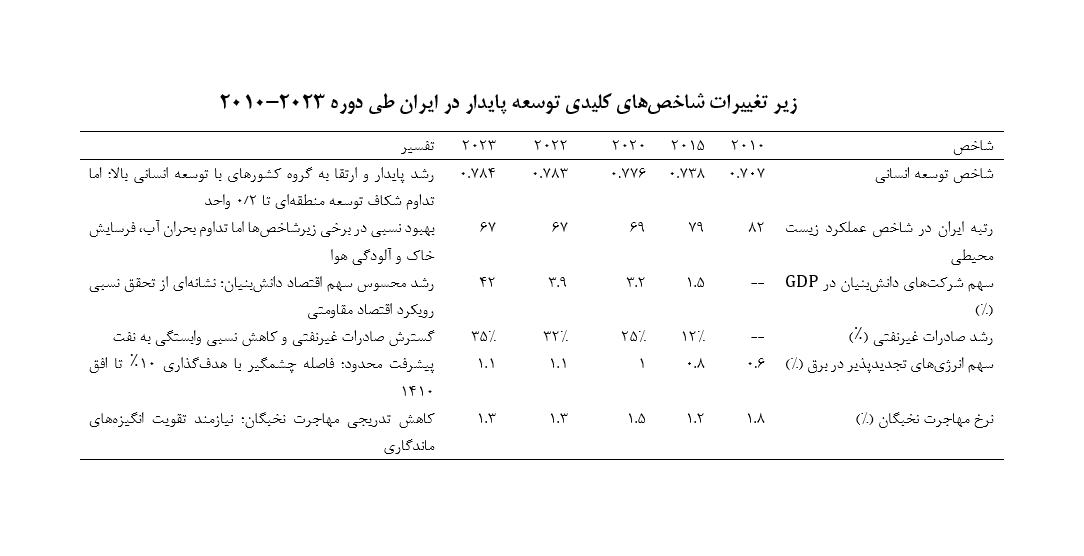
This study aimed to redefine the conceptual framework of sustainable development in the Islamic Republic of Iran based on the discourse and guidance of the Supreme Leader and to examine its linkage with measurable development indicators. This applied–developmental research used a mixed-method design. In the qualitative phase, 53 speeches and 12 strategic statements by the Supreme Leader (1989–2023) and key policy documents such as the “Statement on the Second Step of the Revolution” and macro-level policies were analyzed using meta-analysis and Braun and Clarke’s six-step thematic analysis. Reliability was ensured through double coding and Cohen’s Kappa coefficient (0.82). In the quantitative phase, indicators including the Human Development Index (HDI), Environmental Performance Index (EPI), share of knowledge-based enterprises, non-oil exports, renewable energy share, and elite migration rate (2010–2023) were collected from credible international and national sources and compared with the extracted conceptual framework. Four fundamental pillars were identified in the Leader’s discourse: social and regional justice (37% of themes), resistance-based economy and national self-reliance (29%), environmental protection as a religious and ethical duty (21%), and cultural development and empowerment of young human capital (13%). Quantitative trends showed Iran’s HDI improving from 0.707 (2010) to 0.783 (2022), the share of knowledge-based economy rising from 1.5% to 4.2%, and non-oil exports growing by 35%. However, regional development disparities persist up to 0.2 points, Iran’s EPI rank remained at 67 in 2022, and renewable energy accounts for only 1.2% of the electricity mix. Sustainable development in Iran requires a localized and civilizational redefinition anchored in social justice, economic resilience, environmental ethics, and youth-driven human capital. This framework can better align national policy with the ideals of the Islamic Revolution and improve international development rankings while advancing the Islamic-Iranian Model of Progress.
Downloads
References
Commission on Development. Our Common Future. Oxford: Oxford University Press; 1987.
Assembly UNG. Transforming Our World: The 2030 Agenda for Sustainable Development (SDGs). New York: United Nations, 2015.
Hopwood B, Mellor M, O'Brien G. Sustainable development: Mapping different approaches. Sustainable Development. 2005;13(1):38-52. doi: 10.1002/sd.244.
Sachs JD. The Age of Sustainable Development. New York: Columbia University Press; 2015.
Sen A. Development as Freedom. Oxford: Oxford University Press; 1999.
Sardar Z. Islamic perspectives on sustainability and justice: A civilizational approach. Journal of Islamic Ethics. 2024;9(2):115-38.
Preservation Oot, Publication of the Works of Ayatollah Khamenei. Statements and Decrees of the Supreme Leader Ayatollah Khamenei. 1989.
Iran UNPD. National Human Development Report of Iran. Tehran: UNDP Country Office, 2022.
United Nations Development Programme. Human Development Report 2023: Uncertain Times, Unsettled Lives - Shaping our Future in a Transforming World. New York: UNDP, 2023.
World Bank. Country Economic Memorandum for Iran. Washington, D.C.: The World Bank, 2022.
World Bank. World Development Indicators. 2023.
National Planning and Budget Organization. Annual Reports on Iran's Regional Development. Tehran: Development Research Center; 2023.
Statistical Centre of Iran. Provincial Demographic, Education, and Human Development Indicators. Tehran: Planning and Programs Deputy; 2023.
Agriculture Organization of the United Nations. Land and Water Resources in Iran: Challenges and Opportunities. Rome: FAO, 2021.
IPCC Intergovernmental Panel on Climate Change. Sixth Assessment Report (AR6): Climate Change Impacts and Adaptation. Geneva: IPCC, 2023.
Yale Center for Environmental Law and Policy. 2022 Environmental Performance Index (EPI) Report. New Haven: Yale University, 2022.
Heydari A. Sustainable Development from the Perspective of the Supreme Leader. Tehran: Nikayesh Publishing; 2025.
Mousavi M. Social Justice and Development Sustainability in Iran: An Analysis of Trends and Challenges. Iranian Economic Research Quarterly. 2022;27(3):55-80.
Preservation Oot, Publication of the Works of Ayatollah Khamenei. The Second Step of the Islamic Revolution Statement. Tehran2019.
Ahmadi F. Resistance and Knowledge-Based Economy within the Framework of the Iranian-Islamic Model of Progress. Iranian Economic Research Journal. 2021;15(2):7-25.
Vice-Presidency for Science and Technology. Report on Knowledge-Based Companies and National Innovation. Tehran: Technology Headquarters Secretariat; 2023.
Heydari A, Bakhtar S. Analyzing the regional development of Kurdish border cities of Iran using sustainable urban development indices (study area: Kurdistan province). GeoJournal of Tourism and Geosites. 2018;23(3):797-807. doi: 10.30892/gtg.23315-329.
Naderi S. Environment and Intergenerational Justice in Iran. Quarterly Journal of Public Policy. 2020;11(4):92-115.
Supreme Council of the Cultural Revolution. Comprehensive Scientific and Technological Document of the Islamic Republic of Iran. Tehran: Council Secretariat; 2021.
Brown V, Clarke V. Using thematic analysis in psychology. Qualitative Research in Psychology. 2006;3(2):77-101. doi: 10.1191/1478088706qp063oa.

Downloads
Published
Submitted
Revised
Accepted
Issue
Section
License
Copyright (c) 2025 Ayoub Tayari Dorbash (Author); Akbar Heydari (Corresponding author)

This work is licensed under a Creative Commons Attribution-NonCommercial 4.0 International License.