Lived Experiences of Employees and Customers Regarding Customer-Oriented Empowerment in Bank Mellat of Iran: A Phenomenological Study
Keywords:
Customer-centered empowerment, lived experience, phenomenology, Kleiser method, Mellat Bank, professional developmentAbstract
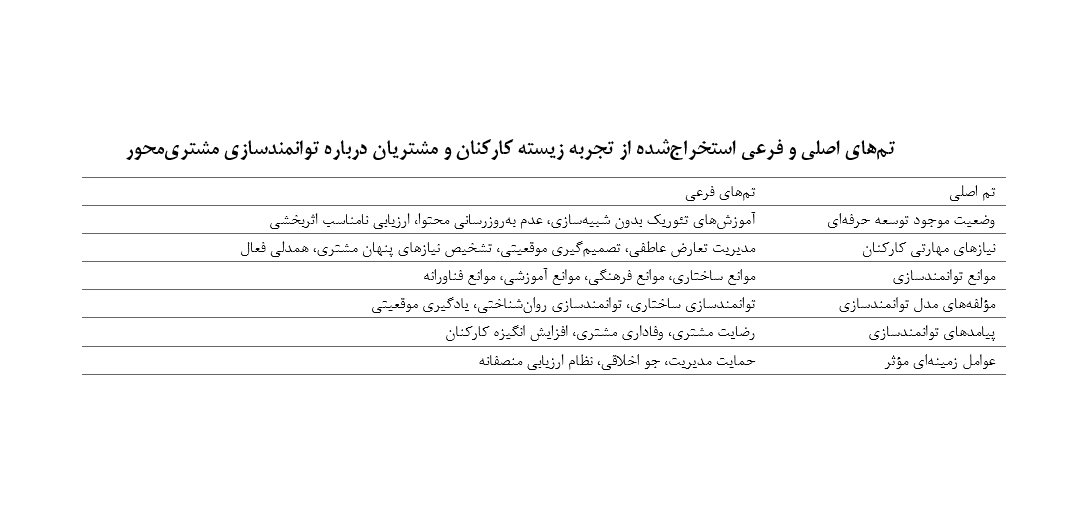
The present study aimed to explore and describe the lived experiences of employees and customers regarding customer-oriented empowerment in Bank Mellat of Iran and to identify the fundamental structure underlying this phenomenon. This qualitative study was conducted using a descriptive phenomenological approach. The participants consisted of 22 stakeholders of Bank Mellat, including 14 employees and 8 customers, who were selected through purposive sampling with maximum variation. Data were collected through in-depth semi-structured interviews and analyzed using Colaizzi’s seven-step phenomenological method. To ensure trustworthiness, member checking, peer review, detailed contextual description, and comprehensive documentation of the research process were employed. Data analysis resulted in the extraction of 421 significant statements, 18 subthemes, and 6 major themes: the current status of professional development, employee competency needs, empowerment barriers, empowerment components, empowerment outcomes, and contextual factors. The findings revealed a substantial gap between employees’ theoretical understanding of customer orientation and their practical ability to implement it. The most influential barriers included hierarchical organizational structures, lack of delegated authority, insufficient emotional-situational skills, and weaknesses in situated learning processes. Furthermore, structural and psychological empowerment were associated with higher customer satisfaction, stronger customer loyalty, and enhanced employee motivation. The essential structure of the participants’ lived experience was identified as a conflict between theoretical knowledge of customer orientation and practical inability to enact it. The results indicate that customer-oriented empowerment in Bank Mellat is shaped by structural, cultural, educational, and competency-related factors, and that theoretical knowledge alone is insufficient for achieving customer-oriented behaviors. Reducing bureaucracy, delegating meaningful authority, strengthening soft skills, and redesigning training systems through simulation-based and situated learning approaches may help bridge the knowledge–action gap and improve service quality.
Downloads
References
1. Uddin MJ, Som HM, Hashim RA, Rahman T. Effect of Leadership Behaviors and Job Satisfaction on Organizational Citizenship Behavior of Private Commercial Banks in Bangladesh: A Conceptual Framework. International Journal of Academic Research in Business and Social Sciences. 2024;14(4). doi: 10.6007/ijarbss/v14-i4/21071.
2. Zoubi FA, Alzoubi AA. Leadership Towards Innovation and Organizations Performance: Encouraging Employees Empowerment. International Journal of Theory of Organization and Practice (Ijtop). 2023;3(1):94-110. doi: 10.54489/ijtop.v3i1.246.
3. Orenuga D, Worlu RE, Olabode O, Nsikan J, Ariyo A, Okon MG, et al. Empowering Bank Employees for Improved Job Performance: An Evaluation of Emerging Strategies. Sa Journal of Human Resource Management. 2024;22. doi: 10.4102/sajhrm.v22i0.2464.
4. Soeharso SY, Raihanah M. The Effect of Psychological Empowerment on Individual Readiness for Change With Perceived Organizational Support as a Moderator Factor: Case in Indonesian Employees of Banking Industry. International Journal of Applied Business and International Management. 2023;8(2):14-25. doi: 10.32535/ijabim.v8i2.2469.
5. Muneer S, Singh A, Choudhary MH, Alshammari AS. The Mediating Role of Psychological Empowerment on the Relationship Between Digital Transformation, Innovative Work Behavior, and Organizational Financial Performance. Behavioral Sciences. 2024;15(1):5. doi: 10.3390/bs15010005.
6. Diniz RGM. Impact of Innovative Work Behaviour and Digitalization on Organization Performance: Empirical Evidence From Brazil. International Journal of Science and Business. 2024;33(1):1-17. doi: 10.58970/ijsb.2311.
7. Yang L, Zhou Y. Physical environment and its impact on customer perceptions of service quality in retail banking. International Journal of Bank Marketing. 2025;43(2):210-28.
8. Taghipourian MJ. The role of emotional branding on brand equity in the banking sector: Is customer experience a mediator? Dynamic Management and Business Analysis. 2026:1-17.
9. Yan X, Li Y, Nie F, Li R. Bank Customer Segmentation and Marketing Strategies Based on Improved DBSCAN Algorithm. Applied Sciences. 2025;15(6).
10. Maziriri ET, Rukuni TF, Nyagadza B, Bepe T. The customer's quest to manage funds digitally: Exploring the factors that influence the intention to use and the ongoing use of mobile banking apps. Computers in Human Behavior Reports. 2026;21:100907. doi: 10.1016/j.chbr.2025.100907.
11. Shaikh AA, Glavee-Geo R, Karjaluoto H, Hinson RE. Mobile Money as a Driver of Digital Financial Inclusion. Technological Forecasting and Social Change. 2023;186:122158. doi: 10.1016/j.techfore.2022.122158.
12. Sakaya AJ. Fear of COVID-19 and Green Bank Service Purchase Intention: The mediating Effect of Customer Empowerment and Customers’ Perceived Value of Digital Service Transactions. Arab Gulf Journal of Scientific Research. 2023;41(4):486-507. doi: 10.1108/agjsr-08-2022-0137.
13. Agusti A, Edriani D, Ilyas A. Financial Empowerment for Women: Closing the Gender Wealth Gap. Equator Journal of Management and Entrepreneurship (Ejme). 2024;12(3):251-9. doi: 10.26418/ejme.v12i3.78781.
14. Aisyah S, Almuzayyad. Social and Economic Transformation of Women Through Microfinance. Peradaban Journal of Economic and Business. 2024;3(1):91-103. doi: 10.59001/pjeb.v3i1.158.
15. Muhammedi S, Pangestu RA, Ilyas Helmi Bin Mohd Y, Akem U. The Role of Productive Women in Alleviating Poverty Through Strengthening Islamic Social Finance: A Study of Micro Waqf Banks in Indonesia. International Economic and Finance Review. 2024;3(1):88-104. doi: 10.56897/iefr.v3i1.53.
16. Nawawi ZM, Soemitra A, Dalimunthe M. Women's Economic Empowerment Through Sharia Micro-Finance Institutions in Indonesia: A Qualitative Research. Iqtishadia Jurnal Kajian Ekonomi Dan Bisnis Islam. 2022;15(2):255. doi: 10.21043/iqtishadia.v15i2.15902.
17. Soemitra A, Kusmilawaty K, Rahma TIF. The Role of Micro Waqf Bank in Women’s Micro-Business Empowerment Through Islamic Social Finance: Mixed-Method Evidence From Mawaridussalam Indonesia. Economies. 2022;10(7):157. doi: 10.3390/economies10070157.
18. Piyanggara D, Puspitasari N, Suparman S. The Role and Constraints of Group Sharia Financing in the Economic Empowerment of Women Customers. Journal of Management Research and Studies. 2023;1(2):144-55. doi: 10.61665/jmrs.v1i2.34.
19. Amaliah I, Aspiranti T, Riani W. Optimization of Ummah Economic Empowerment Through Institutional Strengthening of Waqf Micro Banks. Kne Social Sciences. 2023. doi: 10.18502/kss.v8i18.14235.
20. Amin ARN, Ibrahim D, Abdullah B. Community Empowerment Acceleration Model to Increase the Role of Micro Waqf Bank Aulia Cendekia in Sharia Economic Development. Istinbath. 2023;22(2):195-206. doi: 10.20414/ijhi.v22i2.626.
21. Terminanto AA, Hamid A, Amalia E. Sharia Microfinance Models: A Grameen Bank Approach for Sustainable Construction and Welfare Enhancement. El Dinar Jurnal Keuangan Dan Perbankan Syariah. 2024;12(1):1-24. doi: 10.18860/ed.v12i1.23722.
22. Anwar MK, Ridlwan AA, Wakhidah N. The Role of Baitul Maal Wat Tamwil in Empowering Msmes in Indonesia: A Study of Indonesian Islamic Microfinance Institutions. International Journal of Professional Business Review. 2023;8(4):e0913. doi: 10.26668/businessreview/2023.v8i4.913.
23. Fauzi M, Junaedi J, Mahmudin. Does Micro Waqf Bank Avoid Loan Sharks Practice? Keeping on Indigent Productive Business. International Economic and Finance Review. 2023;2(1):1-29. doi: 10.56897/iefr.v2i1.23.
24. Fauzi M, Haji-Othman Y, Pakkanna M. The Strategy of Micro Waqf Banks for Job Creation on Micro-Scale Enterprises in Indonesia. International Journal of Academic Research in Business and Social Sciences. 2023;13(6). doi: 10.6007/ijarbss/v13-i6/17407.
25. Habibi A, Utami P, Muzammil R, Nasor M. The Policy Role of Bank Syariah Indonesia for MSMEs Sector in Community Economic Empowerment. Jurnal Kewirausahaan Dan Bisnis. 2023;28(1):15. doi: 10.20961/jkb.v28i1.67178.
26. Kerse Y. The Effect of Customer Empowerment on Corporate Reputation Perception. İnsan Ve Toplum Bilimleri Araştırmaları Dergisi. 2023;12(3):2128-41. doi: 10.15869/itobiad.1322091.
27. Rochana E, Sari YR, Mahmud I, Sidemen IG. Community Empowerment-Based Garbage Bank Management System in Bandar Lampung (Case Study of Emak.ID Garbage Bank). 2024. doi: 10.4108/eai.2-11-2023.2343304.
28. Yudithadewi D, Hartanto ST, Parikesit BS, Widyandaru RZ. Analysing Social Entrepreneurship Innovation Through Sustainability Compass. 2022. doi: 10.11594/nstp.2022.2608.
29. Sahi GK, Roy SK, Singh T. Fostering Engagement Among Emotionally Exhausted Frontline Employees in Financial Services Sector. Journal of Service Theory and Practice. 2022;32(3):400-31. doi: 10.1108/jstp-08-2021-0175.
Downloads
Publication Timeline
- Submitted
- Revised
- Accepted
Issue
Section
License
Copyright (c) 2025 Shahram Mirzaei (Author); MUsa Rezvani Chaman Zamin (Corresponding author); Sayedeh Fatemeh Moghimi, Sayedeh Laya Mortazavi (Author)

This work is licensed under a Creative Commons Attribution-NonCommercial 4.0 International License.