تدوین الگوی رهبری معنوی مدیران دانشگاهی
کلمات کلیدی:
رهبری معنوی, مدیران دانشگاهی, معادلات ساختاریچکیده
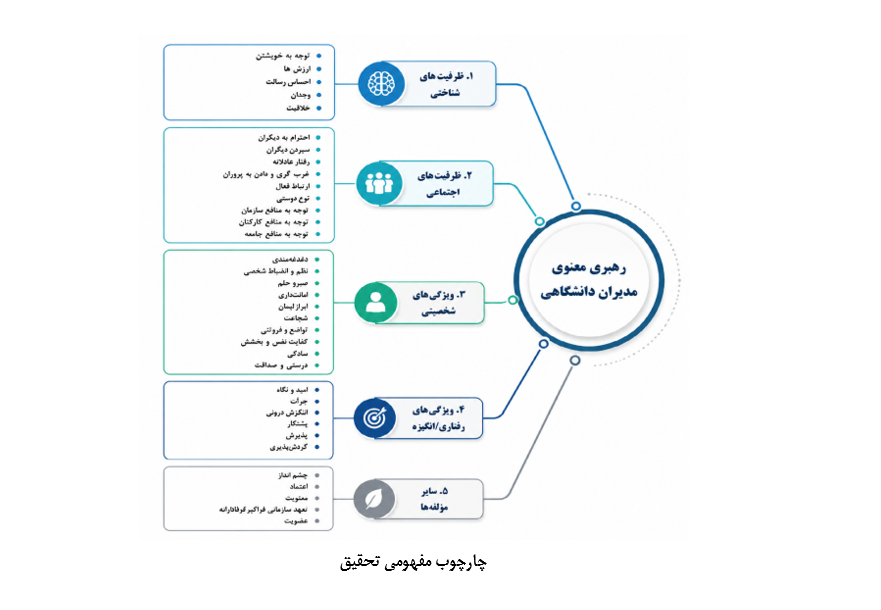
هدف پژوهش حاضر شناسایی، تأیید و اولویتبندی مؤلفههای رهبری معنوی در میان مدیران دانشگاه آزاد اسلامی شهر تهران به منظور تدوین الگویی کاربردی برای مدیریت دانشگاهی بود. این پژوهش از نظر هدف، بنیادی ـ کاربردی و از نظر ماهیت، کیفی ـ کمی بود. در مرحله نخست، مؤلفههای رهبری معنوی از طریق مرور ادبیات و تحلیل محتوای کیفی استخراج شد و سپس توسط گروهی ۳۰ نفری از مدیران و استادان دانشگاهی به عنوان خبرگان مورد بررسی قرار گرفت. جامعه آماری شامل مدیران عالی، میانی و اجرایی واحدهای دانشگاه آزاد اسلامی شهر تهران بود. نمونه پژوهش با روش نمونهگیری تصادفی طبقهای از واحدهای شمال، جنوب، شرق، غرب، مرکز و علوم و تحقیقات انتخاب شد. بر اساس فرمول کوکران، حجم نمونه ۱۴۸ نفر تعیین گردید؛ برای افزایش نرخ بازگشت، ۱۸۰ پرسشنامه توزیع شد و در نهایت ۱۵۰ پرسشنامه قابل تحلیل گردآوری شد. دادهها با استفاده از مدلیابی معادلات ساختاری تحلیل شدند. نتایج مدلیابی معادلات ساختاری نشان داد که از میان ۵۳ مؤلفه اولیه، ۳۵ مؤلفه رهبری معنوی در پنج بعد ظرفیتهای شناختی، ظرفیتهای اجتماعی، ویژگیهای شخصیتی، ویژگیهای رفتاری و سایر ویژگیها تأیید شدند. مقادیر آماره t برای تمام روابط مدل بیش از ۱.۹۶ بود که نشاندهنده معناداری روابط بود. بارهای عاملی استانداردشده نشان دادند که سایر ویژگیها با ضریب ۰.۸۸ قویترین رابطه را با رهبری معنوی مدیران دانشگاهی داشتند و پس از آن ویژگیهای رفتاری با ضریب ۰.۸۳، ظرفیتهای اجتماعی با ضریب ۰.۷۲، ویژگیهای شخصیتی با ضریب ۰.۶۷ و ظرفیتهای شناختی با ضریب ۰.۴۴ قرار گرفتند. شاخصهای برازش نیز برازش قابل قبول مدل را تأیید کردند. بر اساس یافتهها، رهبری معنوی مدیران دانشگاهی سازهای چندبعدی است که ترکیبی از ظرفیتهای شناختی، اجتماعی، شخصیتی، رفتاری و زمینهای را دربرمیگیرد و میتواند مبنایی برای طراحی برنامههای توسعه و توانمندسازی مدیران دانشگاهی قرار گیرد.
دانلودها
مراجع
1. Subhaktiyasa PG. Spiritual leadership in higher education: A conceptual review toward a value-based framework. Jurnal Manajemen Pendidikan. 2026;15(1):1-21.
2. Oh J, Wang J. Spiritual leadership: Current status and agenda for future research and practice. Journal of Management, Spirituality & Religion. 2020;17(3):223-48.
3. Bush T, Sargsyan G. Educational leadership and management: Theory, policy and practice. Main Issues of Pedagogy and Psychology. 2020;3(3):31-43.
4. Fry LW, Hannah ST, Noel M, Walumbwa FO. Impact of spiritual leadership on unit performance. The Leadership Quarterly. 2011:1-12.
5. Chen C, Yang C, Li C. Spiritual leadership, follower mediators, and organizational outcomes: Evidence from three industries across two major Chinese societies. Journal of Applied Social Psychology. 2012;42:890-938. doi: 10.1111/j.1559-1816.2011.00834.x.
6. Chen C-Y, Li C-I. Assessing the spiritual leadership effectiveness: The contribution of follower's self-concept and preliminary tests for moderation of culture and managerial position. The Leadership Quarterly. 2013;24:240-55.
7. Afsar B, Badir Y, Kiani US. Linking spiritual leadership and employee pro-environmental behavior: The influence of workplace spirituality, intrinsic motivation, and environmental passion. Journal of Environmental Psychology. 2016;45:79-88. doi: 10.1016/j.jenvp.2015.11.011.
8. Krishnani H. Workplace spirituality: Exploring the meaning and purpose of life through work. Journal of Advanced Research in Social Sciences. 2023;6(2):48-58.
9. Mhatre SG, Mehta N. A review of workplace spirituality: Identifying present development and future research agenda. Management Research Review. 2023;46(9):1185-206.
10. Adnan N, Bhatti OK, Farooq W. Relating ethical leadership with work engagement: How workplace spirituality mediates? Cogent Business & Management. 2020;7(1):1739494. doi: 10.1080/23311975.2020.1739494.
11. Samul J. Spiritual leadership and work engagement: A mediating role of spiritual wellbeing. Central European Management Journal. 2024;32(3):421-35.
12. Siswanto AB, Susita D, Saptono A. The effect of spiritual leadership on employee engagement. International Journal of Human Capital Management. 2023;7(1):128-40.
13. Khaefollahi AA, Mirzaei A, Motaghi P. Components of spiritual leadership in organizations. Tadbir. 2010(217):29-33.
14. Memarzadeh G, Sanei M. The diamond of spiritual leadership in Iran's administrative system. Management of Development and Transformation Quarterly. 2011(7):9-18.
15. Sharma RR. Preventing corruption through spiritual leadership in organisations. Organization and Management. 2010;14:729-68.
16. Azzuhri M, Huang MP, Irawanto DW. Reinventing spiritual leadership from an Indonesian perspective. International Journal of Cross Cultural Management. 2024;24(2):289-308.
17. Abubakar A. Integration of spirituality, values and ethics in leadership practice and theory in Egypt. International Journal of Leadership and Governance. 2024;4(1):1-12. doi: 10.47604/ijlg.2406.
18. Karsono B, Suraji R, Sastrodiharjo I. The influence of leadership spirituality on improving the quality of higher education in Indonesia. The International Journal of Social Sciences and Humanities Invention. 2022;9(2):6832-41.
19. Subhaktiyasa PG. Spiritual leadership in educational organization: A systematic literature review. Journal of Law and Sustainable Development. 2023;11(5).
20. Zulfqar A, Valcke M, Quraishi U, Devos G. Developing academic leaders: Evaluation of a leadership development intervention in higher education. SAGE Open. 2021;11(1).
21. Prabhu C. A new validated model of leadership development in higher education. Higher Education, Skills and Work-Based Learning. 2023;13(3):465-87.
22. Ajayan S, Balasubramanian S. New managerialism in higher education: The case of United Arab Emirates. International Journal of Comparative Education and Development. 2020;22(2):147-68.
23. Li B, Lei Y, Hu M, Li W. How does spiritual leadership inspire employees' innovative behavior? The role of psychological capital and intrinsic motivation. 2022. doi: 10.21203/rs.3.rs-1237881/v1.
24. Yang J, Chang M, Chen Z, Zhou L, Zhang J. The chain mediation effect of spiritual leadership on employees' innovative behavior. Leadership & Organization Development Journal. 2020;42(1):114-29.
25. Zhang Y, Yang F. How and when spiritual leadership enhances employee innovative behavior. Personnel Review. 2020;50(2):596-609.
26. Alfarajat HS, Emeagwali OL. Antecedents of service innovative behavior: The role of spiritual leadership and workplace spirituality. Organizacija. 2021;54(4):320-33.
27. Morrison EW. Employee voice behavior: Integration and directions for future research. Academy of Management Annals. 2011;5:373-412. doi: 10.5465/19416520.2011.574506.
28. Pahng PH, Kang SM. Voice vs. silence: The role of cognitive appraisal of and emotional response to stressors. Frontiers in Psychology. 2023;14:1079244. doi: 10.3389/fpsyg.2023.1079244.
29. Zhu Y, Akhtar S. Leader trait learning goal orientation and employee voice behavior: The mediating role of managerial openness and the moderating role of felt obligation. The International Journal of Human Resource Management. 2017;30:2876-900. doi: 10.1080/09585192.2017.1335338.
30. Abbas N. Ethical leadership and employee voice behavior in small and medium enterprises: Role of psychological empowerment and task interdependence. Entrepreneurship and Small Business Review. 2023;1:95-121. doi: 10.1177/08948453241307384.
31. Asante K. To speak up or not to speak up, organisational and individual antecedents that undergird this behaviour in resource constrained region. Journal of Advanced Nursing. 2025;81(6):2990-3002. doi: 10.1111/jan.16446.
32. Tian X, Chae H, Song D, Zhang Y. Leader prohibitive voice shapes employee voice through psychological safety moderated by self-efficacy and generational differences. Scientific Reports. 2025;15(1):31469. doi: 10.1038/s41598-025-17500-5.
33. Xu B, Gao Y. How does uncertainty avoidance affect employee voice behavior through the dual-path ways of work engagement and psychological security? BMC Psychology. 2025;13(1):1-12. doi: 10.1186/s40359-025-02598-z.
34. Yang X, Meng Y, Qiu Y, Feng Y. Why am I willing to speak up? The impact of spiritual leadership on employee voice behavior. Frontiers in Psychology. 2019;10:2718. doi: 10.3389/fpsyg.2019.02718.
35. Yu Y, Pitafi S. Exploring the influence of spiritual leadership, leader-member exchange, and traditionality orientation on employee voice behavior. BMC Psychology. 2024;12(1):543.
36. Ka Z, Aboobaker N. Spiritual leadership and intention to stay: Examining the mediating role of employee voice behaviour. Journal of Management Development. 2021;40(5):352-64. doi: 10.1108/JMD-05-2019-0182.
37. Ahmed SS, Khan MM, Rahman MU. Unlocking employees resilience in turbulent times: The role of spiritual leadership and meaning. Continuity & Resilience Review. 2023;5(3):249-61. doi: 10.1108/crr-12-2022-0036.
38. Clarke E, Malinen S, Näswall K, Masselot A. Safe to stay: The role of leader behaviors and psychological safety in employee retention in high-demand workplaces. German Journal of Human Resource Management. 2025. doi: 10.1177/23970022251337643.
39. Luo J, Ng LP, Choong YO. The effect of responsible leadership on organizational citizenship behavior: Double mediation of gratitude and organizational identification. BMC Psychology. 2025;13(1):6. doi: 10.1186/s40359-024-02337-w.
40. Zhao S, Zhang P, Liu H, Huang Q. The impact of public service motivation on voice behavior and the moderating role of risk preference: A survey among grassroots public employees in China. Public Performance & Management Review. 2025:1-26. doi: 10.1080/15309576.2025.2451073.
41. Polat S. The level of faculty members' spiritual leadership (SL) qualities. 2011.
42. Chang PC, Xiaoxiao G, Wu T. Sense of calling, job crafting, spiritual leadership and work meaningfulness. Leadership & Organization Development Journal. 2021;42(5):690-704.
دانلودها
گاهشمار انتشار
- ارسال
- بازنگری
- پذیرش
شماره
نوع مقاله
مجوز
حق نشر 2025 Fatemeh Habibollah Moosavi (Author); Narges Hasanmoradi (Corresponding author); Mahmood Abolghasemi , Mohammad Ghahremani (Author)

این پروژه تحت مجوز بین المللی Creative Commons Attribution-NonCommercial 4.0 می باشد.